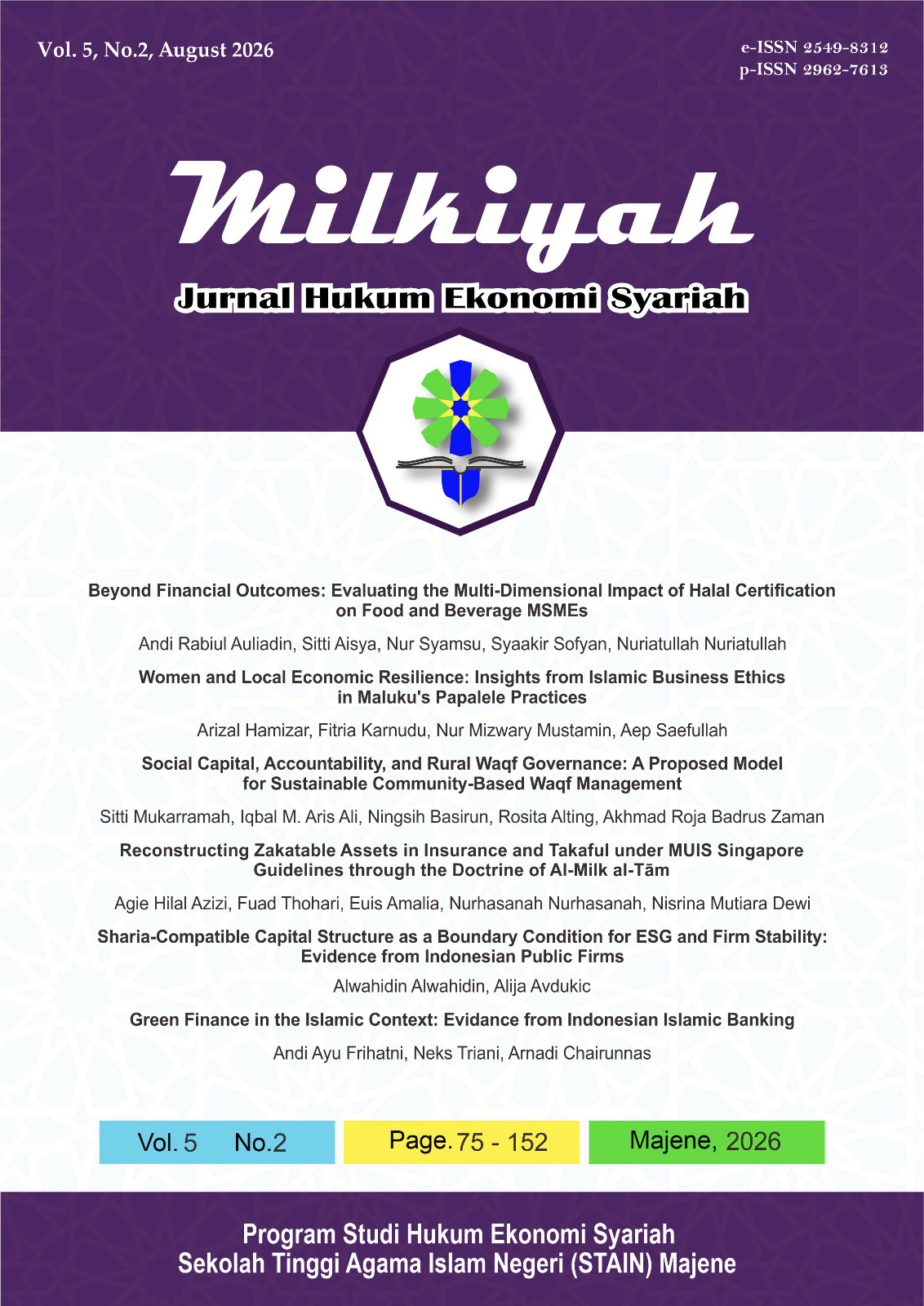
Reconstructing Zakatable Assets in Insurance and Takaful under MUIS Singapore Guidelines through the Doctrine of Al-Milk al-Tām
DOI:
https://doi.org/10.46870/milkiyah.v5i2.2420Keywords:
al-Milk al-Tām, Cash Value, Insurance, Takaful, Zakatable AssetsAbstract
The determination of zakatable assets in insurance and takaful remains a contemporary issue in Islamic jurisprudence, particularly regarding the requirement of complete ownership (al-milk al-tām). This study examines the construction of zakatable assets under the Singapore Islamic Religious Council (MUIS) guideline and evaluates their conformity with the doctrine of al-milk al-tām. Employing a normative juridical method with conceptual and uṣūl al-fiqh approaches, the study analyses the MUIS guideline, zakat calculator, and institutional clarification to examine the legal basis for determining zakatable assets in insurance and takaful. The findings indicate that premium-based constructions encounter difficulties under the doctrine of al-milk al-tām because contributions allocated to the collective tabarru’ fund are no longer subject to the participant’s exclusive ownership and control. By contrast, cash value provides the closest approximation to al-milk al-tām because it represents an identifiable and claimable financial entitlement. Nevertheless, its definitive juristic status remains dependent on whether the claimable amount exclusively reflects the participant’s proprietary investment interest or also incorporates elements attributable to the collective tabarru’ fund. The study contributes to contemporary Islamic legal scholarship by demonstrating that the doctrine of al-milk al-tām offers a coherent analytical framework for distinguishing contractual contributions from claimable financial entitlements in determining zakatable assets within contemporary insurance and takaful arrangements.
References
Abdullah, M. N., Hussin, S., & Anis, A. A. (2025). The Use of Zakat Proceed for Takaful Protection of Aṣnāf (Qualified Receivers): A Maqasid-Base Ijtihād Perspective In Malaysia. In International Conference of Postgraduate Students and Academics in Syariah and Law, 6(1), 134-148. https://fsuproceedings.usim.edu.my/index.php/inpac/article/view/161
Abdullah, Z., Mohd Sharif, M. H., Saad, R. A. J., Mohd Ariff, A. H., Md Hussain, M. H., & Mohd Nasir, M. H. (2023). Zakat institutions’ adoption of social media. Journal of Islamic Accounting and Business Research, 14(8), 1261–1280. https://doi.org/10.1108/JIABR-01-2022-0013
Ahmed, H. (2024). Security tokens, ecosystems and financial inclusion: Islamic perspectives. International Journal of Islamic and Middle Eastern Finance and Management, 17(4), 730–745. https://doi.org/10.1108/IMEFM-04-2024-0195
Al-Bahūtī, M. Y. (n.d.). Kashshāf al-Qināʿ ʿan Matn al-Iqnāʿ. Beirut: Dār al-Kutub al-ʿIlmiyyah.
Al-Ghazālī, A. H. (n.d.). Ihyāʾ ʿulūm al-dīn. Beirut: Dār al-Maʿrifah.
Al-Kashmīrī, M. A. S. (2004). Al-ʿUrf al-shadhī sharḥ Sunan al-Tirmidhī (Vol. 1). Beirut: Dār Iḥyāʾ al-Turāth al-ʿArabī.
Al-Māwardī, Abū al-Ḥasan ʿAlī ibn Muḥammad. (1994). Al-Ḥāwī al-kabīr fī fiqh madhhab al-Imām al-Shāfiʿī. Beirut: Dār al-Kutub al-ʿIlmiyyah.
Al-Qaradawi, Y. (2006). Fiqh al-Zakah: A Comparative Study. Beirut: Muassasah Al-Risalah.
Al-Zuhaili, W. (1989). Al-Fiqh al-Islami wa Adillatuh. Damascus: Dar Al-Fikr.
Arifin, F., Astawa, I. G. P., Maarif, I., Sulastri, D., & Abdullah, M. K. (2025). Recognition of Customary Norms Within the Framework of Indonesian Legal Positivism. Khazanah Hukum, 7(1), 92-104. https://doi.org/10.15575/kh.v7i1.39409
Atmeh, M. A., Maali, B. M., & Fendi, U. (2024). A proposed model for Zakah on financial instruments: accounting approach. International Journal of Islamic and Middle Eastern Finance and Management, 17(6), 1232-1243. https://doi.org/10.1108/IMEFM-01-2024-0055
Bafadhal, H. (2021, June). Zakat on legal entities: Towards concept perfection and its regulations in Indonesia. In Al-Risalah: Forum Kajian Hukum dan Sosial Kemasyarakatan (Vol. 21, No. 1, pp. 13-32). https://doi.org/10.30631/alrisalah.v21i1.734
Bouteraa, M., Chekima, B., Al-Daihani, M., Benlahcene, A., Baddou, A., & Tamma, E. (2026). Artificial intelligence adoption in the Malaysian insurance sector: an integrated TOE–UTAUT framework analysis. Journal of Islamic Marketing, 1-32. https://doi.org/10.1108/JIMA-05-2025-0327
Jamal, A. A., & Motani, H. (2024). Islamic wealth management: prospects, challenges, and the case of Singapore. Capital Markets Law Journal, 19(3), 260-279. https://doi.org/10.1093/cmlj/kmae008
JAWHAR. (2026). Jabatan Perdana Menteri Malaysia. Jabatan Wakaf, Zakat dan Haji. https://www.jawhar.gov.my/
Kadirov, D. (2021). Marketing Islamic services: tackling misconceptualisation of commercial insurance. Journal of Islamic Marketing, 12(2), 264-279. https://doi.org/10.1108/JIMA-08-2019-0172
Kholis, N. (2025). A normative ethical analysis of Islamic unit-linked insurance using the Maqasid Shariah framework of Abu Zahrah. Journal of Islamic Economics Lariba, 11(1), 455-482. https://doi.org/10.20885/jielariba.vol11.iss1.art18
Kunhibava, S., Muneeza, A., Khalid, M. B., Mustapha, Z., & Sen, T. M. (2024). Lessons Learned from the Zakat and Waqaf Frameworks in Indonesia and Singapore for Application in Malaysia. In Islamic Social Finance: Law and Practice in Malaysia (pp. 69-87). Singapore: Springer Nature Singapore. https://doi.org/10.1007/978-981-97-1410-0_4
Mufti Selangor. (2024). Zakat wang simpanan/pelaburan takaful. Jabatan Mufti Negeri Selangor. https://emusykil.muftiselangor.gov.my/index.php/site/jawapan?id=4954
MUIS. (2025). Zakat Singapore. https://www.zakat.sg/
Mukhtar, Y. A., & Jallow, C. (2025). Factors influencing consumers’ intention to adopt Takaful products in Somalia: extension of diffusion of innovation theory. Cogent Business & Management, 12(1), 2543050. https://doi.org/10.1080/23311975.2025.2543050
Paizin, M. N. (2026). Strategic integration of zakat on Lembaga Tabung Angkatan Tentera (LTAT) contributions: Ownership, compliance models, and institutional readiness. Journal of Awqaf, Zakat and Hajj (Jawhar), 4(1), 209–238. https://journal.jawhar.gov.my/wp-content/uploads/2026/05/full-vol-4-no-1-JOURNAL-OF-AWQAF-ZAKAT-AND-HAJJ.pdf#page=213
Rahman, M. H., & Binti Aziz, N. S. Z. (2025). A critical study of tabarrù (donation)-based takaful models: determining tàawun (mutual assistance) as the underlying notion of takaful. Journal of Islamic Accounting and Business Research. Vol. ahead-of-print No. ahead-of-print. https://doi.org/10.1108/JIABR-12-2023-0457
Rosele, M. I., Muneem, A., Ali, A. K. B., Rahman, N. N. B. A., & Razif, N. F. B. M. (2022). Revival of the waqf-based takaful model in Malaysia: issues and the way forward. International Journal of Economics and Business Research, 28(1), 82-101. https://doi.org/10.1504/IJEBR.2024.139291
Rosele, M. I., Muneem, A., Seman, A. B. C., Abdullah, L. H., Rahman, N. N. A., Sukor, M. E. A., & Ali, A. K. (2023). Imposing zakat on cryptocurrency (Bitcoin): a Shariah appraisal. Global Business and Economics Review, 28(1), 91-111. https://doi.org/10.1504/GBER.2023.127550
Taekema, S. (2021). Methodologies of rule of law research: why legal philosophy needs empirical and doctrinal scholarship. Law and philosophy, 40(1), 33-66. https://doi.org/10.1007/s10982-020-09388-1
Wahab, N. Abd, Isa, M. Y., Yusof, R. M., & Lotfi, W. A. N. W. A. (2024). Protecting the Well-Being of Households: Delineating a Social Takāful Fund Initiative for Positive Social Impact. International Journal of Islamic Finance and Sustainable Development, 16(4), 117-135. https://doi.org/10.55188/ijifsd.v16i4.909
Yazbek, F. H. A. (2023). Takaful insurance: A critical evaluation of Takaful business in the UAE and its prospects for growth. https://uhra.herts.ac.uk/id/eprint/15881/
Zafar, M. B., & Aziz, Y. (2026). Zakat and Sustainable Development Goals: Does Islamic Almsgiving Reduce Food Insecurity?. Food Ethics, 11(1), 15. https://doi.org/10.1007/s41055-025-00200-1
Zain, F. A. Mohd, Wan Abdullah, W. A., & Percy, M. (2021). Voluntary adoption of AAOIFI disclosure standards for takaful operators: the role of governance. Journal of Islamic Accounting and Business Research, 12(4), 593-622. https://doi.org/10.1108/JIABR-08-2018-0119
Downloads
Published
How to Cite
Issue
Section
License
Copyright (c) 2026 Agie Hilal Azizi, Fuad Thohari, Euis Amalia, Nurhasanah Nurhasanah, Nisrina Mutiara Dewi

This work is licensed under a Creative Commons Attribution-ShareAlike 4.0 International License.













 e-ISSN 2549-8312 p-ISSN 2962-7613