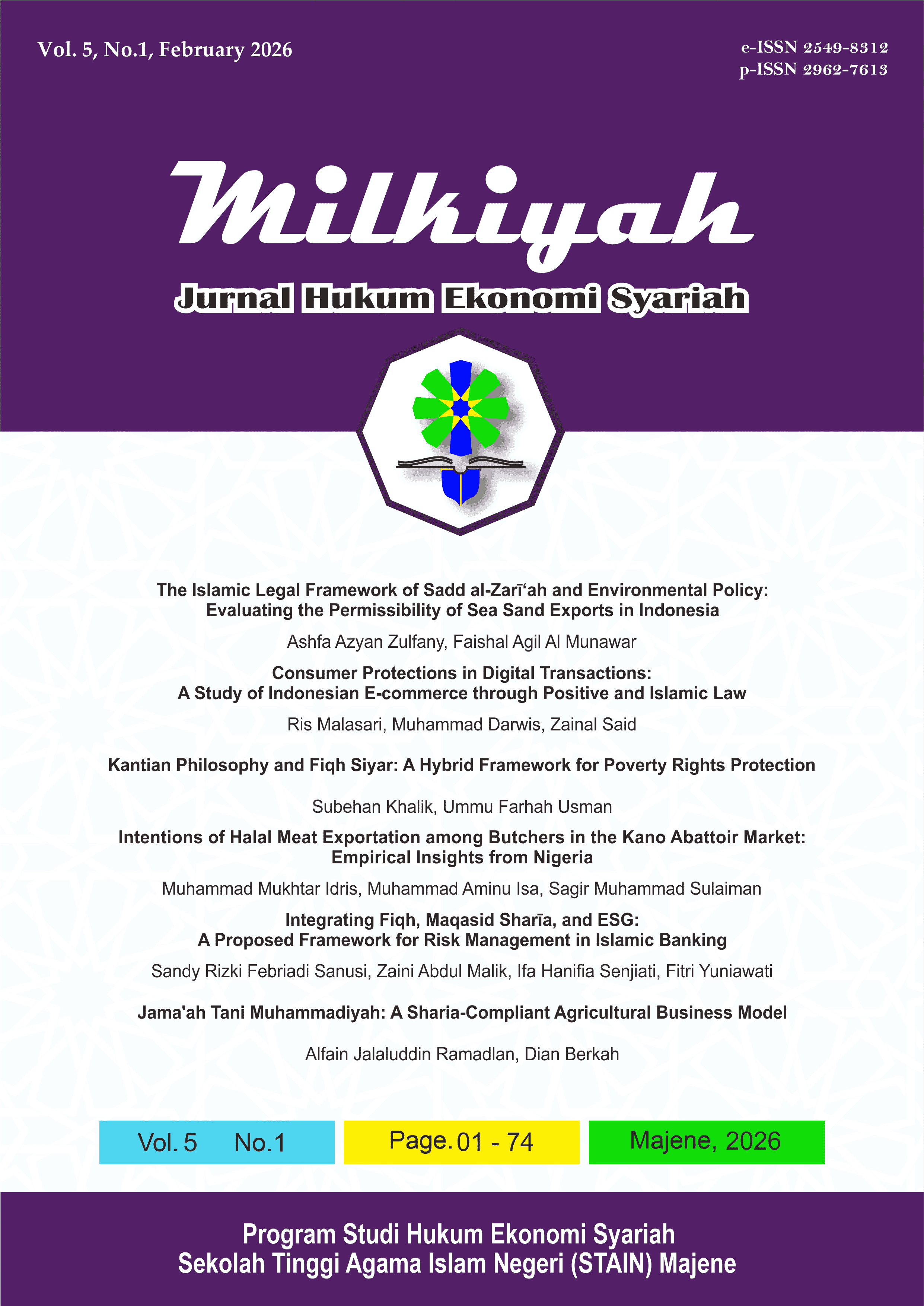
Jama'ah Tani Muhammadiyah: A Sharia-Compliant Agricultural Business Model
DOI:
https://doi.org/10.46870/milkiyah.v5i1.2051Keywords:
Agricultural Business, Islamic Economic Law, Jama’ah Tani, MuhammadiyahAbstract
Jama’ah Tani Muhammadiyah (JATAM) functions as a companion and protector of farmers with the primary aim of strengthening their independence and bargaining position within the agricultural system. This study analyses the business practices of JATAM through the lens of Islamic economic law. The research focuses on identifying the business model developed by JATAM and assessing the extent to which its operational practices align with Islamic economic principles. A qualitative descriptive approach was employed, using in‑depth interviews, field observations, and analysis of organisational documents and financial records. The findings show that JATAM implements a community‑based agricultural business model that collectively integrates production, capital, and marketing. JATAM acts as a facilitator by providing production inputs, offering farming assistance, and managing the distribution of agricultural products for its member farmers. This model reflects key Islamic economic principles, including the avoidance of usury, the application of profit‑sharing mechanisms, and the strengthening of mutual assistance (ta’awun). Its implementation contributes to improving farmers’ welfare, as evidenced by increased production capacity, fairer access to Sharia‑compliant capital, more equitable marketing systems, and stronger bargaining power for farmers. Despite these positive outcomes, several challenges remain, particularly in ensuring consistent adherence to Sharia principles. These challenges include weaknesses in financial documentation, limited clarity in the formulation of Sharia contracts, and the need for more professional and sustainable institutional development. The study highlights that applying Islamic economic principles within modern agricultural enterprises through community‑based institutional models such as JATAM offers a strategic pathway for strengthening the economic resilience of the ummah and empowering farmers.
References
Abdilah, M., & Hamid, I. (2023). Petani Menolak Kalah: Adaptasi Petani Terhadap Perubahan Iklim di Desa Mahang Sungai Hanyar Kabupaten Hulu Sungai Tengah. Jurnal Sosiologi, 2 (1), 62 - 72. https://doi.org/10.20527/h-js.v2i1.39
Ade, A. M., & Zuhud, E. A. (2025). System of a fair profit sharing is necessity and prerequisites for the realization of sustainable palm oil agroindustry in Indonesia. In IOP Conference Series: Earth and Environmental Science. 1534,1, 012014). IOP Publishing. https://doi.org/10.1088/1755-1315/1534/1/012014
Akbar, A., Darma, R., Irawan, A., Feryanto, F., & Akzar, R. (2024). COVID-19 pandemic and food security: Strategic agricultural budget allocation in Indonesia. Journal of Agriculture and Food Research, 18, 101494. https://doi.org/10.1016/j.jafr.2024.101494
Al-Amin, H., Ramadhan, M., & Sugianto. (2024). Islamic Banking and Agricultural Development in Aceh: A Strategic Partnership Model Using ANP Methodology. Journal of Islamic Economics and Finance, 49-66. https://doi.org/10.22373/share.v14i1.24028
Alam, N. & Gupta, L., Shanmugam, B. (2017). Islamic Contracts. In: Islamic Finance. Palgrave Macmillan, Cham. https://doi.org/10.1007/978-3-319-66559-7_4
Andriyani, Yulia, F., Hasanudin, T., & Rangga, K. K. (2023). Perilaku Kelompok Tani Padi Sawah Dalam Mengatasi Kelangkaan Pupuk Bersubsidi Di Kecamatan Trimurjo, Kabupaten Lampung Tengah, Provinsi Lampung. Jurnal Penyuluhan, 19 (1), 159-69. https://doi.org/10.25015/19202341709
Anggraini, C., Rahma, T. I. F., & Atika, A. (2025). Fiqh Muamalah Review of the Object of Akad (E-Commerce) on Defective Goods. Al-Mustashfa: Jurnal Penelitian Hukum Ekonomi Syariah, 10(1), 288-307. https://journal1.uinssc.ac.id/index.php/al-mustashfa/article/view/20753
Ariani, M., Khalid, I., & Wahyuni, S. (2025). Pengaruh sistem bagi hasil terhadap kesejahteraan petani padi dari konsep Mudharabah di Kecamatan Sanrobone. Jurnal Ilmiah Edunomika, 9(4). https://doi.org/10.29040/jie.v9i4.17852
Aouati, F.Z., Arabeche, Z. (2025). Success Through Islamic Entrepreneurship for Sustainable Development. In: Al Naimiy, H.M.K., Bettayeb, M., Gharaibeh, F.A., Elmehdi, H.M., Shehadi, I.A. (eds) Sustainability, AI and Innovation: Proceedings of the Applied Research in Humanities & Social Sciences (ARHSS 2023). EUROCRYPT 1991. Springer, Singapore. https://doi.org/10.1007/978-981-96-2532-1_5
Azhari, & Rahma. (2023). Konsep Produksi dalam Ekonomi Islam: Tinjauan Maqāṣid Syariah dan Keberlanjutan. Jurnal Ekonomi dan Keuangan Islam (JEKI), 5(1), 22–34. https://journal.tangrasula.com/index.php/jeki/article/view/118
Berkah, D. (2012). Perkembangan Pemikiran Hukum dalam Muhammadiyah. Jurnal Hukum Islam, 10 (1), 71-86. https://doi.org/10.28918/jhi.v10i1.575
BPS. (2025). Distribusi Presentase Produk Domestik Regional Bruto Kabupaten Lamongan Atas Dasar Harga Berlaku Menurut Lapangan Usaha (Persen) 2022-2024. lamongankab.bps.go.id/id/statistics-table/2/MTU4IzI=/distribusi-presentase-produk-domestik-regional-bruto-kabupaten-lamongan-atas-dasar-harga-berlaku-menurut-lapangan-usaha.html
Candrawati, I., & Robbani, S. (2025). Understanding the 7 key prohibitions in Islamic trade practices. Profit: Jurnal Kajian Ekonomi dan Perbankan Syariah, 9(1), 44-54. : https://doi.org/10.33650/profit.v9i1.10642
Dewi, E. Y., Yuliani, E., & Rahman, B. (2022). Analisis Peran Sektor Pertanian Terhadap Pertumbuhan Perekonomian Wilayah (Studi Kasus: Kota Pekalongan, Kabupaten Kepulauan Talaud, dan Kabupaten Kampar). Jurnal Kajian Ruang, 2 (2), 229-248. https://doi.org/10.30659/JKR.V2I2.20961
Faisal, Y.A., Kanti, R.A., Alamanda, A.R., & Apriliadi, A. (2023). The Role of Business Model Innovation (BMI) in Social Enterprises During Pandemic COVID-19 in Indonesia: A Case of Islamic Boarding Schools’ Business Units. In: Rafiki, A., Dana, LP., Nasution, M.D.T.P. (eds) Open Innovation in Small Business. Contributions to Environmental Sciences & Innovative Business Technology. Springer, Singapore. https://doi.org/10.1007/978-981-99-5142-0_1
Halim, A. (2026). Economic Engineering of the Profit-Sharing System as an Effort to Improve the Welfare of Rice Farmers in Pinrang Regency. Jurnal Ilmiah Manajemen Kesatuan, 14(1), 65–76. https://doi.org/10.37641/jimkes.v14i1.4480
Harahap, T. M., & Saniah, N. (2025). An Islamic Legal Review of the Implementation of Agricultural Partnership-Based Zakat (Mukhabarah). Pena Justisia, 24 (1), 3454 - 3467. https://doi.org/10.31941/pj.v24i2.6207
Haridah. (2024). Membangun Kemandirian Ekonomi Umat melalui Kewirausahaan dalam Ekonomi Islam. Jurnal Investasi Islam, 5 (1), 565 - 575. https://doi.org/10.32806/ivi.v5i1.183
Haruna, A., Sahel, W., Khindzeka Wirajing, M. A., & Herman, P. R. (2025). Steadfast in crisis: Can Islamic finance enhance Cameroonian SMEs’ resilience strategies against the COVID-19 pandemic and the Russia/ Ukraine war? Borsa Istanbul Review, 25(3), 634-647. https://doi.org/10.1016/j.bir.2025.03.002
Hasmawati, A., & Mohamad, A. (2019). Potential application of Istisna’financing in Malaysia. Qualitative Research in Financial Markets, 11(2), 211-226. https://doi.org/10.1108/QRFM-07-2018-0083
Hayati, S. R. (2018). Model Pembiayaan Sektor Pertanian Melalui Linkage Program Lembaga Keuangan Syariah. SHAHIH: Journal of Islamicate Multidisciplinary, 3(2), 175–188. https://doi.org/10.22515/shahih.v3i2.1385
Herlambang, E., Guntara, D., & Abas, M. (2023). Optimalisasi Pengawasan Pengadaan Dan Penyaluran Pupuk Bersubsidi Dihubungkan Dengan Peraturan Menteri Nomor 4 Tahun 2023. Binamulia Hukum, 12(1), 47-56. https://doi.org/10.37893/jbh.v12i1.328
Ichsandi, A. D., & Candra, H. (2023). Cooperative Contracts in the Agricultural Sector and Their Impact on the Working Time Allocation. Share: Jurnal Ekonomi dan Keuangan Islam, 12(1), 44-58. https://jurnal.ar-raniry.ac.id/index.php/Share/article/view/15116/0
Jaya, P. H.I. (2018). Nasib Petani dan Ketahanan Pangan Wilayah (Studi Tentang Kebijakan Pemerintah dan Respon Masyarakat Desa Mulyodadi, Bantul Ketika Harga Komuditas Pertanian Naik). Jurnal Ketahanan Nasional, 24(1), 77-93. https://doi.org/10.22146/jkn.32923
Jiang, M., Li, J., & Mi, Y. (2024). Farmers’ cooperatives and smallholder farmers’ access to credit: Evidence from China. Journal of Asian Economics, 92, 101746. https://doi.org/10.1016/j.asieco.2024.101746
Jihan, S., & Anggraini, T. (2024). Analysis Of The Cooperation Results Sharing System Between Palm Oil Plantation Workers And Garden Owners According To An Islamic Economic Perspective, Case Study In Sei District. Asahan District Chief. JHSS (Journal of Humanities asnd Social Studies), 8(3), 774-781. https://journal.unpak.ac.id/index.php/jhss/article/view/10862
Kasri, R., & Azzahra, C. (2020). Do Islamic banks more stable than conventional banks? Evidence from Indonesia. Jurnal Ekonomi dan Keuangan Islam, 6(2), 149-164. https://doi.org/10.20885/jeki.vol6.iss2.art6
Mabrur, I., Andani, M., Nurjaiti, & Nur'aini. (2025). A Literature Review on Islamic Contracts in Sharia Financing. Islamijah: Journal of Islamic Social Sciences, 6(2), 156-179. https://doi.org/10.30821/islamijah.v6i2.25431
Majid, R., & Sukmana, R. (2023). Designing a waqf-based agricultural financing model. Journal of Islamic Monetary Economics and Finance, 9(3), 443-464. https://doi.org/10.21098/jimf.v9i3.1686
Mawardi, I., Al Mustofa, M. U., Widiastuti, T., & Ghozali, M. (2024). The influence of institutional quality, economic freedom, and technological development on Islamic financial development in OIC countries. Journal of Open Innovation: Technology, Market, and Complexity, 10(2), 1 - 12. https://doi.org/10.1016/j.joitmc.2024.100279
Mwololo, H. M., Nzuma, J. M., & Githinji, L. M. (2022). Determinants of farmer empowerment in agriculture in Kenya: A Tobit approach. Heliyon, 8(12), 1-8. https://doi.org/10.1016/j.heliyon.2022.e11888
Nuha, M.U, Bin Muhammad, M.Z., & Mohd Salleh, M.Z.B. (2025). Halal Tourism as a Business Opportunity for Farmers: Strategic Integration to Increase Local Income in Pati Regency, Central Java Province, Indonesia. In: Khairy, S., Hayder, G., Al Shukaili, A., Al Abri, S., Soosaimanickam, A., Raja Kasim, R.S. (eds) Exploring Trends, Innovations, and Digitalization of Entrepreneurship. MENAREC 2024. Sustainable Economy and Ecotechnology. Springer, Cham. https://doi.org/10.1007/978-3-031-92942-7_61
Oktaviani, T., Rahma, T. I. F., & Harahap, M. I. (2024). Assessment of the Impact of Agricultural Collaboration Practices on The Income of Farmers through Muzara'ah And Mukhabarah Contracts. Dinar: Jurnal Ekonomi dan Keuangan Islam, 11(1), 1-12. https://doi.org/10.21107/dinar.v11i1.26373
Paminto, Ruju, S., Ahmad, I. K., & Rohman, Z. S. (2024). Fungsionalisasi Kartu Tani Terhadap Pemenuhan Kebutuhan Pupuk Bersubsidi Kepada Petani Di Kabupaten Cianjur Perspektif Undang-Undang Nomor 19 Tahun 2013 Tentang Perlindungan Dan Pemberdayaan Petani. Jurnal Ilmu Hukum Sosial dan Humaniora, 1(3), 221-231. https://doi.org/10.62383/humif.v1i3.328
Ramadhani, M. L., Napsiah, S. K., & Iqbal, M. N. (2025). Muzara'ah, Musaqoh And Mugharasah Contracts In Fiqh Muamalah. Jurnal Multidisiplin Sahombu, 5(1), 89–101. https://ejournal.seaninstitute.or.id/index.php/JMS/article/view/6109
Ranjan, R. (2017). Challenges to farm produce marketing: a model of bargaining between farmers and middlemen under risk. Journal of Agricultural and Resource Economics, 386-405. http://www.jstor.org/stable/44840963.
Roessali, W., Darwanto, D., & Hendarto, M. (2021). Analysis of agricultural sector productivity improvement strategies through cooperative institutions. International Journal of Ethics and Systems, 38(1), 20-34. https://doi.org/10.1108/IJOES-04-2020-0055
Rohimi, U. E. (2025). Commercialization Strategy of Local Biotechnology-Based Food Products: Case Study of PT Galih Estetika Indonesia's Frozen Sweet Potato for Export Market. Journal of Commercial Biotechnology, 30(3), 1169-1175. https://commercialbiotechnology.com/article-detail/?id=2705
Rusanti, E., & Sofyan, A. S. (2023). Implementasi Konsep Ekonomi Islam pada Sektor Pertanian berbasis Kearifan Lokal dan Tantangan Pembiayaan di Perbankan Syariah. Jurnal Ilmu Perbankan Dan Keuangan Syariah, 5(1), 29-51. https://doi.org/10.24239/jipsya.v5i1.188.29-51
Santi, W. O., Hamzah, A., & Jayadisastra, Y. (2024). Pemberdayaan Petani Melalui Peran Kelompok Tani Padi Sawah di Kelurahan Baruga Kecamatan Baruga. JIPPM (Jurnal Ilmiah Penyuluhan dan Pengembangan Masyarakat), 4(3), 228–237. https://doi.org/10.56189/jippm.v4i3.30
Shing, R., Chandrashekar, D., Mungila, B. S., Sukumar, A., & Sadeghi, V. J. (2022). Network cooperation and economic performance of SMEs: Direct and mediating impacts of innovation and internationalisation. Journal of Business Research, 116-130. https://doi.org/10.1016/j.jbusres.2022.04.032
Sunarsip. (2025). Potensi Ekonomi Jawa Timur dan Kontribusi Bank Daerah. https://news.detik.com/kolom/d-7819948/potensi-jawa-timur-dan-peran-bank-daerah
Sunkar, A., Putri, M. M., & Bagus, L. H. (2024). Transparansi Kebijakan dan Janji Kesejahteraan Petani Sawit. Jakarta: Transparency International Indonesia.
Susilowati, S. H. (2016). Urgensi dan opsi perubahan kebijakan subsidi pupuk. Analisis Kebijakan Pertanian, 14(2), 163-185. https://doi.org/10.21082/akp.v14i2.163-185
Swiknyo, D. (2010). Ayat-Ayat Ekonomi Islam. Yogyakarta: Pustaka Pelajar.
White, B., & Taylor, M. (2025). Labour and Land in Indonesia: An Introduction. Journal of Agrarian Change, 25(4), e70034. https://doi.org/10.1111/joac.70034
Zuhdi, F. (2021). Peranan Sektor Pertanian terhadap Pertumbuhan Ekonomi Kabupaten Kampar. Jurnal Ekonomi Pertanian dan Agrabisnis, 5(1), 274-285. https://doi.org/10.21776/ub.jepa.2021.005.01.25
Downloads
Published
How to Cite
Issue
Section
License
Copyright (c) 2026 Alfain Jalaluddin Ramadlan , Dian Berkah

This work is licensed under a Creative Commons Attribution-ShareAlike 4.0 International License.











 e-ISSN 2549-8312 p-ISSN 2962-7613