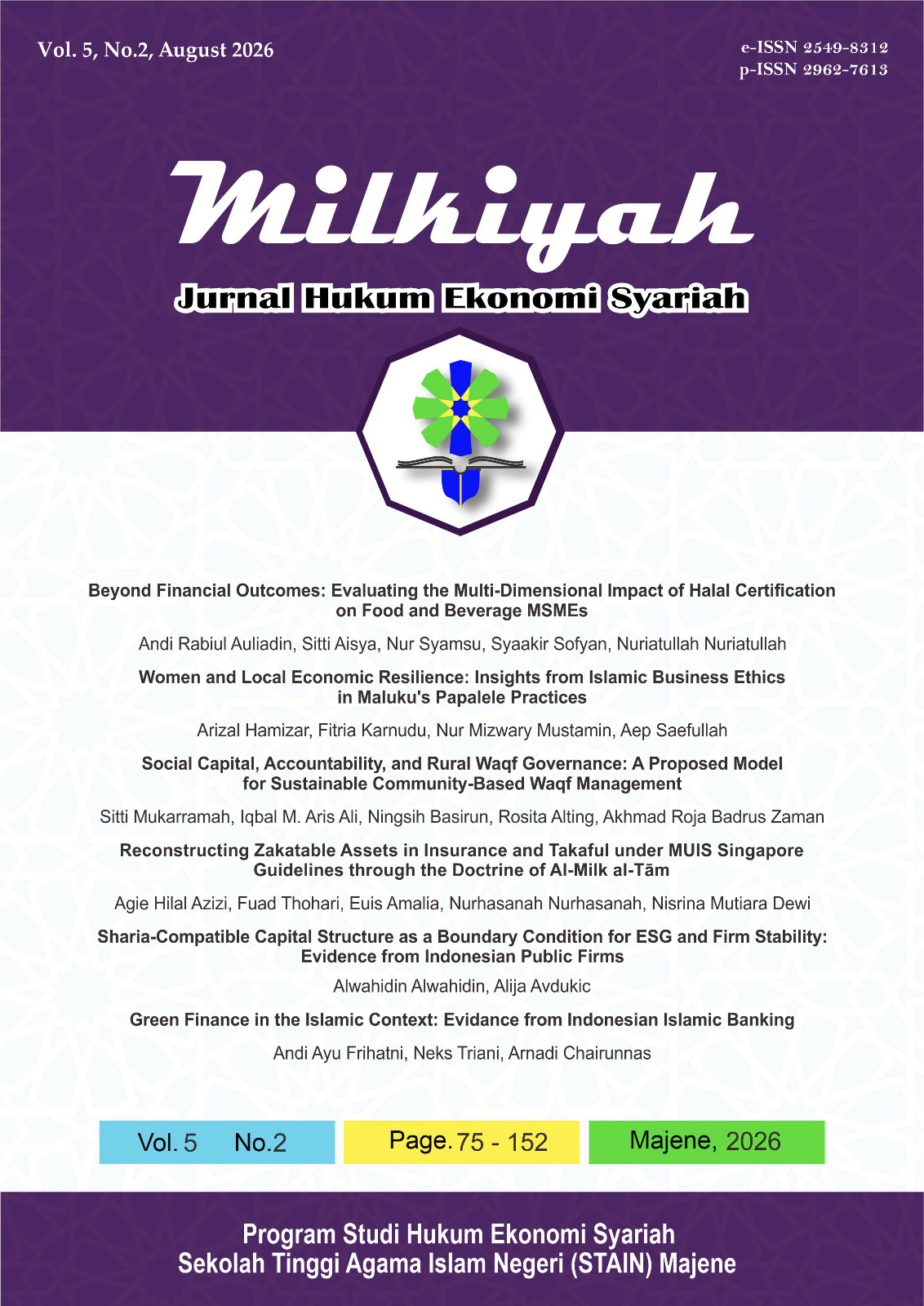
Social Capital, Accountability, and Rural Waqf Governance: A Proposed Model for Sustainable Community-Based Waqf Management
DOI:
https://doi.org/10.46870/milkiyah.v5i2.1893Keywords:
Accountability, Rural Communities, Social Capital, Waqf GovernanceAbstract
Existing studies on waqf governance have largely emphasized professionalization, formal accountability, and institutional strengthening, while giving limited attention to how governance is practiced in rural settings where social relationships remain central. This study examines how waqf governance operates in rural communities through socially embedded mechanisms of trust, social capital, and community participation. Using an interpretive qualitative case study in Woka Jaya Village, East Halmahera, data were collected through in-depth interviews, participant observation, and document analysis. The findings reveal that rural waqf governance is sustained through social capital manifested in trust, religious leadership, mutual cooperation (ta'awun), deliberation, and community-based supervision. These mechanisms enable local assets, including waqf land, coconut plantation yields, and voluntary labor, to be transformed into sustainable religious and social benefits while maintaining downward accountability through direct communication and public deliberation. However, dependence on personal relationships and practices creates challenges related to documentation, leadership succession, and institutional continuity. Based on these findings, this study proposes an Integrated Social Capital-Based Rural Waqf Governance Model consisting of six interconnected dimensions: spiritual values, social capital, nazhir legitimacy, local asset transformation, downward accountability, and institutional reinforcement. The study emphasizes that sustainable rural waqf governance requires the integration of community-based social mechanisms with modern governance practices, including asset legalization, financial reporting, nazhir professionalization, and gradual adoption of digital accounting systems.
References
Alase, A. (2017). The Interpretative Phenomenological Analysis (IPA): A Guide to a Good Qualitative Research Approach. International Journal of Education and Literacy Studies, 5(2), 9. https://doi.org/10.7575/aiac.ijels.v.5n.2p.9
Ali, I. M. A. (2012). Memaknai Disclosure Laporan Sumber dan Penggunaan Dana Kebajikan (Qardhul Hasan) Bank Syariah. Jurnal Akuntansi Multiparadigma, 3(2), 187–209. https://doi.org/10.18202/jamal.2012.08.7154
Ayub, M., Khan, K., Khan, M., & Ismail, M. (2025). Management and governance of Awqāf as social finance institutions. Qualitative Research in Financial Markets. https://doi.org/10.1108/QRFM-01-2025-0013
Bourdieu, P. (1986). The forms of capital. In Handbook of theory and research for the sociology of education. Greenwood Press.
Creswell, J. W., & Poth, C. N. (2016). Qualitative Inquiry and Research Design: Choosing Among Five Approaches. SAGE Publications.
Fogg, K. W. (2018). Reinforcing Charisma in the Bureaucratisation of Indonesian Islamic Organisations. Journal of Current Southeast Asian Affairs, 37(1), 117–140. https://journals.sub.uni-hamburg.de/giga/jsaa/article/view/1104
Frechette, J., Bitzas, V., Aubry, M., Kilpatrick, K., & Lavoie-Tremblay, M. (2020). Capturing Lived Experience: Methodological Considerations for Interpretive Phenomenological Inquiry. International Journal of Qualitative Methods, 19, 1609406920907254. https://doi.org/10.1177/1609406920907254
Hamim, H., Hasanah, N., & Arsyianti, L. D. (2023). The introduction of waqf to empower the economic potential of rural communities as part of community services program. AIP Conference Proceedings, 2722(1), 060003. https://doi.org/10.1063/5.0143118
Himmawan, M. F., Ninglasari, S. Y., & Mirzal, H. (2025). A systematic literature review on waqf governance: Stakeholder analysis. International Journal of Ethics and Systems. https://doi.org/10.1108/IJOES-03-2025-0137
Kementerian Agama Republik Indonesia. (2024). Sistem Informasi Wakaf (SIWAK): Data nasional tanah wakaf Indonesia.
Kuran, T. (2001). The Provision of Public Goods under Islamic Law: Origins, Impact, and Limitations of the Waqf System. Law & Society Review, 35(4), 841–897. https://doi.org/10.2307/3185418
Ladiku, H., & Zaman, A. R. B. (2024). Good Governance for Zakah, Infaq, and Sadaqah (ZIS) Collection Within Local Communities: A Case Study in Gorontalo Regency. Al-Qalam, 30(1), 63–77. https://doi.org/10.31969/alq.v30i1.1411
Ladiku, H., Zaman, A. R. B., & Sahabat, A. I. (2025). Zakat and the Sustainable Development Goals: Fostering Socio-Economic Synergy in Gorontalo Regency. ZISWAF: Jurnal Zakat Dan Wakaf, 12(2), 141–157. https://doi.org/10.21043/ziswaf.v12i2.31425
Mikail, S. A., Djafri, F., & Ahmad, M. (2024). Waqf and Microfinance Integration for Enabling Sustainable Financial Inclusion: Analysis of Sharīʿah Compliance. International Journal of Islamic Finance and Sustainable Development, 16(3), 43–66. https://doi.org/10.55188/ijifsd.v16i3.901
Monzer, K. (2003). The role of waqf in improving the ummah welfare. International Seminar on Waqf as a Private Legal Body, 6(1).
Moses, C. J. J. (2021). Establishing a Waqf: Space and the study of Islam. Ethnic and Racial Studies, 44(10), 1799–1820. https://doi.org/10.1080/01419870.2020.1846765
Osman, A. Z., & Agyemang, G. (2020). Privileging downward accountability in Waqf management. Journal of Islamic Accounting and Business Research, 11(3), 533–554. https://doi.org/10.1108/JIABR-05-2017-0064
Palinkas, L. A., Horwitz, S. M., Green, C. A., Wisdom, J. P., Duan, N., & Hoagwood, K. (2015). Purposeful sampling for qualitative data collection and analysis in mixed method implementation research. Administration and Policy in Mental Health, 42(5), 533–544. https://doi.org/10.1007/s10488-013-0528-y
Putnam, R. D. (2000). Bowling Alone: The Collapse and Revival of American Community. Simon and Schuster.
Srirejeki, K., & Khairurrizqo, K. (2025). The role of community engagement as corruption control strategy in local governments: Insights from Indonesia. International Journal of Public Sector Management, 38(7), 872–894. https://doi.org/10.1108/IJPSM-12-2024-0407
Sulaiman, S., Ahmed, H., Hasbullah, M., & Gumus, N. (2026). Institutional Pressures On Waqf Unit Trust Funds In Islamic Social Finance: The ASNB Wakalah Model For Social And Economic Impact. Journal of Fatwa Management and Research, 31(1), 80-108. https://doi.org/10.33102/jfatwa.vol31no1.708
Trifiletti, M. (2026). The Waqf (Ḥubus): a Millennial Institution between Canonical Inalienability, Governance Crisis and FinTech Revival for Sustainable Development. European Journal of Islamic Finance, 13(1), 52–74. https://doi.org/10.13135/2421-2172/12900
Wagay, A. H., & Nabi, G. (2025). Empowering Communities: The Impact of Waqf on Social and Economic Development: Research Article. Religion and Development, 4(2–3), 145–162. https://doi.org/10.30965/27507955-12340402
Wibowo, R., Zaman, A. R. B., Ihsanillah, M. M., & Aisyah, F. S. (2026). Green waqf crowdfunding model for SDGs: A fiqh al-bi’ah legal framework. Review of Islamic Social Finance and Entrepreneurship, 5(1), 120–136. https://doi.org/10.20885/RISFE.vol5.iss1.art7
Zafar, M. B., & Jafar, A. (2025). Waqf over a century: Innovation and tradition in shaping social equity and sustainable development. International Journal of Sociology and Social Policy, 46(3–4), 448–472. https://doi.org/10.1108/IJSSP-12-2024-0625
Zaimah, N. R., & Zaman, A. R. B. (2024). How did its Charity Go? The Practice of Zakat Management in e-Commerce Platforms. Milkiyah: Jurnal Hukum Ekonomi Syariah, 3(1), 17–30. https://doi.org/10.46870/milkiyah.v3i1.758
Zainuddin, S. A. B., Rahman, R. B. A., Ridzuan, F., Aziz, R. B. C., Mahdi, N. M. N., Anuar, N. I. M., Mohamad, S. R., Yasoa′, M. R. B., & Zaib, S. Z. M. (2025). Enhancing Transparency and Accountability in Waqf Management Through Digital Accounting Practices. In A. Hamdan (Ed.), Integrating Artificial Intelligence, Security for Environmental and Business Sustainability: Volume 1 (pp. 251–257). Springer Nature Switzerland. https://doi.org/10.1007/978-3-031-91424-9_23
Downloads
Published
How to Cite
Issue
Section
License
Copyright (c) 2026 Sitti Mukarramah, Iqbal M. Aris Ali, Basirun Ningsih, Rosita Alting, Akhmad Roja Badrus Zaman

This work is licensed under a Creative Commons Attribution-ShareAlike 4.0 International License.










 e-ISSN 2549-8312 p-ISSN 2962-7613