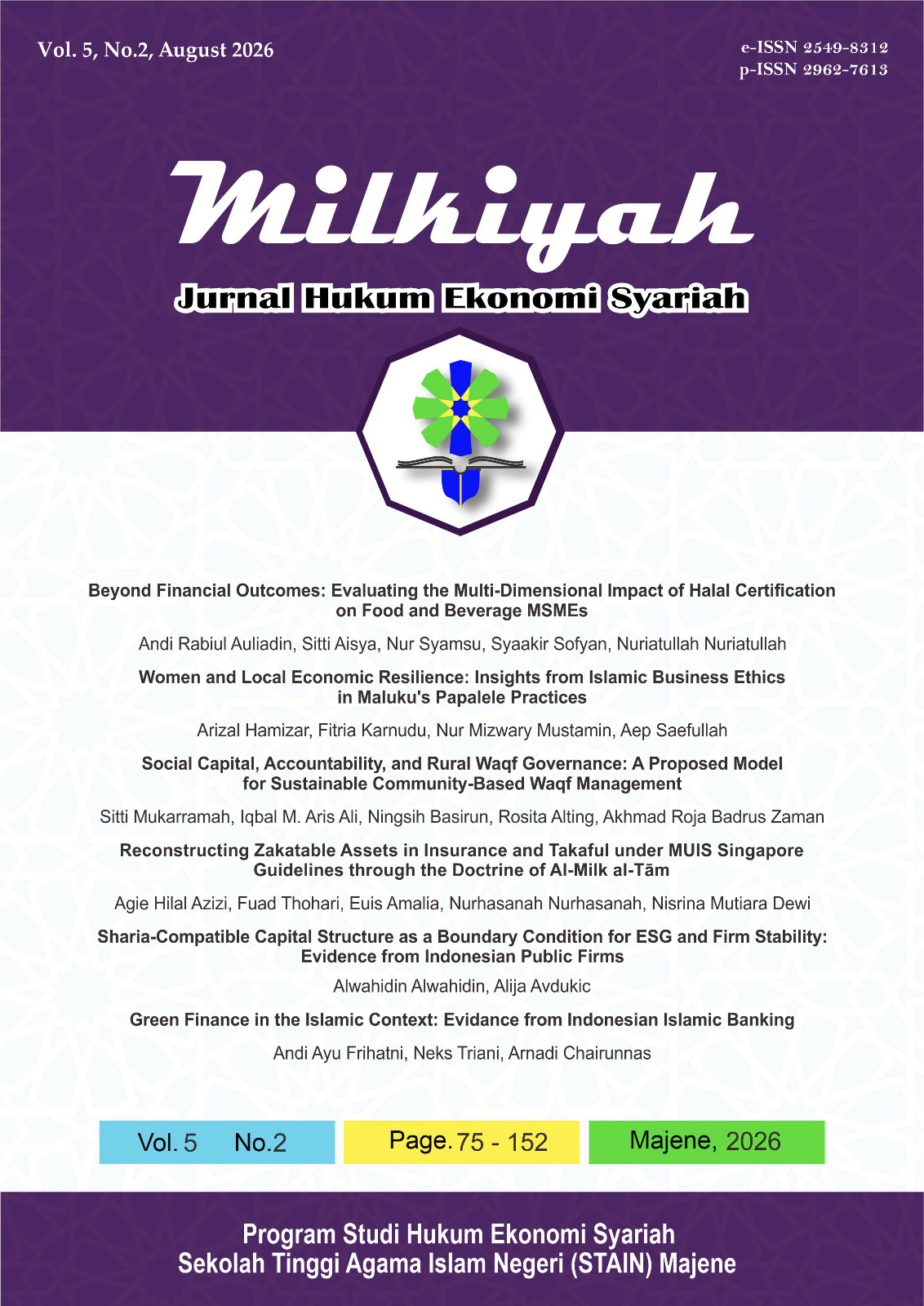
Green Finance in the Islamic Context: Assessing Its Implementation in Indonesian Banking
DOI:
https://doi.org/10.46870/milkiyah.v5i2.1536Keywords:
Green Finance, Islamic Banking, Sustainability , Sustainable Economic GrowthAbstract
Green finance has emerged as an important mechanism for promoting sustainable development by directing financial resources toward environmentally responsible activities. In the Islamic context, green finance is closely aligned with the principles of Maqasid Sharia, which emphasize social welfare and environmental stewardship. Despite growing interest in sustainable finance, empirical evidence regarding the implementation of green finance in Islamic banking remains limited, particularly in developing countries. This study aims to assess the implementation of green finance in Indonesian banking by examining the extent to which it has been adopted in Islamic banking, comparing its adoption with conventional banking, and evaluating its impact on sustainable economic growth. Using a quantitative approach, panel data were collected from annual reports, sustainability reports, and Financial Services Authority publications covering the period 2013-2022. The sample consists of conventional and Islamic commercial banks selected through purposive sampling. Descriptive statistics and panel data regression were employed for data analysis. The findings indicate that Islamic banks exhibit a higher level of green finance implementation than conventional banks, reflecting the strong compatibility between Islamic finance principles and sustainability objectives. However, green finance does not significantly affect sustainable economic growth in either banking system. These results suggest that green finance in Indonesia remains at an early stage of development, with its scale and maturity still insufficient to generate meaningful macroeconomic impacts. This study contributes to the growing literature on sustainable and Islamic finance by providing comparative evidence from Indonesia's dual banking system and highlighting the need for stronger regulations, expanded Sharia-compliant green financial instruments, and greater institutional capacity to support sustainable development.
References
Abbas, A., & Sari, N. W. (2022). Lanskap Kinerja Keuangan Unit Usaha Syariah di Indonesia. BANCO: Jurnal Manajemen dan Perbankan Syariah, 4(2), 75-82. https://ejurnal.iainpare.ac.id/index.php/banco/article/view/3369
Agrawal, R., Agrawal, S., Samadhiya, A., Kumar, A., Luthra, S., & Jain, V. (2024). Adoption of green finance and green innovation for achieving circularity: An exploratory review and future directions. Geoscience Frontiers, 15(4). https://doi.org/10.1016/J.GSF.2023.101669
Akomea-Frimpong, I., Kukah, A. S., Jin, X., Osei-Kyei, R., & Pariafsai, F. (2022). Green finance for green buildings: A systematic review and conceptual foundation. Journal of cleaner production, 356, 131869. https://doi.org/10.1016/j.jclepro.2022.131869
Al-Tamimi, S. M. A., & Abdellatif, M. S. (2026). Maqāṣid al-Sharīʿah (the higher objectives of islamic law) as an alternative perspective for contemporary environmental sustainability. Research Journal in Advanced Humanities, 7(1). https://doi.org/10.58256/fxbcpz88
Alam, N., Duygun, M., & Ariss, R. T. (2016). Green sukuk: An innovation in Islamic capital markets. In B. S. Sergi (Ed.), Energy and finance: Financial market integration and risk management (pp. 167–185). Springer International Publishing. https://doi.org/10.1007/978-3-319-32268-1_10
Aneja, R., Kappil, S. R., Das, N., & Banday, U. J. (2023). Does the green finance initiatives transform the world into a green economy? A study of green bond issuing countries. Environmental Science and Pollution Research, 30(15), 42214–42222. https://doi.org/10.1007/s11356-023-25317-w
Benameur, K., Hassanein, A., Mostafa, M. M., Elmaghrabi, M., & Tharwat, H. (2025). A decade of sustainable finance scholarly research: performance analysis, science mapping and future pathways. Journal of Financial Reporting and Accounting. Vol. ahead-of-print No. ahead-of-print. https://doi.org/10.1108/JFRA-10-2024-0722
Ben Jedidia, K., & Ghroubi, M. (2025). Islamic finance and SDGs: bibliometric review and future research agenda. Journal of Chinese Economic and Business Studies, 23(3), 329–362. https://doi.org/10.1080/14765284.2024.2445959
Chandran, R., Chandran, M.C.S., Achuthan, K., & Sahib, Padma Rao. (2025). Theoretical perspectives on green banking adoption in India: regulatory uncertainty, institutional barriers, and policy solutions. Discover Sustainability, 6, 581. https://doi.org/10.1007/s43621-025-01406-3
Daoulhadj, B., & Hussin, N. (2023). Islamic green finance, ecosystem and prospects in scaling up sustainable investments. Islamic Finance, 21. https://business.utm.my/wp-content/uploads/2024/10/update-VOL-III_AHIBS-ACT-Conference-Proceedings.pdf#page=30
Dikau, S., & Volz, U. (2021). Central bank mandates, sustainability objectives and the promotion of green finance. Ecological Economics, 184, Article 107022. https://doi.org/10.1016/j.ecolecon.2021.107022
Ejaz, M., Ashraf, M., Shahid, M. S., & Kamran, M. (2025). Impact of green finance and ESG on the sustainable performance of Islamic banks. Sustainable Business and Society in Emerging Economies, 7 (2), 221–240. https://doi.org/10.26710/sbsee.v7i2.3353
Falcone, P. M. (2020). Environmental regulation and green investments: The role of green finance. International Journal of Green Economics, 14(2), 159-173. https://doi.org/10.1504/IJGE.2020.109735
Fu, C., Lu, L. & Pirabi, M. (2023). Advancing green finance: a review of sustainable development. DESD 1, 20. https://doi.org/10.1007/s44265-023-00020-3
Goni, M.O., Uddin, S.M.S., Alam, S., Meinhold, R., & Maria, S. (2026). Regulator-led sustainable finance governance for climate-resilient development in Bangladesh through green finance participation, banking disclosure, and implementation gaps. Discover Sustainability. https://doi.org/10.1007/s43621-026-04162-0
Haddad, C., & Hornuf, L. (2019). The emergence of the global fintech market: economic and technological determinants. Small Business Economics, 53(1), 81–105. https://doi.org/10.1007/s11187-018-9991-x
Handayani, A., & Rokhim, R. (2023). A Comparative Study of Financial Performance between Sustainable and Conventional Investment. Journal of Entrepreneurship & Business, 4(2), 114 - 124. https://doi.org/10.24123/jeb.v4i2.5691
Hang, M., Geyer-Klingeberg J, Rathgeber A.W. (2019). It is merely a matter of time: A meta-analysis of the causality between environmental performance and financial performance. Business Strategy and the Environment, 28, 257–273. https://doi.org/10.1002/bse.2215
Hassan, M. K., Aliyu, S., Huda, M., & Rashid, M. (2019). A survey on Islamic Finance and accounting standards. Borsa Istanbul Review, 19. https://doi.org/10.1016/J.BIR.2019.07.006
Julia, T & Kassim, S (2020). Exploring green banking performance of Islamic banks vs conventional banks in Bangladesh based on Maqasid Shariah framework. Journal of Islamic Marketing, Vol. 11 No. 3 pp. 729–744, doi: https://doi.org/10.1108/JIMA-10-2017-0105
Kang, S., & Geng, W. (2025). Green finance innovation and high-quality economic development: Evidence from a quasi-natural experiment. Finance Research Letters, 78, 107209. https://doi.org/10.1016/j.frl.2025.107209
Kassim, S. (2016). Islamic finance and economic growth: The Malaysian experience. Global Finance Journal, 30, 66–76. https://doi.org/10.1016/j.gfj.2015.11.007
Keshminder, J. S., Singh, G. K. B., Wahid, Z. A., & Abdullah, M. S. (2019). Green sukuk: Malaysia taking the lead. Malaysian Journal of Consumer and Family Economics, 22(2), 1-22. https://majcafe.com/wp-content/uploads/2022/11/2019-Vol-22-S2-Article-1.pdf
Kumar, B., Kumar, L., Kumar, A., Kumari R., Tagar, U., & Sassanelli, C. (2024). Green finance in circular economy: a literature review. Environ Dev Sustain 26, 16419–16459. https://doi.org/10.1007/s10668-023-03361-3
Lebdaoui, H., & Wild, J. (2016). Islamic banking presence and economic growth in Southeast Asia. International Journal of Islamic and Middle Eastern Finance and Management, 9(4), 551–569. https://doi.org/10.1108/IMEFM-03-2015-0037
Liu, C., & Wu, S. S. (2023). Green finance, sustainability disclosure and economic implications. Fulbright Review of Economics and Policy, 3(1), 1-24. https://doi.org/10.1108/FREP-03-2022-0021
Mohanty, S., Nanda, S. S., Soubhari, T., Vishnu, N. S., Biswal, S., & Patnaik, S. (2023). Emerging Research Trends in Green Finance: A Bibliometric Overview. Journal of Risk and Financial Management, 16(2). https://doi.org/10.3390/jrfm16020108
OJK. (2017). Peraturan Otoritas Jasa Keuangan Nomor 51/POJK.03/2017 tentang Penerapan Keuangan Berkelanjutan bagi Lembaga Jasa Keuangan, Emiten, dan Perusahaan Publik. Otoritas Jasa Keuangan Republik Indonesia. https://www.greenfinanceplatform.org/policies-and-regulations/indonesias-regulation-application-sustainable-finance-no-51pojk032017
Park, H., & Kim, J. D. (2020). Transition towards green banking: role of financial regulators and financial institutions. Asian Journal of Sustainability and Social Responsibility, 5(1), 1-25. https://doi.org/10.1186/s41180-020-00034-3
Sachs, J. D., Woo, W. T., Yoshino, N., & Taghizadeh-Hesary, F. (2017). WHY IS GREEN FINANCE IMPORTANT? Asian Development Bank Institute. Institute of Sciences, 917. https://www.adb.org/publications/why-green-finance-important
Setyowati, A. B. (2023). Governing sustainable finance: Insights from Indonesia. Climate Policy, 23(1), 108–121. https://doi.org/10.1080/14693062.2020.1858741
Sharma, M., & Choubey, A. (2022). Green banking initiatives: a qualitative study on Indian banking sector. Environment, Development and Sustainability, 24(1), 293–319. https://doi.org/10.1007/s10668-021-01426-9
Shompa Z.A., Akbar, M.A, Mohadis H.M. (2025). Harmonizing Maqasid al-Shari’ah with sustainable waste management practices: a conceptual framework for principles and implementation. International Journal of Islamic and Middle Eastern Finance and Management, (18) 1. 142–165. https://doi.org/10.1108/IMEFM-02-2024-0061
Tawiah, V., Zakari, A., & Adedoyin, F. F. (2021). Determinants of green growth in developed and developing countries. Environmental Science and Pollution Research, 28(29), 39227–39242. https://doi.org/10.1007/s11356-021-13429-0
Taghizadeh-Hesary, F., & Yoshino, N. (2019). The way to induce private participation in green finance and investment. Finance Research Letters, 31, 98–103. https://doi.org/10.1016/j.frl.2019.04.016
Udeagha, M. C., & Ngepah, N. (2023). The drivers of environmental sustainability in BRICS economies: Do green finance and fintech matter? World Development Sustainability, 3(August), 100096. https://doi.org/10.1016/j.wds.2023.100096
Wang, X., & Wang, Q. (2021). Research on the impact of green finance on the upgrading of China's regional industrial structure from the perspective of sustainable development. Resources Policy, 74, 102436. https://doi.org/10.1016/j.resourpol.2021.102436
Wei, Y., & Zhong, F. (2025). Effect of green finance on sustainable growth: evidence from China. Environ Dev Sustain. https://doi.org/10.1007/s10668-025-06696-1
Xiong, Y., & Dai, L. (2023). Does green finance investment impact on sustainable development: Role of technological innovation and renewable energy. Renewable Energy, 214, 342-349. https://doi.org/10.1016/j.renene.2023.06.002
Xu, J., She, S., Gao, P., & Sun, Y. (2023). Role of green finance in resource efficiency and green economic growth. Resources Policy, 81. https://doi.org/10.1016/j.resourpol.2023.103349
Yang, X., Zhang, J., Ren, S., & Ran, Q. (2021). Can the new energy demonstration city policy reduce environmental pollution? Evidence from a quasi-natural experiment in China. Journal of Cleaner Production, 287(xxxx), 125015. https://doi.org/10.1016/j.jclepro.2020.125015
Zhang, D., Zhang, Z., & Managi, S. (2019). A bibliometric analysis on green finance: Current status, development, and future directions. Finance Research Letters, 29, 425–430. https://doi.org/10.1016/j.frl.2019.02.003
Zhou, G., Zhu, J., & Luo, S. (2022). The impact of fintech innovation on green growth in China: Mediating effect of green finance. Ecological Economics, 193, 107308. https://doi.org/10.1016/j.ecolecon.2021.107308
Zhou, Z., Zhou, Y., Wu, Y., & Ge, X. (2023). The impact of green finance policy on total factor productivity: based on quasi-natural experiment evidence from China. Journal of cleaner production, 425, 138873. https://doi.org/10.1016/j.jclepro.2023.138873
Zulfiqar, B., Ijaz, M.S., Hanif, M. (2024). Nurturing Sustainable Futures: Islamic Green Finance and the Sustainable Development Agenda. In: Hunjra, A.I., Goodell, J.W. (eds) The Palgrave Handbook of Green Finance for Sustainable Development. Palgrave Studies in Impact Finance(). Palgrave Macmillan, Cham. https://doi.org/10.1007/978-3-031-65756-6_7
Downloads
Published
How to Cite
Issue
Section
License
Copyright (c) 2026 Andi Ayu Frihatni, Neks Triani, Arnadi Chairunnas

This work is licensed under a Creative Commons Attribution-ShareAlike 4.0 International License.












 e-ISSN 2549-8312 p-ISSN 2962-7613