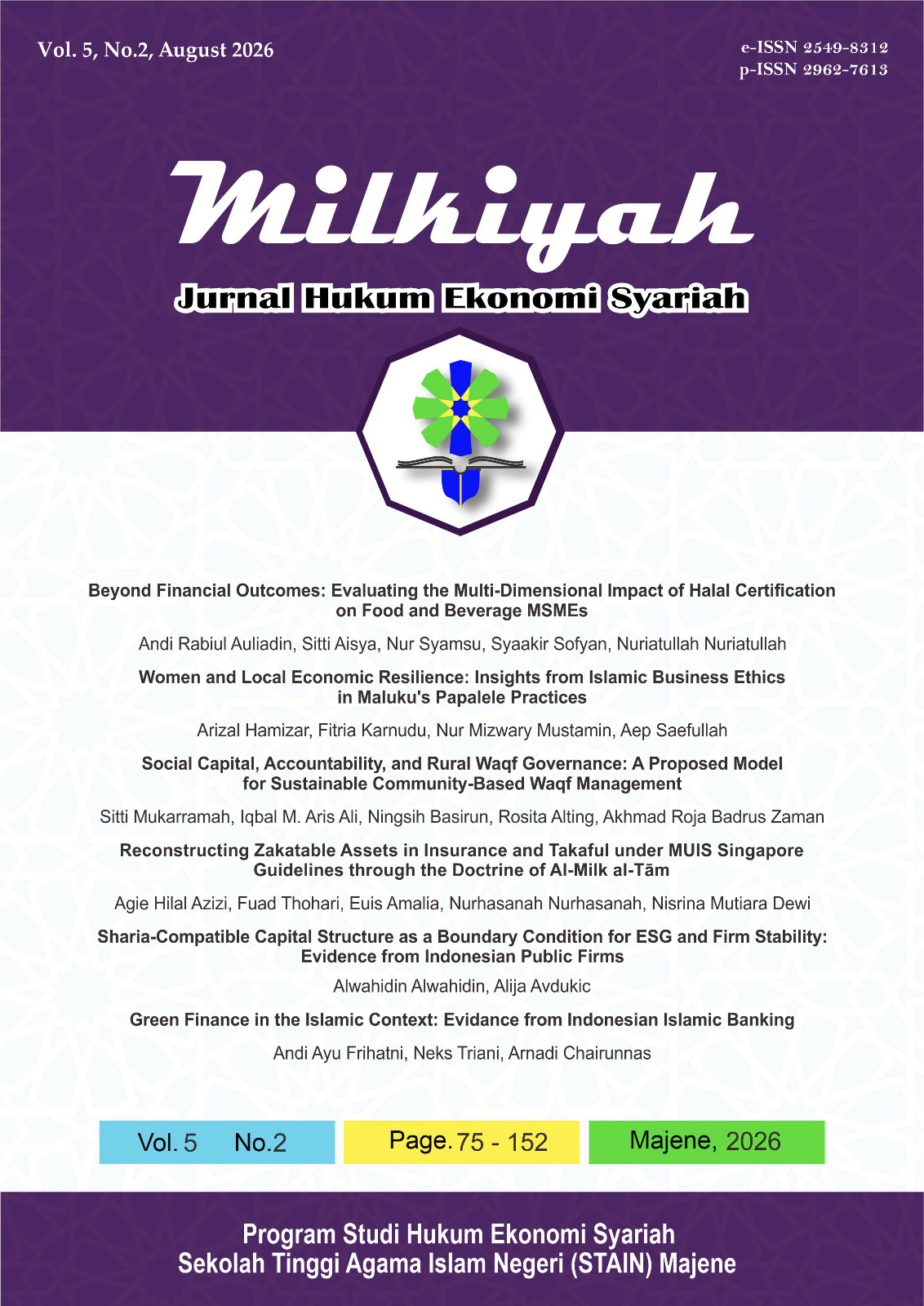
Women and Local Economic Resilience: Insights from Islamic Business Ethics in Maluku's Papalele Practices
DOI:
https://doi.org/10.46870/milkiyah.v5i2.2114Keywords:
Ethics, Islamic Business, Local Economic Resilience, Papalele, Ṣiddiq, WomenAbstract
The informal sector remains a critical source of livelihood in Maluku despite the province's strong economic growth. This study aims to analyze the role of Papalele women in strengthening local economic resilience, explore consumer behavior toward Papalele traders, and examine the implementation of the Islamic business ethics principle of ṣidq (truthfulness) in traditional market practices. A qualitative descriptive approach was employed in Ambon, Maluku. Data were collected through in-depth interviews with Papalele women traders and consumers, complemented by participant observation and documentation. The data were analyzed using the Miles and Huberman interactive model. The findings reveal that Papalele women serve as key economic actors who sustain household livelihoods and function as shock absorbers in the local economy amid economic and environmental uncertainties. Their contributions extend beyond income generation to maintaining the circulation of local goods and supporting community welfare. Consumer engagement with Papalele traders is shaped by three interrelated factors: trust, time efficiency, and social solidarity. Furthermore, the principle of sidq is practiced through honesty, transparency, and fairness in transactions, enabling traders to build consumer trust, reduce transaction uncertainty, and strengthen long-term market relationships. This study implies that local economic resilience is not solely determined by macroeconomic growth but is also sustained by women-led informal economic activities grounded in ethical values. The findings highlight the importance of integrating Islamic business ethics into community-based economic development strategies while recognizing the significant contribution of women traders to resilient and inclusive local economies
References
Akter, N., & Hasan, S. (2023). The moderating role of perceived behavioral control in predicting Muslim tourists’ halal tourism intention: a developing country perspective. Journal of Islamic Marketing, 14(7), 1744–1767. https://doi.org/10.1108/JIMA-10-2021-0336
Al-Doghan, M. A., Abdelmegeed Abdelwahed, N. A., Ramish, M. S., & Soomro, B. A. (2025). Linking Islamic business ethics to life satisfaction and financial performance: the intervening effects of employee relations climate and competitive strategy in the financial sector. Journal of Islamic Accounting and Business Research, 1–24. https://doi.org/10.1108/JIABR-05-2025-0312
Alhejaili, M (2025). Harmonising derivatives with Shari’ah: ethical practices and regulatory insights. International Journal of Islamic and Middle Eastern Finance and Management, 18(5), 1132–1149, https://doi.org/10.1108/IMEFM-03-2024-0163
Alm, K., & Guttormsen, D. S. A. (2023). Enabling the Voices of Marginalized Groups of People in Theoretical Business Ethics Research. Journal of Business Ethics, 182(2), 303–320. https://doi.org/10.1007/s10551-021-04973-3
Alqhaiwi, Z. O., Koburtay, T., & Syed, J. (2024). The Interplay Between Islamic Work Ethic, Unethical Pro Behaviors, and Moral Identity Internalization: The Moderating Role of Religiosity. Journal of Business Ethics, 193(2), 393–408. https://doi.org/10.1007/s10551-023-05527-5
Althalathini, D., Al-Dajani, H., & Apostolopoulos, N. (2022). The Impact of Islamic Feminism in Empowering Women’s Entrepreneurship in Conflict Zones: Evidence from Afghanistan, Iraq and Palestine. Journal of Business Ethics, 178(1), 39–55. https://doi.org/10.1007/s10551-021-04818-z
Anggraini, M. (2025). GEN-Z’S CONSUMPTIVE BEHAVIOR TOWARDS THE TREND OF YOU LIVE ONLY ONCE TO YOU NEED ONLY ONE IN THE PERSPECTIVE OF ISLAMIC BUSINESS ETHICS. Journal of Management and Islamic Finance, 5(2), 196–214. https://doi.org/10.22515/jmif.v5i2.12385
Antaranews.com. (2024). Pertumbuhan ekonomi Maluku dan Papua tertinggi pada 2024. Https://Papuatengah.Antaranews.Com/Berita/58769/Bps-Pertumbuhan-Ekonomi-Maluku-Dan-Papua-Tertinggi-Pada-2024.
Apituley, M., Tuasela, J., Iwamony, R., & Saiya, R. (2025). Feminist economic theology and gender justice: The case of fisherwomen in Moluccas. HTS Teologiese Studies / Theological Studies, 81(1). https://doi.org/10.4102/hts.v81i1.10781
Arifin, M. R., Raharja, B. S., & Nugroho, A. (2023). Do young Muslim choose differently? Identifying consumer behavior in Halal industry. Journal of Islamic Marketing, 14(4), 1032–1057. https://doi.org/10.1108/JIMA-02-2021-0049
Aruqaj, B. (2023). An integrated approach to the conceptualisation and measurement of social cohesion. Social Indicators Research, 168 (1), 227-263. https://doi.org/10.1007/s11205-023-03110-z
Azizah, M., & Hariyanto, H. (2021). Implementasi Etika Bisnis Islam terhadap Konsep Green Economics. Supremasi Hukum: Jurnal Kajian Ilmu Hukum, 10(2), 237–252. https://doi.org/10.14421/sh.v10i2.2392
Barta, S., Gurrea, R., & Flavián, C. (2023). Consequences of consumer regret with online shopping. Journal of Retailing and Consumer Services, 73, 103332. https://doi.org/10.1016/j.jretconser.2023.103332
Bhutto, M. Y., Rūtelionė, A., & Vienažindienė, M. (2024). Investigating EWOM and halal product knowledge on gen Z’s halal cosmetics purchase intentions in Pakistan. Journal of Islamic Marketing, 15(11), 3266–3281. https://doi.org/10.1108/JIMA-09-2023-0292
ChoudhuryKaul, S., Supriyadi, O., & Fahlevi, N. (2023). Muslim Indonesian women entrepreneurs: a factor analysis of business performance. Journal of Islamic Marketing, 14(12), 3186–3207. https://doi.org/10.1108/JIMA-01-2022-0036
Delia, E. B., Nicole Melton, E., Sveinson, K., Cunningham, G. B., & Lock, D. (2022). Understanding the Lack of Diversity in Sport Consumer Behavior Research. Journal of Sport Management, 36(3), 265–276. https://doi.org/10.1123/jsm.2021-0227
Deti, S. (2025). Halal awareness and Muslim consumer behavior in Indonesia: A systematic literature review. Alkasb: Journal of Islamic Economics, 4(1), 121–147. https://doi.org/10.59005/alkasb.v4i1.662
Farahani, M., Payandeh, R., & Jafari Haftkhani, N. (2026). Toward an Islamic data ethics theory (IDET): a blueprint for balanced data practices in business. Journal of Islamic Accounting and Business Research, 1–23. https://doi.org/10.1108/JIABR-12-2024-0527
Fredström, A., Peltonen, J., & Wincent, J. (2021). A country-level institutional perspective on entrepreneurship productivity: The effects of informal economy and regulation. Journal of Business Venturing, 36(5), 106002. https://doi.org/10.1016/j.jbusvent.2020.106002
Hasan, S., Faruk, M., Naher, K., & Hossain, S. (2024). Influence of halal marketing on intention towards halal cosmetics: halal awareness and attitude as mediators. Journal of Islamic Marketing, 15(7), 1783–1806. https://doi.org/10.1108/JIMA-03-2023-0100
Hayati, B. N. (2025). Women Informal Workers’ Resilience During The Health Emergency: A Case Study In Ketitang Village, Boyolali. Progress In Social Development, 6(2), 396–402. https://doi.org/10.30872/psd.v6i2.140
Ismail, I. J. (2023). When love leads the way! Conceptualizing triangular theory of love and expectations-confirmation theory in Islamic banking. Journal of Islamic Marketing, 14(11), 2887–2906. https://doi.org/10.1108/JIMA-03-2022-0089
Khan, Z., Khan, A., Nazish, M., & Arwab, M. (2026). A fusion of TAM and TPB with halal product knowledge and religiosity to understand online purchase intentions of halal cosmetics among Muslims Gen Z. Journal of Islamic Marketing, 17(4), 1415–1437. https://doi.org/10.1108/JIMA-10-2024-0456
Khasanah, M. (2025). The impact of habit and halal involvement on the intention to purchase international branded food: evidence from Indonesia. Journal of Islamic Marketing, 16(7), 1949–1973. https://doi.org/10.1108/JIMA-09-2023-0289
Latupeirissa, M. P. A. (2021). Perempuan dan Rekonsiliasi Peran Mama-mama Papalele dalam Membangun Rekonsiliasi Haria-Porto, Maluku. PALASTREN: Jurnal Studi Gender, 14(1). https://doi.org/10.21043/palastren.v14i1.8050
Lenggono, T. O., & Sabaruddin, L. O. (2025). Konsep Harga Berbasis Nilai Pela Gandong Dalam Komunitas Jibu-Jibu. Jurnal Akuntansi Multiparadigma, 16(1). https://doi.org/10.21776/ub.jamal.2025.16.1.06
Mbanaso, U. M., Abrahams, L., & Okafor, K. C. (2023). Research philosophy, design and methodology. In Research techniques for computer science, information systems and cybersecurity (pp. 81-113). Cham: Springer Nature Switzerland.
Mey, G. (2022). Qualitative methodology. In International handbook of psychology learning and teaching (pp. 453-478). Cham: Springer International Publishing.
Miles, M. B., Huberman, A. M., & Saldana, J. (2014). Qualitative data analysis. Sage.
Munawaroh, M. (2022). Determinan Perempuan Bekerja di Kalimantan Barat pada Sektor Informal selama Pandemi. Jurnal Forum Analisis Statistik (FORMASI), 1(2), 81–89. https://doi.org/10.57059/formasi.v1i2.18
Nurhadi, N., Yuda, T. K., Kafaa, K. A., & Pratiyudha, P. P. (2023). Changing welfare solidarity: social policy and solidarity ventures during COVID-19 outbreak in Indonesia. Journal of Asian Public Policy, 1–21. https://doi.org/10.1080/17516234.2023.2236397
Ohorella, R., Risakotta, T. K., & Tuhumena, L. (2022). Model Pemberdayaan Perempuan Pelaku Usaha Perikanan di Negeri Tulehu Kabupaten Maluku Tengah. ACROPORA: Jurnal Ilmu Kelautan Dan Perikanan Papua, 5(1), 1-5. https://doi.org/10.31957/acr.v5i1.2259
Panakaje, N., Zuha, A., Parvin, S. M. R., Sheikh, N., Shaid, M., Irfana, S., & V, M. (2025). Exploring the role of islamic ethical training and business integrity in shaping ethical decision-making and business performance: a mediated–moderated analysis. Journal of Islamic Accounting and Business Research, 1–33. https://doi.org/10.1108/JIABR-02-2025-0099
Papilaya, R. L., Latuconsina, J., & Nurhaeny, A. (2024). Dampak Aksesibilitas Transportasi Darat Dalam Pengembangan Ekonomi Wilayah Pesisir Berbasis Sektor Perikanan (Studi Kasus: Pulau Ambon, Provinsi Maluku). PAPALELE (Jurnal Penelitian Sosial Ekonomi Perikanan Dan Kelautan), 8(1), 80–87. https://doi.org/10.30598/papalele.2024.8.1.80
Putri, R. A., Wati, E. R. K., Nurrizalia, M., Anggelia, R. D., Syakirin, A., & Syawalludin, S. (2024). Realitas Tantangan Tenaga Kerja Wanita di Sektor Informal: Kontribusi, Tantangan dan Dampak yang Terjadi. Jurnal Pendidikan Non Formal, 1(3), 11. https://doi.org/10.47134/jpn.v1i3.367
Santos ‐Corrada, M. D. L. M., Méndez‐Tejeda, R., Flecha‐Ortiz, J. A., & Lopez, E. (2024). An analysis of sustainable consumption practices through the role of the consumer behavior in the circular economy. Journal of Consumer Behaviour, 23(1), 229–242. https://doi.org/10.1002/cb.2183
Saputra, T. A. (2025). Islamic Ethical Values in Traditional Commerce: A Field Study of Market Traders. Ta’amul: Journal of Islamic Economics, 4(1), 37–48. https://doi.org/10.58223/taamul.v4i1.451
Satarudin, S., Suprianto, S., & Sujadi, S. (2021). Survey Pekerja Sektor informal Dan Sektor Formal Era Revolusi Industri di Kota Mataram. Journal of Economics and Business, 7(2), 175–194. https://doi.org/10.29303/ekonobis.v7i2.74
Sofyan, A. S., Rusanti, E., Nurmiati, N., Sofyan, S., Kurniawan, R., & Caraka, R. E. (2026). Islam in business ethics research: a bibliometric analysis and future research agenda. International Journal of Ethics and Systems, 42(2), 345–377. https://doi.org/10.1108/IJOES-02-2024-0058
Sopamena, J. F., & Pattiselanno, A. E. (2021c). Papalele and Market: Traditional Exchange in Saparua Island, Maluku. JSW (Jurnal Sosiologi Walisongo), 5(2), 173–190. https://doi.org/10.21580/jsw.2021.5.2.7002
Sugiyono. (2023). Metode Penelitian Kualitatif (Untuk penelitian yang bersifat: eksploratif, enterpretif, interaktif dan konstruktif). Metode Penelitian Kualitatif.
Suhartanto, D., Dean, D., Sarah, I. S., Hapsari, R., Amalia, F. A., & Suhaeni, T. (2021). Does religiosity matter for customer loyalty? Evidence from halal cosmetics. Journal of Islamic Marketing, 12(8), 1521–1534. https://doi.org/10.1108/JIMA-03-2020-0069
Sulaeman, S., Herianingrum, S., Ryandono, M. N. H., Napitupulu, R. M., Hapsari, M. I., Furqani, H., & Bahari, Z. (2025). Islamic business ethics in the framework of higher ethical objective (Maqasid al-Shariah): a comprehensive analysis and future research directions. International Journal of Ethics and Systems, 1–29. https://doi.org/10.1108/IJOES-12-2024-0398
Supriani, I., Ninglasari, S. Y., & Iswati, S. (2025). How social media influencers form Muslim consumers’ halal cosmetics purchase intention: religiosity concern. Journal of Islamic Marketing, 16(2), 502–525. https://doi.org/10.1108/JIMA-02-2024-0085
Uneputty, P. A., Haumahu, S., & Mamesah, J. A. B. (2023). Pelestarian Sumber Daya dan Lingkungan Pesisir dan Laut. Open Community Service Journal, 2(2), 84-90. https://doi.org/10.33292/ocsj.v2i2.40
Wati, A., Paramansyah, A., & Damayanthi, D. (2020). Penerapan Etika Bisnis Islam Dalam Transaksi Jual Beli: El-Mal: Jurnal Kajian Ekonomi & Bisnis Islam, 1(2), 184–200. https://doi.org/10.47467/elmal.v1i2.344
Yilmaz, I. (2024). Exploring the foundations of Islamic moral economy: a return to substantive morality. International Journal of Ethics and Systems, 40(4), 605–621. https://doi.org/10.1108/IJOES-03-2024-0085
Yudha, A. T. R. C., Atiya, N., Faidah, A. R., Febriyanti, N., & Masrufah, N. (2025). Maslahah value optimization in exploring Muslim consumption behavior: a study of impulse buying on e-wallet users in East Java, Indonesia. Journal of Islamic Marketing, 16(9), 2514–2542. https://doi.org/10.1108/JIMA-03-2024-0118
Downloads
Published
How to Cite
Issue
Section
License
Copyright (c) 2026 Arizal Hamizar, Fitria Karnudu, Nur Mizwary Mustamin, Aep Saefullah

This work is licensed under a Creative Commons Attribution-ShareAlike 4.0 International License.









 e-ISSN 2549-8312 p-ISSN 2962-7613