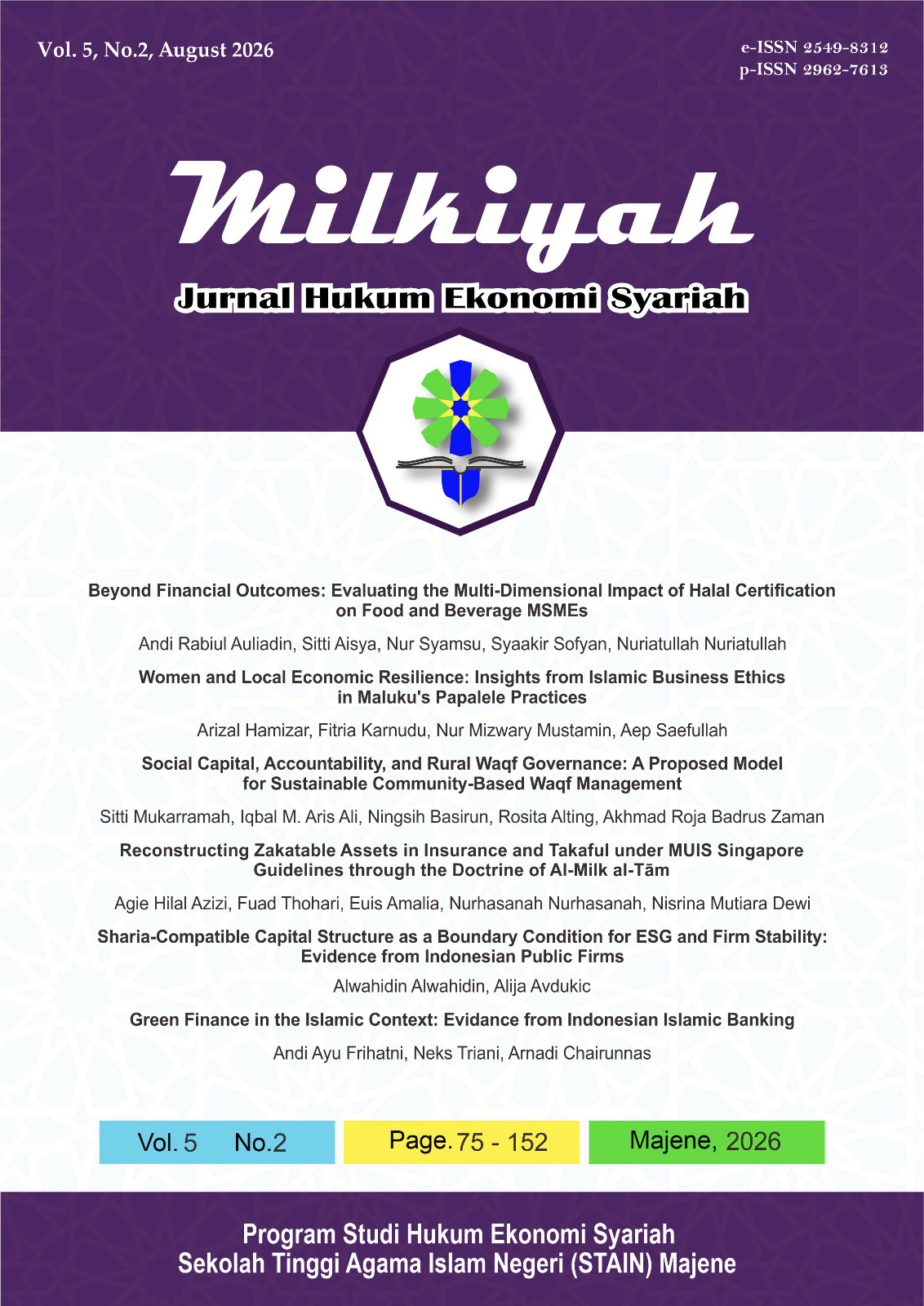
Beyond Financial Outcomes: Evaluating the Multi-Dimensional Impact of Halal Certification on Food and Beverage MSMEs
DOI:
https://doi.org/10.46870/milkiyah.v5i2.2064Keywords:
Balanced Scorecard, Food and Beverage Industry, Halal Certification, MSMEs, PerformanceAbstract
While existing research primarily emphasizes efficiency and market competitiveness, it often overlooks broader dimensions such as customer trust, internal processes, and organizational learning. This study investigates the multi-dimensional impacts of halal certification on MSMEs. Using the Balanced Scorecard framework, this qualitative case study examines the performance of food and beverage MSMEs in Palu City. Data were gathered from 16 purposively selected halal-certified MSMEs through semi-structured interviews and documentation, then analyzed thematically. The findings indicate that the most substantial impact of halal certification extends beyond financial outcomes, emerging most prominently within internal business processes, particularly in areas such as hygiene control, documentation, traceability, raw material selection, and production discipline. These improvements bolster customer trust and product legitimacy, which can facilitate broader market access and more stable sales. However, financial benefits tend to be indirect, depending on an MSME's ability to leverage certification for growth while managing compliance costs. Ultimately, this study highlights that halal certification serves not merely as a regulatory requirement, but as a vital organizational governance mechanism that strengthens business credibility and operational discipline
References
Ahamed, F. (2025). Appreciating Successful Growth Strategies: A Case of Omani Islamic Bank Using the Balanced Scorecard Approach. In C. Pon Selvan, N. Sehgal, S. Ruhela, & N. U. Rizvi (Eds.), International Conference on Innovation, Sustainability, and Applied Sciences (ICISAS 2023), . 229–235). https://doi.org/10.1007/978-3-031-68952-9_30
Aisya, S., & Syamsu, N. (2024). Emerging Themes and Research Directions in Halal Fashion: A Bibliometric Study. In Equilibrium: Jurnal Ekonomi Syariah 12(1), 141-170. https://doi.org/10.21043/equilibrium.v12i1.23205
Akhiroh, P., Utami, H. D., Umam, K., Awwaly, A., Febrianto, N., & Hartono, B. (2025). Synergizing Halal Compliance with Balanced Scorecard Approach : Implications for Supply Chain Performance in Indonesian Fried Chicken MSMEs. Sustainability,. 17(21), 9814. https://doi.org/10.3390/su17219814
Alexakis, C., Izzeldin, M., Johnes, J., & Pappas, V. (2019). Performance and productivity in Islamic and conventional banks: Evidence from the global financial crisis. Economic Modelling, 79, 1-14. https://doi.org/10.1016/j.econmod.2018.09.030
Alzadjal, M. A. J., Abu-Hussin, M. F., Md Husin, M., & Mohd Hussin, M. Y. (2021). Moderating the role of religiosity on potential customer intention to deal with Islamic banks in Oman. Journal of Islamic Marketing, 13 (11): 2378–2402. https://doi.org/10.1108/JIMA-05-2020-0150
Ariyantiningsih, F., & Santoso, B. (2026). The Role of Customer Satisfaction in Improving Sharia Industry Performance. Quality - Access to Success, 27(210), 273–286. https://doi.org/10.47750/QAS/27.210.31
Azizah, S. N., Koeswinarno, K., Salam, A. N., Ansyah, R. H. A., Kustini, K., Atieqoh, S., & M., F. (2025). Linking halal certificate and micro, small and medium enterprises (MSMEs) performance in Indonesia. International Journal of Islamic and Middle Eastern Finance and Management, 18(6), 1271–1290. https://doi.org/10.1108/IMEFM-12-2023-0463
Berger, A. N., Boubakri, N., Guedhami, O., & Li, X. (2019). Liquidity creation performance and financial stability consequences of Islamic banking: Evidence from a multinational study. Journal of Financial Stability, 44, 100692. https://doi.org/10.1016/j.jfs.2019.100692
Braun, V., & Clarke, V. (2006). Using thematic analysis in psychology. Qualitative Research in Psychology, 3(2), 77–101. https://doi.org/10.1191/1478088706qp063oa
Creswell, J. W., & Poth, C. N. (2018). Qualitative inquiry and research design: Choosing among five approaches (4th ed.). Sage Publications.
Esquivias, M. A., Primanthi, M. R., Rachmaningtyas, L., LAU, W., & Tarassyta, A. (2025). Beyond compliance: Examining the link between industrial standards and firm performance in Indonesia. Social Sciences and Humanities Open, 11. https://doi.org/10.1016/j.ssaho.2025.101590
Fathoni, M. A., Priyatno, P. D., Wiryanto, F. S., & Rachbini, W. (2025). Unlocking barriers and strategies of halal certification for micro and small enterprises in Indonesia: Analytic network process approach. Problems and Perspectives in Management, 23(1), 169. 169-180. https://doi.org/10.21511/ppm.23(1).2025.13
Fianto, B. A., Fauzi, F. P., Suprayogi, N., Filianti, D., Gan, C., & Anisha, A. I. I. N. (2026). Factors influencing behavior intention to obtain halal certificate: study on MSMEs in Indonesia and Malaysia. Journal of Islamic Marketing, 17(1), 160-190. https://doi.org/10.1108/JIMA-05-2020-0152
Giyanti, I., Indrasari, A., Sutopo, W., & Liquiddanu, E. (2021). Halal standard implementation in food manufacturing SMEs: its drivers and impact on performance. Journal of Islamic Marketing, 12(8), 1577–1602. https://doi.org/10.1108/JIMA-11-2019-0243
Isabella, A. A., & Loliyani, R. (2026). Assessing the Sustainability of the Self-Declare Halal Certification Program for MSMEs in Lampung Province. Ilomata International Journal of Management, 7(1), 524–536. https://doi.org/10.61194/ijjm.v7i1.1860
Ismail, A. H., Sariyanto, Pradesyah, R., & Munawaroh, M. (2026). The Effect of Halal Literacy and the Burden of Management Costs on the Interest of MSMEs in the Halal Certification Process. Majapahit Journal of Islamic Finance and Management, 6(1), 123–137. https://doi.org/10.31538/mjifm.v6i1.720
Kaplan, Robert S, & Norton, D. P. (1996). The Balanced Scorecard: Translating Strategy into Action. Harvard Business School Press.
Kaplan, R. S., & Norton, D. P. (2005). The balanced scorecard: measures that drive performance. Harvard Business Review, 70, (71-79). Boston, MA, USA: Harvard Business Review.
Kemnaker. (2023). Menaker Dorong Perusahaan Beri Perhatian ke UMKM. https://kemnaker.go.id/news/detail/menaker-dorong-perusahaan-beri-perhatian-ke-umkm
Kristanto, D., & Kurniawati, D. A. (2025). Financial performance of Indonesian frozen food MSMEs: halal supply chain resilience, certification and competitive advantage. Journal of Islamic Marketing. https://doi.org/10.1108/JIMA-07-2024-0278
Lincoln, Y. S., & Guba, E. G. (1985). Naturalistic inquiry. Sage Publications.
Maflahah, I., Omar, E. N., Firmansyah, R. A., Asfan, D. F., & Hadiguna, R. A. (2025). Evaluation of the Performance of the Halal Supply Chain in Fish Processing SMEs: An Empirical Study Utilizing the PLS-SEM Approach. Modelling, Measurement and Control B, 12(3). https://doi.org/10.18280/mmep.120322
Makhasi, G. Y. M., Syamsu, N., Aisya, S., & Hariyanto, H. (2025). Discovering halal tourism’s footprints: a bibliometric perspective on business research using scopus data (1997–2023). Malaysian Journal of Syariah and Law, 13(3), 797-818. https://doi.org/10.33102/mjsl.vol13no3.681
Marlina, L., Juliana, J., Ismail, S., & Dewi, S. V. (2026). Halal industry development strategy: a bibliometric analysis. Journal of Islamic Marketing, 17(1), 324–348. https://doi.org/10.1108/JIMA-12-2024-0591
Maulana, M. K., Dwiputri, R. M., & Harri, M. (2026). Advancing sustainability in culinary: Examining the role of halal supply chain management and operational efficiency. European Journal of Sustainable Development Research, 10(1 AR-em0363). https://doi.org/10.29333/ejosdr/17557
Miles, M. B., Huberman, A. M., & Saldana, J. (2014). Qualitative Data Analysis (Third Edit). Arizona State University.
Pratama, M. A. R. (2024). How Halal Certification and Islamic Ethics Tackle Greenwashing: New Solutions for a Sustainable Economy. Jurnal of Middle East and Islamic Studies, 11(3). 1-19 https://doi.org/10.7454/meis.v11i3.190
Purnomo, B. R., Ikawati, R., & Erwanto, Y. (2026). Halal certification boosts ratings, not sales: signalling theory and MSME modernization in Indonesia’s digital food ecosystem. British Food Journal, 1–20. https://doi.org/10.1108/BFJ-09-2025-1198
Sadiyah, S., & Erawati, E. (2024). Effectiveness of Halal Traceability and Self-Declared Certification on Indonesian MSMEs Performance. Indonesian Journal of Islamic Economic Law, 1(2), 72–90. https://doi.org/10.23917/ijoel.v1i2.4816
Siregar, R., Ramadhan, M., & Kamilah, K. (2026). Enhancing Financial Performance of Halal MSMEs through Intellectual Capital and Business Sustainability in Medan City, Indonesia. Journal of Islamic Economics Lariba, 11(1), 129–168. https://doi.org/10.20885/jielariba.vol11.iss1.art6
Susiang, M. I. N., Siswanti, I., Permana, D., & Wibowo, M. W. (2026). Effects of competitive intelligence and halal integrity on Halalan Tayyiban implementation strategy in Indonesian MSMEs: the mediating role of halal orientation strategy. Journal of Islamic Marketing, 17(2), 753–771. https://doi.org/10.1108/JIMA-10-2023-0344
Syamsu, N., Aisya, S., Fitriani, N., Ikhram, M., & Ismail, N. (2025). Beyond Religious Boundaries: Determinants Driving Non-Muslim Consumers’ Halal Product Choices in Palu, Indonesia. Al-Intaj: Jurnal Ekonomi Dan Perbankan Syariah, 11(2), 450–471.
Tuan, T. T. (2020). The Impact of Balanced Scorecard on Performance: The Case of Vietnamese Commercial Banks. The Journal of Asian Finance, Economics and Business, 7(1), 71–79. https://doi.org/10.13106/jafeb.2020.vol7.no1.71
Usman, F., Pattilouw, D. R., & Hahury, H. D. (2026). Strategic Pathways for MSME Development Through Business Legality and Halal Certification: Evidence from Ambon City. Al-Kharaj: Journal of Islamic Economic and Business, 8(1). https://doi.org/10.24256/kharaj.v8i1.9343
Yin, R. K. (2016). Qualitative Research from Start to Finish (2nd ed.). Guilford Press.
Downloads
Published
How to Cite
Issue
Section
License
Copyright (c) 2026 Andi Rabiul Auliadin, Sitti Aisya, Nur Syamsu, Syaakir Sofyan, Nuriatullah Nuriatullah

This work is licensed under a Creative Commons Attribution-ShareAlike 4.0 International License.












 e-ISSN 2549-8312 p-ISSN 2962-7613