Announcement

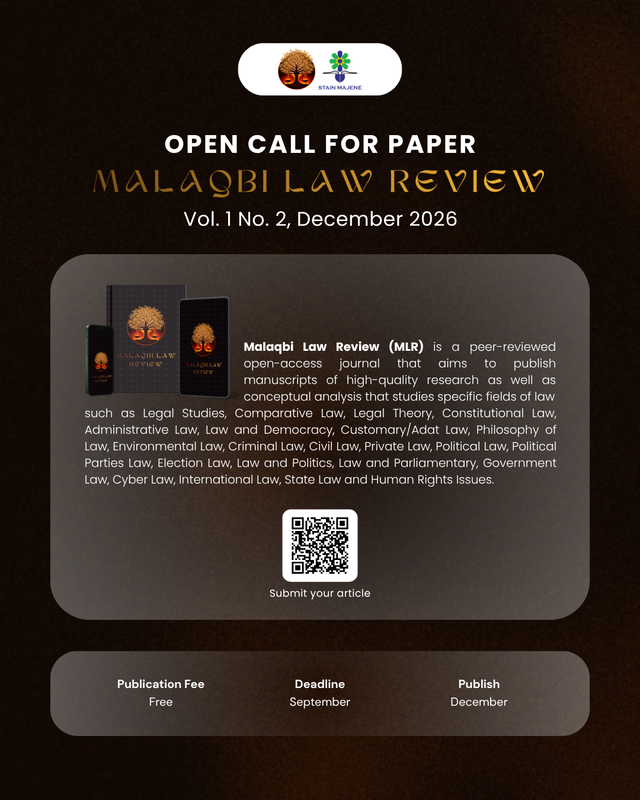
OPEN CALL FOR PAPER

Malaqbi Law Review (MLR) – Vol. 1 No. 2 (December 2026)

Malaqbi Law Review (MLR) invites academics, researchers, practitioners, and students to submit their best scholarly articles. MLR is a peer-reviewed, open-access journal dedicated to publishing high-quality research manuscripts and conceptual analyses that examine legal issues in depth.

Scope of Issues:
Legal Studies, Comparative Law, Legal Theory, Constitutional Law, Administrative Law, Law and Democracy, Customary Law, Philosophy of Law, Environmental Law, Criminal Law, Civil Law, Private Law, Political Law, Political Party Law, Election Law, Law and Politics, Law and Parliament, Government Law, Cyber ​​Law, International Law, State Law, and Human Rights issues.

Important information::

  • Publication Fee: Free

  • Deadline Submit: September

  • Target Publication Date: December 2026

We look forward to your best contributions to enriching the discourse and development of legal science.


New Submission, Registration, and Template Compliance Policy

To uphold the integrity of academic publishing and prevent unethical practices such as ghost authorship, identity fraud, the involvement of paper mills, and the submission of manuscripts by unauthorized third parties, Malaqbi Law Review (MLR) implements policies governing manuscript submission, user registration, author identity verification, and compliance with the official journal manuscript template. These policies reflect MLR's commitment to academic integrity, publication ethics, transparency, and quality assurance in scholarly communication.

1. Submission and Registration Policy

Malaqbi Law Review (MLR) requires all authors to submit their manuscripts through the journal's official Open Journal Systems (OJS) platform. Authors must ensure that their registration details and manuscript information are accurate, complete, and consistent.

Each author is required to provide their full name (without academic titles), institutional affiliation, complete institutional address, and an active email address for editorial correspondence. Authors are strongly encouraged to use official institutional email addresses issued by universities, government agencies, research institutions, or other formally recognized organizations whenever available.

Authors who do not have institutional email addresses may use active personal email accounts, provided that their identity and institutional or independent researcher status can be appropriately verified. The use of personal email addresses does not automatically constitute grounds for rejection.

The Editorial Board reserves the right to conduct periodic reviews of registered OJS accounts and request additional information or verification documents whenever inconsistencies or concerns regarding author identity and affiliation arise. Authors are responsible for maintaining accurate and updated OJS profiles to ensure smooth editorial communication and processing. Failure to provide the necessary clarification or verification may affect the processing of manuscript submissions.

2. Mandatory Compliance with the Official Malaqbi Law Review (MLR) Manuscript Template

All manuscripts submitted to Malaqbi Law Review (MLR) must strictly comply with the official journal manuscript template and author guidelines. The template serves as a standardized reference for manuscript preparation, covering article structure, formatting, writing conventions, and overall presentation in accordance with the journal's editorial requirements.

Authors are required to carefully follow the prescribed template and writing guidelines before submitting their manuscripts. Compliance with these requirements is essential to maintain consistency, readability, and editorial efficiency throughout the publication process.

Manuscripts that do not comply with the prescribed template, formatting requirements, or writing guidelines may be returned to the authors for technical revision before proceeding to the editorial evaluation and peer-review process. Substantial or unresolved technical non-compliance may prevent a manuscript from advancing to the subsequent stages of evaluation.

The official Malaqbi Law Review (MLR) manuscript template can be accessed through the following link:

Official Malaqbi Law Review (MLR) Manuscript Template

3. Purpose and Ethical Rationale of the Policy

The implementation of these policies reflects Malaqbi Law Review's commitment to maintaining high standards of academic integrity, publication ethics, and editorial accountability. Specifically, these policies aim to:

  • Verify Author Identity and Institutional Affiliation

    Ensure that all authors provide accurate and verifiable identity information and institutional affiliations, thereby strengthening the credibility, transparency, and accountability of published scholarly works.

  • Prevent Unethical Publication Practices

    Deter and prevent unethical practices, including ghost authorship, identity fraud, paper mill activities, plagiarism, and unauthorized third-party manuscript submissions that may undermine the integrity of academic publishing.

  • Maintain Academic and Professional Standards

    Promote consistency in manuscript preparation, ensure compliance with established writing guidelines, and uphold transparent and professional communication among authors, reviewers, and the Editorial Board.

  • Strengthen Journal Governance and Quality Assurance

    Support the long-term reputation, credibility, and scholarly development of Malaqbi Law Review by implementing transparent editorial procedures, responsible authorship practices, and rigorous manuscript evaluation in accordance with recognized standards of academic publishing.

4. Note to Independent Researchers

Malaqbi Law Review recognizes that valuable scholarly contributions may also originate from independent researchers who are not formally affiliated with universities or research institutions.

Independent researchers who do not possess institutional email addresses are encouraged to contact the Editorial Office through a formal inquiry before completing registration or submitting their manuscripts. They should provide their full name, current professional or research status, active email address, and any relevant information required for identity verification.

Requests for verification arrangements will be considered on a case-by-case basis, subject to appropriate identity verification procedures determined by the Editorial Board. Independent researchers are expected to provide accurate information regarding their professional status and must not claim institutional affiliations that they do not hold.

For further information or assistance regarding registration and manuscript submission, authors may contact the Malaqbi Law Review Editorial Office at:

Email: malaqbilawreview@stainmajene.ac.id

Journal Website: https://jurnal.stainmajene.ac.id/index.php/malaju