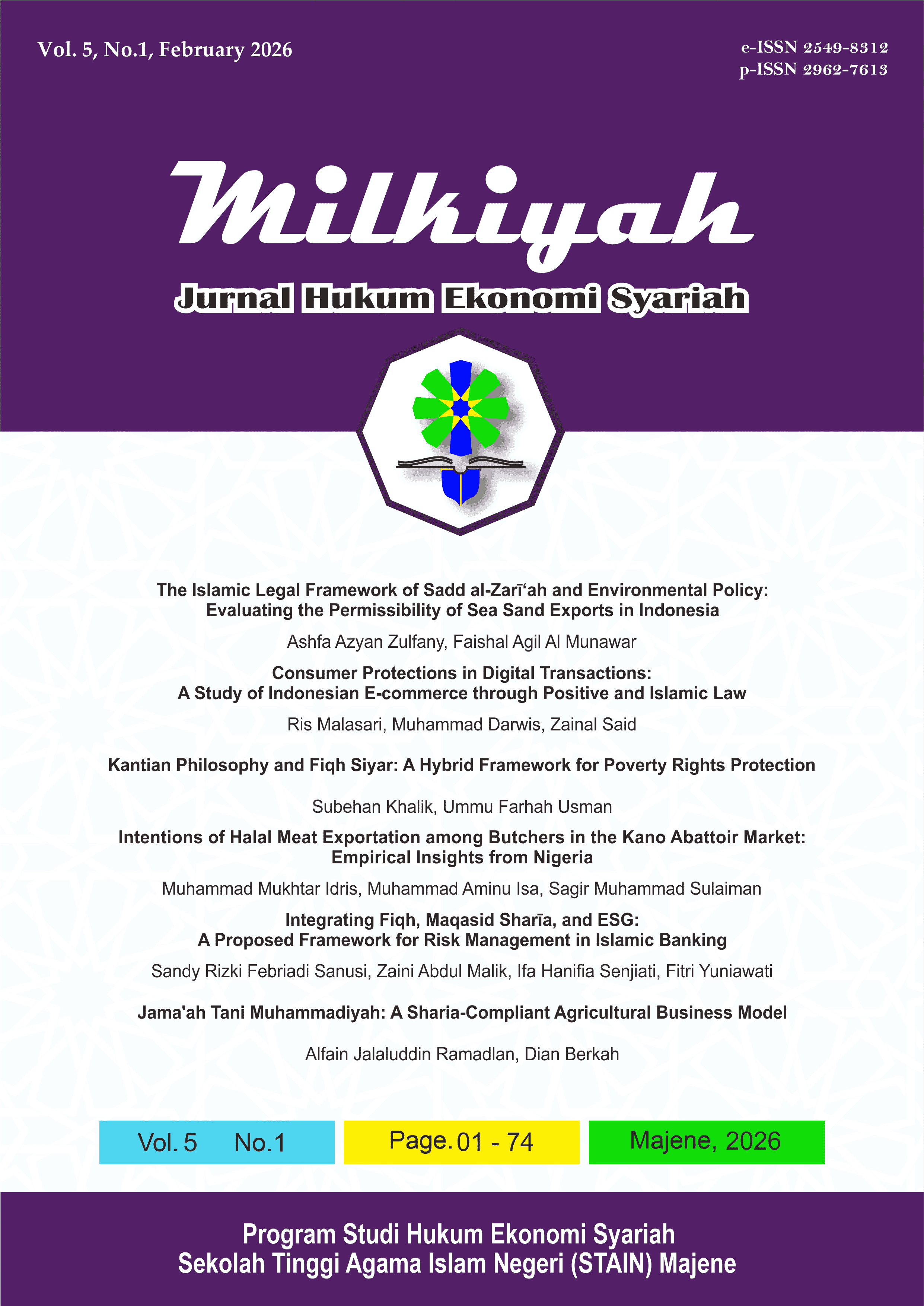
Integrating Fiqh, Maqasid Sharīa, and ESG: A Proposed Framework for Risk Management in Islamic Banking
DOI:
https://doi.org/10.46870/milkiyah.v5i1.1783Keywords:
ESG, Fiqh, Maqāṣid Sharīʿa, Risk ManagementAbstract
Islamic banks are undergoing rapid digital transformation, yet this shift brings new vulnerabilities and increases exposure to climate‑related risks. These challenges indicate that digitalisation is not merely a technological upgrade but a strategic evolution requiring Islamic banks to embed sustainability and resilience at the core of their governance systems. This study aims to explain the integration of Fiqh principles and Maqāṣid Sharīa in Islamic bank risk management and explore the relevance of ESG to risk management. It also seeks to develop an ESG framework aligned with Fiqh and Maqāṣid Sharīa. Using a qualitative descriptive case study approach, this research examines Bank Syariah Indonesia (BSI) as the primary unit of analysis. Data were collected through triangulation (semi‑structured interviews with Sharia authorities and practitioners), document analysis of BSI’s 2023–2024 Sustainability Reports, relevant regulations, and direct observation of ESG implementation. The findings reveal that Fiqh provides the legal foundation for risk governance, while Maqāṣid Sharīa functions as an ethical and teleological compass guiding decision‑making toward public welfare. ESG, in turn, offers operational tools that transform Sharia values into measurable sustainability practices. Evidence from BSI’s initiatives in sustainable financing and digital financial inclusion demonstrates that ESG can operate as a vital instrument for risk mitigation while simultaneously generating positive socio‑environmental impact. Key implications include the need for regulators to develop ESG reporting standards that are integrated with Islamic law, the importance of capacity building for Sharia Supervisory Boards and risk management teams, and the necessity of industry‑wide commitment to sustainability as a driver of long‑term competitiveness and institutional resilience.
References
Agustin, F., Muhtadi, R., & Sahal, S. (2023). The Importance of Implementing Environment, Social and Government (ESG) and Maqasid Sharia-Based Islamic Finance in Islamic Bank. Journal of Islamic Economic Laws, 6(2), 133–158. https://doi.org/10.23917/jisel.v6i2.21214
Alhammadi, S. (2026). Islamic finance as a driver for enhancing economic sustainability and innovation in the GCC. Journal of Science and Technology Policy Management, 17(1), 25-46. https://doi.org/10.1108/JSTPM-11-2023-0206
Al Hawaj, A. Y., & Buallay, A. M. (2022). A worldwide sectorial analysis of sustainability reporting and its impact on firm performance. Journal of Sustainable Finance & Investment, 12(1), 62–86. https://doi.org/10.1080/20430795.2021.1903792
Ammar, R., Rebai, S., & Saidane, D. (2023). Toward the development of an Islamic banking sustainability performance index. International Journal of Islamic and Middle Eastern Finance and Management, 16(4), 734-755. https://doi.org/10.1108/IMEFM-12-2021-0479
Annamalah, S. (2024). The value of case study research in practice: A methodological review with practical insights from organisational studies. Journal of Applied Economic Sciences (JAES), 19(4 (86)), 485-498. https://www.ceeol.com/search/article-detail?id=1295895
Antonio, M. S., Sanrego, Y. D., & Taufiq, M. (2014). An Analysis of Islamic Banking Performance: Maqashid Index Implementation in Indonesia and Jordania. Journal of Islamic Finance, 1(1). https://doi.org/10.31436/jif.v1i1.2
Arsyad, I., Kharisma, D. B., & Wiwoho, J. (2025). Artificial intelligence and Islamic finance industry: problems and oversight. International Journal of Law and Management, Vol. ahead-of-print No. ahead-of-print. https://doi.org/10.1108/IJLMA-07-2024-0236
AUDA, J. (2008). Maqasid Al-Shariah as Philosophy of Islamic Law: A Systems Approach. International Institute of Islamic Thought. https://doi.org/10.2307/j.ctvkc67tg
Buallay, A.M, Al Marri, M., Nasrallah, N., Hamdan, A., Barone, E., & Zureigat, Q. (2023). Sustainability reporting in banking and financial services sector: a regional analysis. Journal of Sustainable Finance & Investment, 13(1), 776-801. https://doi.org/10.1080/20430795.2021.1978919
Chapra, M. U. (2008). The Islamic vision of development in the light of maqasid al-shariah. Islamic Research and Training Institute.
CIBAFI. (2022). Sustainability guide for Islamic financial institutions (IFIs). (Guidance Report No. 2). Retrieved from https://gifiip.org/wp-content/uploads/2022/06/CIBAFI-Sustainability-Guide-EN.pdf.
Dusuki, A. W., & Bouheraoua, S. (2011). The framework of maqasid al-shariah and its implication for Islamic finance. ICR Journal, 2:316-36. https://doi.org/10.52282/icr.v2i2.651
Fauzan, M., Asmuni, & Anggraini, T. (2024). Green banking dalam Islam: Konsep Alquran tentang investasi yang bertanggung jawab. Jurnal Masharif al-Syariah: Jurnal Ekonomi dan Perbankan Syariah, 9(1). https://journal.um-surabaya.ac.id/Mas/article/view/21402
Foglie, A.D, Panetta, I. C., Boukrami, E., & Vento, G. (2025). The impact of the Blockchain technology on the global Sukuk industry: smart contracts and asset tokenisation. Technology Analysis & Strategic Management, 37(4), 417–431. https://doi.org/10.1080/09537325.2021.1939000
Ghazali, N. M., Sawari, M. F. M., Alhabshi, S. M. S. J., & Ghalia, B. (2024). Fiqh maxim of "al-ghurm bi al-ghunm": a critique on the interpretation of the maxim relating to risk-return concept in Islamic banking and finance. ISRA international journal of islamic finance, 16(2), 4-19. https://doi.org/10.55188/ijif.v16i2.412
Hadi, A., Yunani, A., Swandari, F., Hayat, A., & Maharani, D. (2025). Integrating ESG into Islamic investment: A scoping review of challenges and opportunities. Asian Journal of Management, Entrepreneurship and Social Science, 5(02), 879-905. https://doi.org/10.63922/ajmesc.v5i02.1345
Hassan, R., Othman, A. A., Omar, M. N., Napiah, M. D. M., Abdullah, M. A., Arifin, M., & Karim, M. S. A. (2017). Shariah risk management process for Islamic financial institutions in the context of shariah governance framework 2010. UUM Journal of Legal Studies, 8, 1-15. https://e-journal.uum.edu.my/index.php/uumjls/article/view/uumjls.8.2017.4642
Heravi, F. A., & Sharofiddin, A. (2025). Assessment of Sharia-Compliant Risk Management Framework for Sukuk. Journal of Islamic Finance, 14(1), 98-111. https://journals.iium.edu.my/iiibf-journal/index.php/jif/article/view/899
Kim U.Y. (2025). The Role of Islamic Finance in Advancing the United Nations SDGs: Case Studies and Critical Gaps in the Banking Sector in ASEAN Countries. Intergovernmental Research and Policy Journal. https://irpj.euclid.int/articles/the-role-of-islamic-finance-in-advancing-the-united-nations-sustainable-development-goals-sdgs-case-studies-and-critical-gaps-in-the-banking-sector-in-asean-countries/
Kuzmina, J., Maditinos, D., Norena-Chavez, D., Grima, S., & Kadłubek, M. (2023). ESG integration as a risk management tool within the financial decision-making process. https://doi.org/10.1108/S1569-37592023000111A007
Kuzmina, J., Maditinos, D., Norena-Chavez, D., Grima, S., & Kadłubek, M. (2023). ESG integration as a risk management tool within the financial decision-making process. In Digital Transformation, Strategic Resilience, Cyber Security and Risk Management. https://doi.org/10.1108/S1569-37592023000111A007
Mergaliyev, A., Asutay, M., Avdukic, A. & Karbhari, Y. (2021). Higher Ethical Objective (Maqasid al-Shari’ah) Augmented Framework for Islamic Banks: Assessing Ethical Performance and Exploring Its Determinants. Journal of Business Ethics, 170, 797–834. https://doi.org/10.1007/s10551-019-04331-4
Mohammed, M.O. & Md Taib, F. (2025). Developing Islamic Banking Performance Measures Based on Maqasid al-Shari’ah Framework: Cases of 24 Selected Banks. Journal of Islamic Monetary Economics and Finance, 1, 1, 55–78. https://doi.org/10.21098/jimf.v1i1.483
Muslim, A. M., Fatwa, N., Rini, N., & Sobari, N. (2025). Integration of maqashid sharia in the implementation of risk management in Islamic banking. Formosa Journal of Sustainable Research, 4(1), 112–130. https://doi.org/10.55927/fjsr.v4i5.220
Paltrinieri, A., Dreassi, A., Migliavacca, M., & Piserà, S. (2020). Islamic finance development and banking ESG scores: Evidence from a cross-country analysis. Research in International Business and Finance, 51, 101–122. https://doi.org/10.1016/j.ribaf.2019.101100
Purwanto, H. (2024). Integrasi prinsip ESG (Environmental, Social, Governance) dalam perbankan syariah. Studia Economica: Jurnal Ekonomi Islam, 10(2), 240–250. https://doi.org/10.30821/se.v10i2.21738
Qudah, H., Malahim, S., Airout, R., Alomari, M., Hamour, A. A., & Alqudah, M. (2023). Islamic finance in the era of financial technology: a bibliometric review of future trends. International Journal of Financial Studies, 11(2), 76. https://doi.org/10.3390/ijfs11020076
Rabbani, M. R. (2022). Fintech innovations, scope, challenges, and implications in Islamic Finance: A systematic analysis. International Journal of Computing and Digital Systems, 11(1), 1-28. https://www.researchgate.net/publication/359040780
Ramli, N. A., Nor, F. M., Aziz, M. R., Shahwan, S., Marzuki, A., Basah, M. Y. A., & Sabri, H. (2024). Application of Maqasid al-Shariah in responsible investment (MSRI) and practices towards ESG. Journal of Infrastructure, Policy and Development, 8(16), 5864. https://doi.org/10.24294/jipd5864
Sairally, B. S. (2015). Integrating Environmental, Social and Governance (ESG) Factors in Islamic Finance: Towards the Realisation of Maqāṣid al-Sharīʿah. ISRA International Journal of Islamic Finance, 7(2), 145–154. Retrieved from https://journal.inceif.edu.my/index.php/ijif/article/view/210
Sheikh, R. (2025). Developing ethical investment criteria based on Maqasid Shariah. Qualitative Research in Financial Markets. Vol. ahead-of-print No. ahead-of-print. https://doi.org/10.1108/QRFM-04-2025-0103
Sheikh, R., Ayaz, M., & Siddique, M. A. (2023). Sharī ‘ah governance and Sharī ‘ah non-compliance risk management: a Maqāsid Sharī ‘ah based appraisal. Journal of Islamic Thought and Civilization, 13(1), 270-291. https://doi.org/10.32350/jitc.131.19
Susanti, Yumarni, A., & Rumatiga, H. (2024). Penerapan prinsip larangan “Magrib: Maysir, Gharar, dan Riba” dalam pembiayaan yang bergerak di bidang usaha non halal. Karimah Tauhid, 3(4), 4310–4330. https://doi.org/10.30997/karimahtauhid.v3i4.12841
Widyaningsih, B., Ashlihah, & Ibnu Afan, T. (2024). Peran manajemen risiko dalam meningkatkan ketahanan bank syariah di era digital. Jurnal Masharif al-Syariah: Jurnal Ekonomi dan Perbankan Syariah, 9(3), 1459–1470. https://doi.org/10.30651/jms.v9i3.22933
Yadiati, W., Fitrijanti, T., & Sueb, M. (2022). The relationship between risk-taking and Maqasid Shariah-based performance in Islamic banks: does Shariah governance matter?. Banks and Bank Systems, 17(1), 137. https://doi.org/10.21511/bbs.17(1).2022.12
Zain, F. A.M., Muhamad, S. F., Abdullah, H., Sheikh Ahmad Tajuddin, S. A. F., & Wan Abdullah, W. A. (2024). Integrating environmental, social and governance (ESG) principles with Maqasid al-Shariah: a blueprint for sustainable takaful operations. International Journal of Islamic and Middle Eastern Finance and Management, 17(3), 461-484. https://doi.org/10.1108/IMEFM-11-2023-0422
Downloads
Published
How to Cite
Issue
Section
License
Copyright (c) 2026 Sandy Rizki Febriadi Sanusi, Zaini Abdul Malik, Ifa Hanifia Senjiati, Fitri Yuniawati

This work is licensed under a Creative Commons Attribution-ShareAlike 4.0 International License.












 e-ISSN 2549-8312 p-ISSN 2962-7613