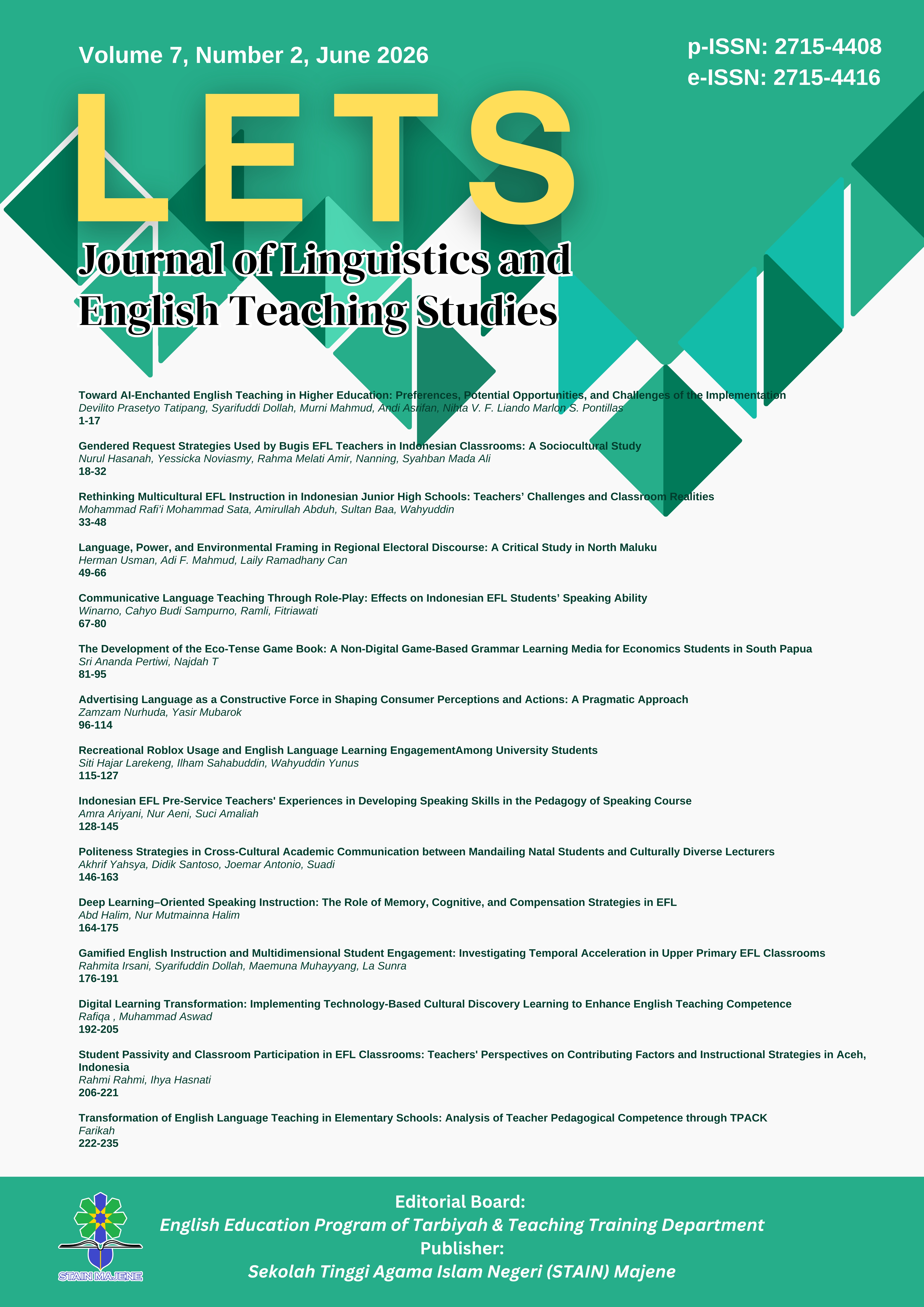
Politeness Strategies in Cross-Cultural Academic Communication between Mandailing Natal Students and Culturally Diverse Lecturers
DOI:
https://doi.org/10.46870/lets.v7i2.2193Keywords:
Academic Communication, Lecturer–student Interaction, Politeness Strategies, Pragmatics, SociopragmaticsAbstract
Although politeness in academic communication has been widely discussed in pragmatic studies, limited research has examined how students from local cultural backgrounds employ politeness strategies when interacting with lecturers from different cultural backgrounds in Indonesian higher education settings. This gap is important to address because differences in cultural norms and communication styles may lead to misunderstandings and affect the effectiveness of lecturer–student interaction. This study aims to investigate the politeness strategies used by Mandailing Natal students when interacting with lecturers from different cultural backgrounds at STAIN Mandailing Natal. This study employed a qualitative pragmatic research design with a sociopragmatic approach. The participants consisted of 15 Mandailing Natal students and 6 lecturers from non-Mandailing cultural backgrounds. The data were collected through classroom observations, audio-recorded lecturer–student interactions, academic consultation recordings, semi-structured interviews, and field notes. The data were analyzed using pragmatic discourse analysis based on Brown and Levinson’s politeness theory. The findings reveal that students predominantly employed negative politeness strategies, including indirect expressions, hedging, apologetic forms, and softened statements to show respect and minimize imposition toward lecturers. Students frequently avoided direct disagreement and tended to communicate cautiously due to cultural values emphasizing respect for authority and social harmony. In contrast, lecturers generally used more direct communication styles when giving feedback, instructions, and asking questions. These differences in communication styles sometimes created misunderstandings during classroom discussions and thesis supervision sessions. Students often hesitated to ask for clarification, while lecturers sometimes interpreted students’ silence as passiveness or lack of preparation. The study concludes that politeness strategies in lecturer–student interaction are strongly influenced by cultural values, social hierarchy, and academic roles. The findings highlight the importance of pragmatic and intercultural awareness in higher education communication in order to reduce misunderstandings and support more effective academic interaction.
References
Anugrawati, N., & Syam, U. K. (2024). Politeness Strategies in Selected Academic Settings: Insights from Lecturer-Student Interactions in Eastern Indonesia. REiLA : Journal of Research and Innovation in Language, 6(3), 291–304. https://doi.org/10.31849/reila.v6i3.20409
Basuki, R. (2015). Kesantunan Berbahasa Dalam Wacana Interaksi Komunikasi di Lingkungan Universitas Bengkulu. BAHTERA : Jurnal Pendidikan Bahasa Dan Sastra, 14(1), 16–25. https://doi.org/10.21009/BAHTERA.141.02
Brown, P., & Levinson, S. C. (1987). Politeness Some Universals in Language Usage Studies in Interactional Sociolinguistics 4. Cambridge University Press.
Creswell, J. W. . (2017). Research Design : Qualitative, Quantitative, and Mixed Methods Approaches. SAGE.
Dörnyei, Z. (2007). Research Methods in Applied Linguistics : Quantitative, Qualitative, and Mixed Methodologies. Oxford University Press.
Eelen, G. (2001). A Critique of Politeness Theories. St. Jerome Publishing.
Fairclough, Norman. (1989). Language and power. Longman.
Gass, S. M., Gass, S. M., Mackey, A., & Mackey, A. (2013). Stimulated Recall Methodology in Second Language Research. Routledge. https://doi.org/10.4324/9781410606006
Goffman, Erving. (1967). Interaction ritual; essays on face-to-face behavior. Doubleday.
Gusnawaty, G., & Nurwati, A. (2019). A Learning Model of Bahasa Indonesia as a Foreign Language Based on Local Intercultural Politeness. Jurnal Cakrawala Pendidikan, 141–155. https://doi.org/10.21831/cp.v38i1.23164
Haugh, M., & Chang, W.-L. M. (2015). Understanding im/politeness across cultures: an interactional approach to raising sociopragmatic awareness. International Review of Applied Linguistics in Language Teaching, 53(4). https://doi.org/10.1515/iral-2015-0018
Hofstede, G. (2011). Dimensionalizing Cultures: The Hofstede Model in Context. Online Readings in Psychology and Culture, 2(1). https://doi.org/10.9707/2307-0919.1014
Hutchby, Ian., & Wooffitt, Robin. (2008). Conversation analysis. Polity.
Hyland, K. (2004). Disciplinary Discourses: Social Interactions in Academic Writing. University of Michigan Press.
Hyland, K. (2005). Stance And Engagement: A Model Of Interaction In Academic Discourse. Discourse Studies, 7(2), 173–192. https://doi.org/10.1177/1461445605050365
Jazeri, M., Soengkono Madayani, N., & IAIN Tulungagung, S. (2020). Kesantunan Positif Dan Negatif Dosen Dalam Interaksi Perkuliahan di IAIN Tulungagung. Jurnal Bahasa Lingua Scientia, 12(1). https://doi.org/10.21274/ls.2020.12.1.147-166
Kádár, D. Z., & Haugh, M. (2013). Understanding Politeness. Cambridge University Press. https://doi.org/DOI: 10.1017/CBO9781139382717
Kasper, G., & Dahl, M. (1991). Research Methods in Interlanguage Pragmatics. Studies in Second Language Acquisition, 13(2), 215–247. https://doi.org/10.1017/S0272263100009955
Kramsch, C. J. . (2019). Language and Culture. Oxford University Press.
Leech, G. N. . (2014). The Pragmatics of Politeness. Oxford University Press.
Locher, M. A. (2018). Politeness. In The Encyclopedia of Applied Linguistics (pp. 1–7). Wiley. https://doi.org/10.1002/9781405198431.wbeal0916.pub2
Locher, M. A., & Watts, R. J. (2005). Politeness Theory and Relational Work 1. Journal of Politeness Research 1, 1.
Marlina. (2022). Interpersonal Communication of Lecturers in Shaping the Student’s Character of STAIN Mandailing Natal.
Pasaribu, A. N., Saragih, E., & Gea, A. (2021). Politeness in Thesis Consultation by WhatsApp: Do Lecturers and Students Apply Different Strategies? Elsya : Journal of English Language Studies, 4(1). https://doi.org/10.31849/elsya.v4i1.6376
Patton, M. Quinn. (2002). Qualitative research and evaluation methods. Sage Publications.
Silverman. D. (2011). Interpreting Qualitative Data: A Guide to the Principles of Qualitative Research. Sage.
Spencer-Oatey, H. (2008). Culturally speaking: Culture, communication and politeness theory (2nd ed.). Continuum.
Sudar, S., Sukarni, S., Setiyono, J., Widoyoko, S. E. P., & Irianto, S. (2025). Language politeness in EFL student-lecturer interactions through technology-assisted communication. Indonesian Journal of Applied Linguistics, 15(1), 171–182. https://doi.org/10.17509/ijal.v15i1.69949
Thomas, J. (1983). Cross-Cultural Pragmatic Failure. Applied Linguistics, 4(2), 91–112. https://doi.org/10.1093/applin/4.2.91
Walsh, S. (2011). Exploring Classroom Discourse. Routledge. https://doi.org/10.4324/9780203827826
Watts, R. J. . (2003). Politeness. Cambridge University Press.
Winiharti, M., & Mubarok, A. (2023). Banjarese College Students’ Positive Politeness toward Their Lecturers Through Online Chats. Lingua Cultura, 17(1), 59–66. https://doi.org/10.21512/lc.v17i1.9643
Witsel, M. (2003). Teaching And Learning Issues In The Multicultural Classroom. https://api.semanticscholar.org/CorpusID:31780032
Zulkarnain, I., Asmara, S., & Sutatminingsih, R. (2023). Tutur: language and traditional communication in the Mandailing community, Indonesia. Cogent Arts & Humanities, 10(1). https://doi.org/10.1080/23311983.2023.2211816
Downloads
Published
Issue
Section
License
Copyright (c) 2026 Akhrif Yahsya, Didik Santoso, Joemar Antonio, Suadi Suadi

This work is licensed under a Creative Commons Attribution-ShareAlike 4.0 International License.