
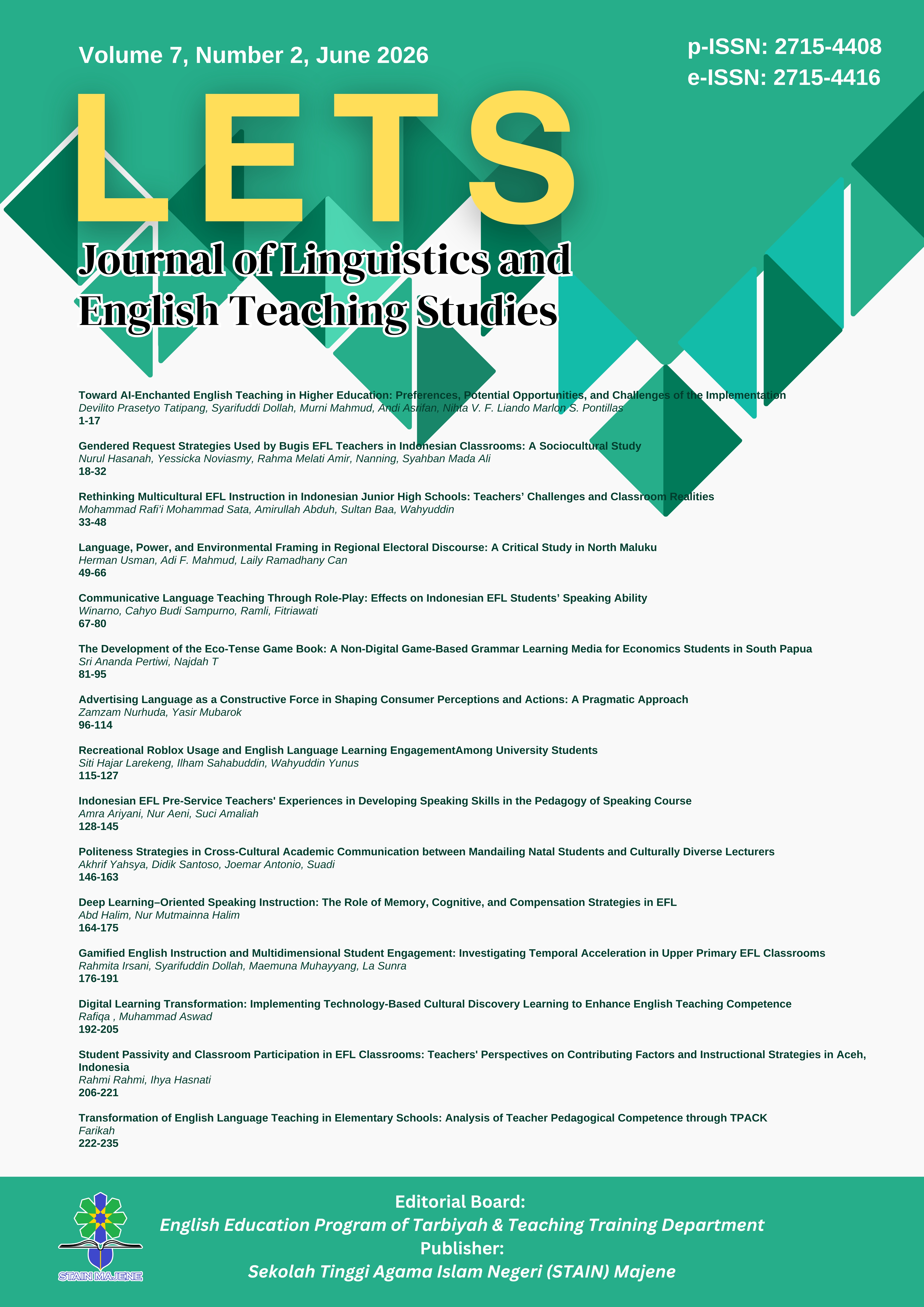
Student Passivity and Classroom Participation in EFL Classrooms: Teachers' Perspectives on Contributing Factors and Instructional Strategies in Aceh, Indonesia
DOI:
https://doi.org/10.46870/lets.v7i2.2192Keywords:
Classroom Participation, EFL Teachers, Instructional Strategies, Student Passivity, Teachers' PerspectivesAbstract
This study investigated teachers’ perceptions of the factors contributing to student passivity in English as a Foreign Language (EFL) classrooms and the strategies they employed to promote active classroom participation in Aceh, Indonesia. Adopting a qualitative descriptive design, data were collected through semi-structured interviews with five EFL teachers from two junior high schools in Southwest Aceh. The interview data were analyzed using the interactive model of data analysis proposed by Miles, Huberman, and Saldaña, involving data reduction, data display, and conclusion drawing. The findings revealed that teachers generally conceptualized student passivity as limited behavioral engagement characterized by silence, reluctance to respond, and low involvement in classroom activities. Teachers identified psychological, linguistic, motivational, and contextual factors as contributing to student passivity. To address this issue, teachers reported implementing collaborative group work, game-based learning activities, and technology-enhanced instruction. These findings demonstrate how teachers interpreted the causes of student passivity and responded through instructional practices aimed at increasing participation. This study contributes to the EFL literature by providing context-specific insights into student passivity in Aceh, an underexplored educational setting, and by demonstrating how teachers interpreted and responded to passive participation. The findings offer practical implications for EFL teachers, teacher educators, and policymakers seeking to foster more active classroom participation.
References
Abdullah, M. Y., Abu Bakar, N. R., & Mahbob, M. H. (2012). The dynamics of student participation in the classroom: Observation on level and forms of participation. Procedia-Social and Behavioral Sciences, 59, 61–70. https://doi.org/10.1016/j.sbspro.2012.09.246
Abedinpour, N. (2026). “Break the silence already”: A dynamic analysis approach on how “silence” shapes the communication in English as a foreign language classrooms. TESOL Quarterly, 60(1), 34–61. https://doi.org/10.1002/tesq.70016
Afzal, A., & Rafiq, S. (2022). Impact of teachers' instructional techniques on student involvement in class: A case study. UMT Education Review, 5(2), 184–204. https://doi.org/10.32350/uer.52.10
Alzahrani, M. A. (2018). The learning experience of international students in Canada: Progressive educational theory and passive learning styles. English Language Teaching, 11(7), 76–85. https://doi.org/10.5539/elt.v11n7p76
Ames, C. (1992). Classrooms: Goals, structures, and student motivation. Journal of Educational Psychology, 84(3), 261–271. https://doi.org/10.1037/0022-0663.84.3.261
Ardi, P., & Rianita, E. (2022). Leveraging gamification into EFL grammar class to boost student engagement. Teaching English with Technology, 22(2), 90–114.
Ariebowo, T., & Pustpitasari, E. (2022). Students' teacher-dependency and passiveness in online learning during COVID-19 pandemic. Journal of Education and Learning (EduLearn), 16(2), 235–243. https://doi.org/10.11591/edulearn.v16i2.20450
Arifin, W. L. (2017). Psychological problems and challenges in EFL speaking classroom. Register Journal, 10(1), 29–47. https://doi.org/10.18326/rgt.v10i1.29-47
Aripin, J., & Umam, A. (2019). Dealing with students’ reticence in speaking activity in EFL classroom. English Journal, 13(1), 1–8.
Baktash, F., & Chalak, A. (2015). An investigation on Iranian university students’ reluctance to participate in EFL classrooms. Journal of Scientific Research and Development, 2(6), 1–7.
Chang, F. (2011). The causes of learners’ reticence and passivity in English classrooms in Taiwan. Journal of Asia TEFL, 8(1).
Chen, B. B., Wiium, N., Dimitrova, R., & Chen, N. (2019). The relationships between family, school and community support and boundaries and student engagement among Chinese adolescents. Current Psychology, 38(3), 705–714. https://doi.org/10.1007/s12144-017-9646-0
Cheng, X. (2000). Asian students’ reticence revisited. System, 28(3), 435–446. https://doi.org/10.1016/S0346-251X(00)00015-4
Chung, J. H. J. (2021). “We participate, silently”: Explicating Thai university students’ perceptions of their classroom participation and communication. Qualitative Research in Education, 10(1), 62–87. https://doi.org/10.17583/qre.2021.7159
Dewan, M. S., & Sharma, B. D. (2025). Enhancing oral communication in English as a second language. Journal of Tikapur Multiple Campus, 8, 18–41.
Doyle, L., McCabe, C., Keogh, B., Brady, A., & McCann, M. (2020). An overview of the qualitative descriptive design within nursing research. Journal of Research in Nursing, 25(5), 443–455. https://doi.org/10.1177/1744987119880234
Louise Doyle, Catherine McCabe, Brian Keogh, Annemarie Brady, & Margaret McCann (2020). An overview of the qualitative descriptive design within nursing research. Journal of Research in Nursing, 25(5), 443–455. https://doi.org/10.1177/1744987119880234
Gil, A. J., Antelm-Lanzat, A. M., Cacheiro-González, M. L., & Pérez-Navío, E. (2021). The effect of family support on student engagement: Toward the prevention of dropouts. Psychology in the Schools, 58(6), 1082–1095. https://doi.org/10.1002/pits.22490
Gilakjani, A. P. (2012). The significant role of multimedia in motivating EFL learners' interest in English language learning. International Journal of Modern Education and Computer Science, 4(4), 57. https://doi.org/10.5815/ijmecs.2012.04.08
Harjunen, E. (2012). Patterns of control over the teaching–studying–learning process and classrooms as complex dynamic environments: A theoretical framework. European Journal of Teacher Education, 35(2), 139–161. https://doi.org/10.1080/02619768.2011.643465
King, J. (2013). Silence in the second language classroom. Palgrave Macmillan UK.
Kumaravadivelu, B. (2003). Problematizing cultural stereotypes in TESOL. TESOL Quarterly, 37(4), 709–719. https://doi.org/10.2307/3588219
Laksanasut, S. (2025). Gamification in ESL/EFL education: Transforming language learning and teaching through play. TESOL and Technology Studies, 6(1), 16–29. https://doi.org/10.48185/tts.v6i1.1562
Listianingsih, M. (2025). Teacher strategies in managing passive learners in learning English as a foreign language: An Indonesian case study in junior high school (Unpublished thesis).
Liu, J. (2001). Asian students’ classroom communication patterns in U.S. universities: An emic perspective. Greenwood Publishing Group.
Mariappan, L. (2023). Empowering passive learners: Enhancing the teaching and learning process with scenario-based learning. The English Teacher, 52(2). https://doi.org/10.52696/ICLL3481
McDonough, K. (2004). Learner-learner interaction during pair and small group activities in a Thai EFL context. System, 32(2), 207–224. https://doi.org/10.1016/j.system.2004.01.003
Meece, J. L., Anderman, E. M., & Anderman, L. H. (2006). Classroom goal structure, student motivation, and academic achievement. Annual Review of Psychology, 57(1), 487–503. https://doi.org/10.1146/annurev.psych.56.091103.070258
Mercer, N., & Dawes, L. (2008). The value of exploratory talk. In N. Mercer & S. Hodgkinson (Eds.), Exploring talk in schools (pp. 55–72). Sage.
Miles, M. B., Huberman, A. M., & Saldaña, J. (2014). Qualitative data analysis: A methods sourcebook (3rd ed.). SAGE Publications.
Mukundan, J., Hajimohammadi, R., & Nimehchisalem, V. (2011). Developing an English language textbook evaluation checklist. Contemporary Issues in Education Research, 4(6), 21–28.
Muzari, T., Shava, G. N., & Shonhiwa, S. (2022). Qualitative research paradigm: A key research design for educational researchers, processes and procedures: A theoretical overview. Indiana Journal of Humanities and Social Sciences, 3(1), 14–20.
Ngoc, T. T. N. (2017). Understanding first year university students’ passivity via their attitudes and language behaviors towards answering questions in class. Ho Chi Minh City Open University Journal of Science – Social Sciences, 84–93.
Nisa, N. K. (2025). Exploring effective teaching strategies to encourage participation of passive learners in English classes in rural schools (Undergraduate thesis, Universitas Islam Negeri Maulana Malik Ibrahim).
Nunan, D. (1988). The learner-centred curriculum. Cambridge University Press.
Nurrohmah, Z. Q. A., & Waluyo, A. A. (2021). The correlation between silence phenomenon and EFL student online class. English Learning Innovation, 2(2), 62–74. https://doi.org/10.22219/englie.v2i2.17736
Obilor, E. I. (2023). Convenience and purposive sampling techniques: Are they the same? International Journal of Innovative Social & Science Education Research, 11(1), 1–7.
Rahmi, R. (2024). Students’ silence in EFL classroom: Contributing factors and identities. Journal of Linguistics and Language Teaching, 10(1), 149–170. https://doi.org/10.29300/ling.v10i1.4633
Rizki, A. B., Andania, R. A., & Kusumawati, E. (2025). The meanings of silence in Indonesian EFL classrooms. Acitya: Journal of Teaching and Education, 7(1), 179–191. https://doi.org/10.30650/ajte.v7i1.4289
Ruslin, R., Mashuri, S., Rasak, M. S. A., Alhabsyi, F., & Syam, H. (2022). Semi-structured interview: A methodological reflection on the development of a qualitative research instrument in educational studies. IOSR Journal of Research & Method in Education, 12(1), 22–29. https://doi.org/10.9790/7388-1201052229
Sari, F. M. (2018). EFL students’ dilemma: Factors determining their talk in the language learning process. Konferensi Linguistik Tahunan Atma Jaya, April, 0-5.
Shea, D. P. (2017). Compelled to speak: Addressing student reticence in a university EFL classroom. The Asian Journal of Applied Linguistics, 4(2), 173–184.
Sipahelut, G. M. (2023). EFL primary teachers' problems and strategies in dealing with passive students in an emergency remote teaching situation in Ambon, Indonesia (Unpublished thesis).
Smith, D. (2014). The case for “passive” learning – The “silent” community of online learners. European Journal of Open, Distance and E-Learning, 17(2). https://doi.org/10.2478/eurodl-2014-0021
Smith, D., & Smith, K. (2014). Case for “passive” learning–the “silent” community of online learners. European Journal of Open, Distance and E-Learning, 17(2), 86–99. https://doi.org/10.2478/eurodl-2014-0021
Styati, E. W., & Latief, M. A. (2018). Investigating dominant and passive students on pair work towards the students’ writing performance. 3L: Language, Linguistics, Literature, 24(3). https://doi.org/10.17576/3L-2018-2403-11
Swain, M. (1985). Communicative competence: Some roles of comprehensible input and comprehensible output in its development. In S. Gass & C. Madden (Eds.), Input in second language acquisition (pp. 235–253). Newbury House.
Swain, M. (2000). The output hypothesis and beyond: Mediating acquisition through collaborative dialogue. In J. Lantolf (Ed.), Sociocultural theory and second language learning (pp. 97–114). Oxford University Press.
Tong, J. (2010). Write some observations of students’ reticent and participatory behaviour in Hong Kong English classrooms. Electronic Journal of Foreign Language Teaching, 7(2), 239–254.
Triwibowo, F. D. (2023). Enhancing English proficiency: The impact of communicative language teaching on second language learners. Tomorrow’s Education Journal, 1(2), 1–10.
Wang, J., King, R. B., & Rao, N. (2019). The role of social-academic goals in Chinese students’ self-regulated learning. European Journal of Psychology of Education, 34(3), 579–600. https://doi.org/10.1007/s10212-018-0404-y
Wang, M. T., & Hofkens, T. L. (2020). Beyond classroom academics: A school-wide and multi-contextual perspective on student engagement in school. Adolescent Research Review, 5(4), 419–433. https://doi.org/10.1007/s40894-019-00115-z
Yahyazade, M., Moghaddam, M. M., & Attaran, A. (2014). Towards an interactive EFL class: Using active learning strategies. International Journal of Modern Education and Computer Science, 6(8), 8–14. https://doi.org/10.5815/ijmecs.2014.05.02
Zafarina, N. F. (2022). Silent learners’ voices: Exploring the silence behavior in Indonesian EFL classroom. Journal of English Language Teaching and Linguistics, 7(2), 349–363. https://doi.org/10.21462/jeltl.v7i2.846
Downloads
Published
Issue
Section
License
Copyright (c) 2026 Rahmi Rahmi, Ihya Hasnati

This work is licensed under a Creative Commons Attribution-ShareAlike 4.0 International License.