
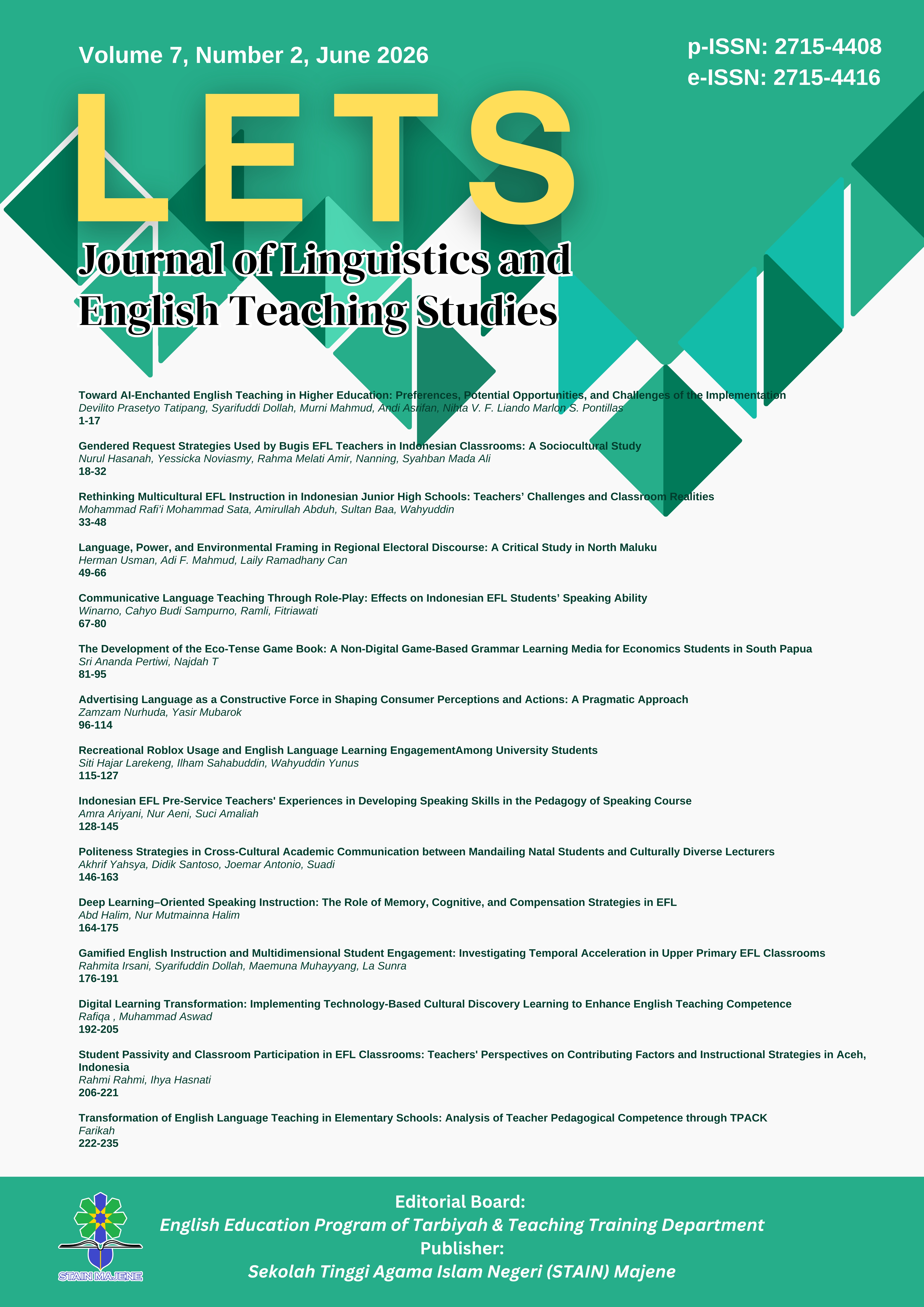
Gamified English Instruction and Multidimensional Student Engagement: Investigating Temporal Acceleration in Upper Primary EFL Classrooms
DOI:
https://doi.org/10.46870/lets.v7i2.2181Keywords:
Keywords: gamification, EFL, student engagement, flow, primary education, qualitative researcAbstract
Despite growing scholarly interest in gamification as a pedagogical strategy, existing research relies heavily on quantitative measures test score, participant rates, and survey instruments that reveal little about how students actually experience gamified environments. This study investigates how upper primary EFL students in an Islamic school setting in Indonesia experience gamified English instruction, and what dimensions of engagement emerge from that experience. Drawing on classroom observations, semi-structured interviews, and teacher-written reflective journals involving twelve students from grades 4 through 6 and two experienced English teachers, the study captures the texture of day-to-day engagement with Wordwall and Kahoot over a sustained instructional period. Utilizing Thematic analysis revealed four interrelated dimensions: a noticeable sharpening of behavioral participation and on-task effort; emotional transformation marked by enthusiasm and competitive anxiety; a strategic cognitive effort beyond surface level game playing; and recurring reports of temporal acceleration, interpreted as indicative of flow states. Reading these findings through the lens of self-determination theory and the multidimensional engagement framework, the study argues that gamification functions as a psychological activator rather than a mere motivational add-on. These findings suggest that when thoughtfully integrated, gamified instruction has the potential to deepen genuine learner engagement; however, future research must examine whether such engagement translates into durable linguistic gains.
References
Bai, S., Hew, K. F., & Huang, B. (2020). Does gamification improve student learning outcome? Evidence from a meta-analysis and synthesis of qualitative data in educational contexts. Educational Research Review, 30, 100322. https://doi.org/10.1016/j.edurev.2020.100322
Bernik, A., Bubas, G., & Radosevic, D. (2023). Use of gamification in primary and secondary education: A systematic literature review. International Journal of Educational Methodology, 9(1), 103–117.
Braun, V., & Clarke, V. (2006). Using thematic analysis in psychology. Qualitative Research in Psychology, 3(2), 77–101. https://doi.org/10.1191/1478088706qp063oa
Buckley, P., & Doyle, E. (2016). Gamification and student motivation. Interactive Learning Environments, 24(6), 1162–1175. https://doi.org/10.1080/10494820.2014.964263
Chen, C. M., & Law, V. (2024). The effects of digital game-based learning on flow experience and academic achievement: A meta-analysis. Computers & Education, 202, 104829.
Chen, C. M., Liu, H. C., & Huang, H. B. (2023). Effects of gamified mobile learning on EFL students’ motivation and engagement. Educational Technology & Society, 26(1), 45–60.
Copland, F., Garton, S., & Burns, A. (2013). Challenges in teaching English to young learners: Global perspectives and local realities. TESOL Quarterly, 48(4), 738–762. https://doi.org/10.1002/tesq.171
Creswell, J. W., & Poth, C. N. (2018). Qualitative inquiry and research design: Choosing among five approaches (4th ed.). Thousand Oaks, CA. Sage.
Csikszentmihalyi, M. (1990). Flow: The psychology of optimal experience. New York, NY. Harper & Row.
Deci, E. L., & Ryan, R. M. (2000). The “what” and “why” of goal pursuits: Human needs and the self-determination of behavior. Psychological Inquiry, 11(4), 227–268. https://doi.org/10.1207/S15327965PLI1104_01
Deterding, S., Dixon, D., Khaled, R., & Nacke, L. (2011). From game design elements to gamefulness: Defining gamification. In A. Lugmayr (Ed.), Proceedings of the 15th International Academic MindTrek Conference (pp. 9–15). New York, NY. ACM.
Dewaele, J. M., & MacIntyre, P. D. (2014). The two faces of Janus? Anxiety and enjoyment in the foreign language classroom. Studies in Second Language Learning and Teaching, 4(2), 237–274. https://doi.org/10.14746/ssllt.2014.4.2.5
Fredricks, J. A., Blumenfeld, P. C., & Paris, A. H. (2004). School engagement: Potential of the concept, state of the evidence. Review of Educational Research, 74(1), 59–109. https://doi.org/10.3102/00346543074001059
Hew, K. F., Bai, S., & Huang, W. (2023). Engaging students through gamified learning environments: A systematic review. Computers & Education, 188, 104567.
Huang, B., & Hew, K. F. (2021). Implementing gamification in higher education: Effects on motivation and flow. Educational Technology Research and Development, 69(1), 81–103.
Lincoln, Y. S., & Guba, E. G. (1985). Naturalistic inquiry. Beverly Hills, CA. Sage.
Pekrun, R., & Linnenbrink-Garcia, L. (2012). Academic emotions and student engagement. In S. L. Christenson, A. L. Reschly, & C. Wylie (Eds.), Handbook of research on student engagement (pp. 259–282). New York, NY. Springer.
Sailer, M., & Homner, L. (2020). The gamification of learning: A meta-analysis. Educational Psychology Review, 32(1), 77–112. https://doi.org/10.1007/s10648-019-09498-w
Xu, B., Chen, N. S., & Chen, Y. (2022). Effects of gamified flipped learning on EFL learners’ engagement. Computers & Education, 182, 104468. https://doi.org/10.1016/j.compedu.2022.104468
Yin, R. K. (2018). Case study research and applications: Design and methods (6th ed.). Thousand Oaks, CA. Sage.
Zainuddin, Z., Shujahat, M., Haruna, H., & Chu, S. K. W. (2020). The role of gamified e-quizzes on student learning and engagement: An interactive gamification solution for a formative assessment system. Computers & Education, 145, 103729. https://doi.org/10.1016/j.compedu.2019.103729
Zein, M. S. (2017). Elementary English education in Indonesia: Policy developments, current practices, and future prospects. English Today, 33(1), 10–16. https://doi.org/10.1017/S0266078416000407
Downloads
Published
Issue
Section
License
Copyright (c) 2026 Rahmita Irsani, Syarifuddin Dollah, Maemuna Muhayyang, La Sunra

This work is licensed under a Creative Commons Attribution-ShareAlike 4.0 International License.