
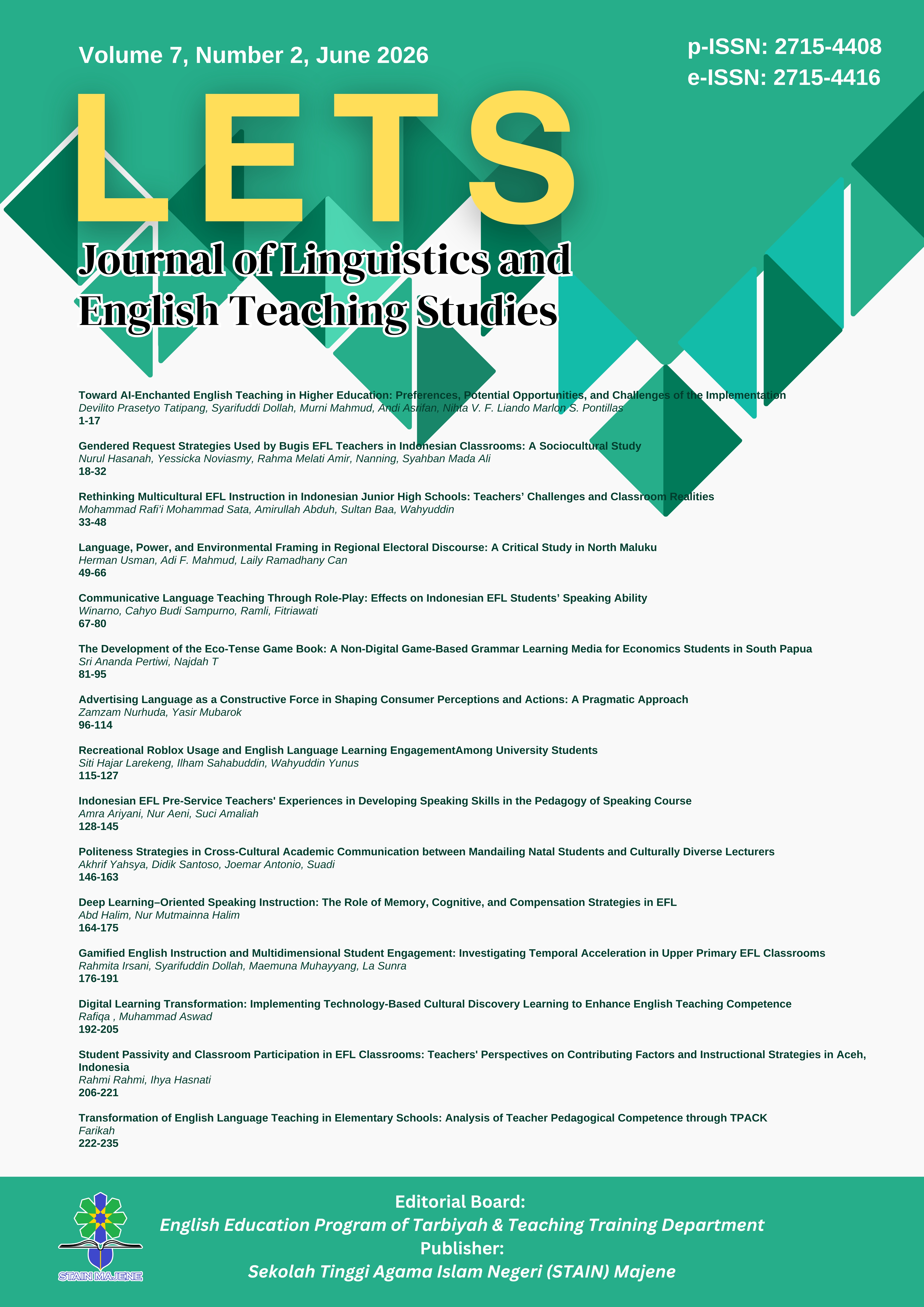
Toward AI-Enchanted English Teaching in Higher Education: Preferences, Potential Opportunities, and Challenges of the Implementation
DOI:
https://doi.org/10.46870/lets.v7i2.2152Keywords:
Higher Education, ELT and Technology, AI, AI-Infused ELTAbstract
This study explores the preferences, potential opportunities, and challenges associated with the implementation of AI in English language instruction in higher education. Mix method was adopted in this study, by using a questionnaire and semi-structure interview to collect data. 15 English lecturers with approximately 5-10 years of teaching experiences involved in the sample, and 5 of them were interviewed. The result shows that preferences in AI-Implemented English teaching within higher education are multifaceted. Lecturers often prefer AI systems that seamlessly augment their teaching methodologies rather than replace them. Additionally, preferences also extend to the number of AI tools, such as ChatGPT, ELSA Speak, smalltool.ai, paraphrase.io, and language generation systems, etc., being prominent choices. Furthermore, AI transforms English language teaching by personalizing student learning, providing modern teaching and learning tools, delivering timely and objective performance feedback, accelerating core literacy skills, creating immersive virtual reality simulations, and enhancing language acquisition. However, these potential opportunities must be balanced against challenges like cost, data security, and the potential dehumanization of education. As AI continues to evolve, a thoughtful and adaptable approach to its implementation is paramount to harness its full potential while preserving the integrity of higher education.
References
Auliawan, A. G., & Ong, S. (2020). The Usage of AI Robot in English Language Teaching for City Revitalization Case Study: Toda Daini Elementary School, Toda City, Saitama, Japan. IOP Conference Series: Earth and Environmental Science, 436(1), 012022. https://doi.org/10.1088/1755-1315/436/1/012022
Chiu, T. K. F., Moorhouse, B. L., Chai, C. S., & Ismailov, M. (2023). Teacher support and student motivation to learn with Artificial Intelligence (AI) based chatbot. Interactive Learning Environments. https://doi.org/10.1080/10494820.2023.2172044
Faddouli, E. ;, Harouni, N.-E. ;, Lu, M. H. A. ;, Titrek, O., Biasutti, M., Hamal, O., Faddouli, N.-E. El, Hachem, M., Harouni, A., & Lu, J. (2022). Artificial Intelligent in Education. Sustainability, 14(5), 2862. https://doi.org/10.3390/SU14052862
Fernández-Martínez, C., Hernán-Losada, I., & Fernández, A. (2021). Early Introduction of AI in Spanish Middle Schools. A Motivational Study. KI - Kunstliche Intelligenz, 35(2), 163–170. https://doi.org/10.1007/S13218-021-00735-5/TABLES/3
Fitria, T. N. (2021). Grammarly as AI-powered English Writing Assistant: Students’ Alternative for Writing English. Metathesis: Journal of English Language, Literature, and Teaching, 5(1), 65. https://doi.org/10.31002/METATHESIS.V5I1.3519
Kashive, N., Powale, L., & Kashive, K. (2021). Understanding user perception toward artificial intelligence (AI) enabled e-learning. International Journal of Information and Learning Technology, 38(1), 1–19. https://doi.org/10.1108/IJILT-05-2020- 0090/FULL/XML
Khalaf, M., & Makhlouf, I. (2021). Effect of Artificial Intelligence-Based Application on Saudi Preparatory-Year Students’ EFL Speaking Skills at Albaha University. International Journal of English Language Education, 9(2). https://doi.org/10.5296/ijele.v9i2.18782
Koraishi, O. (2023). Teaching English in the Age of AI: Embracing ChatGPT to Optimize EFL Materials and Assessment. Language Education and Technology, 3(1). https://langedutech.com/letjournal/index.php/let/article/view/48
Liando, N. V. F., Dallyono, R., Tatipang, D. P., & Lengkoan, F. (2023). Among English, Indonesian and local language: Translanguaging practices in an Indonesian EFL classroom. Indonesian Journal of Applied Linguistics, 13(1), 204–216. https://doi.org/10.17509/IJAL.V13I1.58270
Liando, N. V. F., & Tatipang, D. P. (2023). Enlightened Minds: Navigating The Nexus of Artificial Intelligence and Educational Modernization. Penerbit Tahta Media. https://tahtamedia.co.id/index.php/issj/article/view/615
Journal of Linguistics and English Teaching Studies 15
Lin, P. Y., Chai, C. S., Jong, M. S. Y., Dai, Y., Guo, Y., & Qin, J. (2021). Modeling the structural relationship among primary students’ motivation to learn artificial intelligence. Computers and Education: Artificial Intelligence, 2, 100006. https://doi.org/10.1016/J.CAEAI.2020.100006
Markauskaite, L., Marrone, R., Poquet, O., Knight, S., Martinez-Maldonado, R., Howard, S., Tondeur, J., De Laat, M., Buckingham Shum, S., Gašević, D., & Siemens, G. (2022). Rethinking the entwinement between artificial intelligence and human learning: What capabilities do learners need for a world with AI? Computers and Education: Artificial Intelligence, 3, 100056. https://doi.org/10.1016/J.CAEAI.2022.100056
Mhlanga, D. (2023). Open AI in Education, the Responsible and Ethical Use of ChatGPT Towards Lifelong Learning. SSRN Electronic Journal. https://doi.org/10.2139/SSRN.4354422
Pelenkahu, N., Ali, M. I., Tatipang, D. P., Wuntu, C. N., & Rorintulus, O. A. (2024). Metacognitive strategies and critical thinking in elevating EFL argumentative writing proficiency: Practical insights. Studies in English Language and Education, 11(2), 873–892. https://doi.org/10.24815/SIELE.V11I2.35832
Sumakul, D. T. Y. G., & Hamied, F. A. (2023). Amotivation in AI injected EFL classrooms: Implications for lecturers. Indonesian Journal of Applied Linguistics, 13(1). https://doi.org/10.17509/ijal.v13i1.58254
Terzopoulos, G., & Satratzemi, M. (2019). Voice assistants and artificial intelligence in education. ACM International Conference Proceeding Series. https://doi.org/10.1145/3351556.3351588
Tsz, D., Ng, K., Kai, S., & Chu, W. (2021). Motivating Students to Learn AI through Social Networking Sites: A Case Study in Hong Kong. Online Learning, 25(1), 195–208. https://doi.org/10.24059/olj.v25i1.2454
Wuntu, C. N., Tatipang, D. P., & Ali, M. I. (2024). Literature Pedagogy for English Development: Investigating Preferences, Motivation and Best Practices Toward the Implementation. Teaching English Language, 18(2), 1–34. https://doi.org/10.22132/TEL.2024.456555.1608
Xu, B., & Margevica-Grinberga, I. (2021). A Discourse on Innovation of English Teaching in China from the Perspective of Artificial Intelligence. Cypriot Journal of Educational Sciences, 16(5), 2313–2323. https://doi.org/10.18844/cjes.v16i5.6347
Yang, H., Kim, H., Lee, J. H., & Shin, D. (2022). Implementation of an AI chatbot as an English conversation partner in EFL speaking classes. ReCALL, 34(3), 327–343. https://doi.org/10.1017/S0958344022000039
Yoon, S. Y. (2019). Student Readiness for AI Instruction: Perspectives on AI in University EFL Classrooms. Multimedia-Assisted Language Learning, 22(4), 134–160.
Zhang, H., Lee, I., Ali, S., DiPaola, D., Cheng, Y., & Breazeal, C. (2022). Integrating Ethics and Career Futures with Technical Learning to Promote AI Literacy for Middle School Students: An Exploratory Study. International Journal of Artificial Intelligence in Education, 33(2), 290–324. https://doi.org/10.1007/S40593-022-00293-3/TABLES/5
Zhang, X. (2020). The application research of artificial intelligence and big data analysis technology in university foreign language teaching. Journal of Physics: Conference Series, 1684(1). https://doi.org/10.1088/1742-6596/1684/1/012022
Zhu, D. (2017). Analysis of the Application of Artificial Intelligence in College English Teaching. Proceedings of the 2017 2nd International Conference on Control, Automation and Artificial Intelligence (CAAI 2017), 235–237. https://doi.org/10.2991/CAAI-17.2017.52
Downloads
Published
Issue
Section
License
Copyright (c) 2026 Devilito Prasetyo Tatipang, Syarifuddin Dollah, Murni Mahmud, Andi Asrifan, Nihta V. F. Liando, Ceisy N. Wuntu

This work is licensed under a Creative Commons Attribution-ShareAlike 4.0 International License.