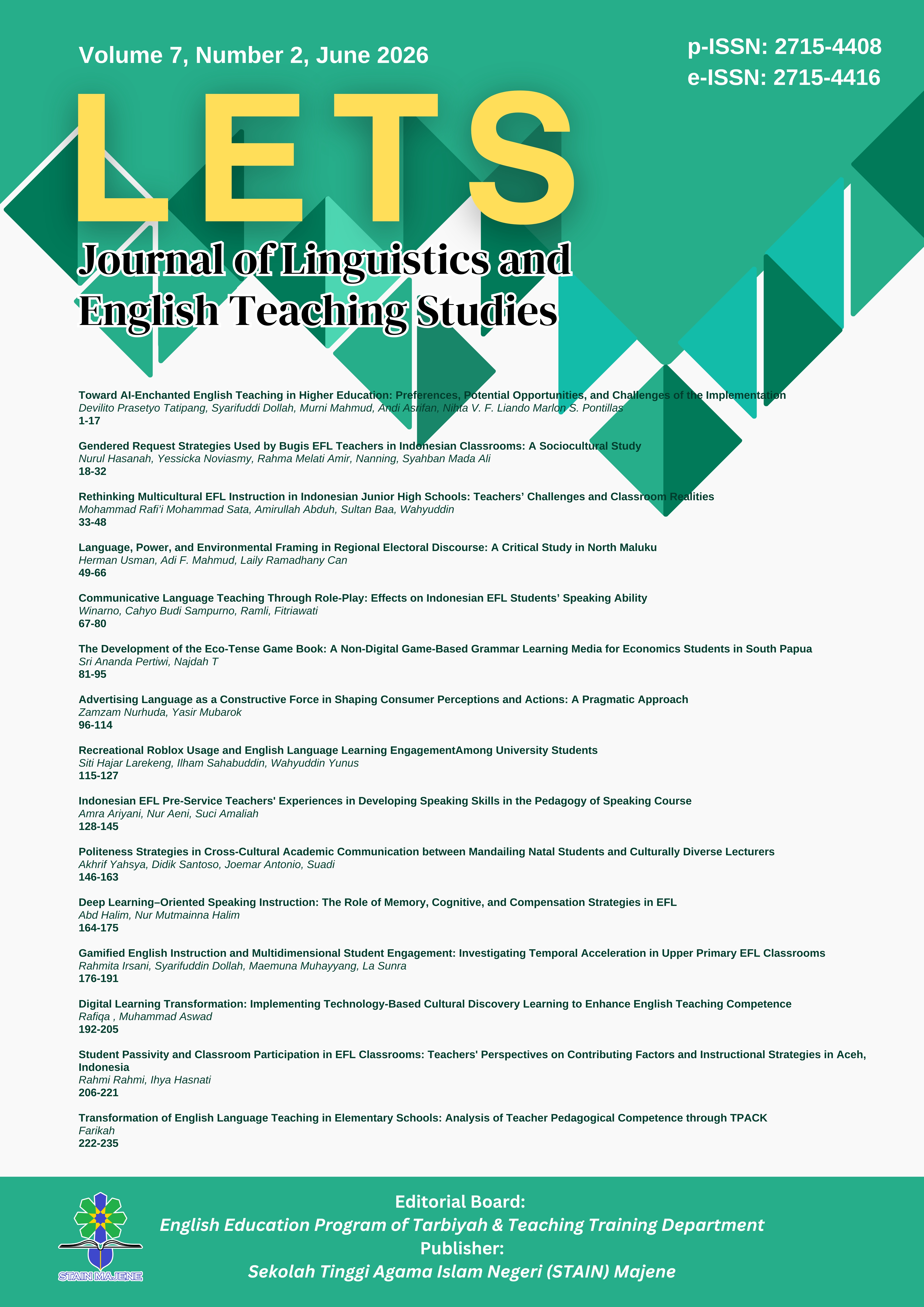
Gendered Request Strategies Used by Bugis EFL Teachers in Indonesian Classrooms: A Sociocultural Study
DOI:
https://doi.org/10.46870/lets.v7i2.2089Keywords:
Bugis Culture, EFL Classroom Discourse, Gendered Communication, Request Strategies, Sociocultural InteractionAbstract
This study examines gendered request strategies in Indonesian EFL classrooms from a sociocultural perspective, focusing on how Bugis EFL teachers negotiate authority, politeness, and interpersonal relations through classroom requests. Drawing on sociocultural approaches to classroom discourse and pragmatics, the study investigates how local cultural norms shape teachers’ interactional practices during English-mediated instruction. Employing a qualitative discourse-analytic design, data were collected through classroom observations, audio recordings, and semi-structured interviews involving four Bugis EFL teachers at a senior high school in South Sulawesi, Indonesia. A total of 360 minutes of naturally occurring classroom interaction were transcribed and analyzed thematically. The findings reveal distinct gendered patterns in classroom request realization. Female teachers tended to employ mitigated and relationally oriented requests through modalization, hedging devices, minimizers, and kinship-based address terms to maintain interpersonal rapport and participation. In contrast, male teachers tended to employ more direct and task-oriented request strategies emphasizing instructional clarity, efficiency, and classroom control. The findings further demonstrate that classroom requests function not merely as pedagogical directives but as socioculturally mediated interactional practices shaped by local sociocultural understandings of hierarchy, solidarity, and politeness within the Bugis cultural context. This study contributes to sociocultural approaches to classroom pragmatics by highlighting the importance of localized cultural meanings in interpreting classroom discourse and gendered communication in multilingual EFL settings.
References
Al-Harahsheh, A. M. A. (2014). Language and Gender Differences in Jordanian Spoken Arabic: A Sociolinguistics Perspective. Theory and Practice in Language Studies, 4(5). https://doi.org/10.4304/tpls.4.5.872-882
Aridah, A. (2021). Intercultural Communication in the Perspective of Gender. Journal of English as A Foreign Language Teaching and Research, 1(2), 1–10. https://doi.org/10.31098/jefltr.v1i2.690
Brown, P., & Levinson, S. C. (1987). Politeness: Some Universals in Language Usage. Cambridge University Press. https://doi.org/10.1017/CBO9780511813085
Clarke, V., & Braun, V. (2017). Thematic Analysis. The Journal of Positive Psychology, 12(3), 297–298. https://doi.org/10.1080/17439760.2016.1262613
Creswell, J., & Poth, C. (2018). Qualitative inquiry and research design: Choosing among five approaches (4th ed.). SAGE Publications.
Dagarin, M. (2004). Classroom Interaction and Communication Strategies in Learning English as a Foreign Language. ELOPE: English Language Overseas Perspectives and Enquiries, 1(1–2). https://doi.org/10.4312/elope.1.1-2.127-139
Dao, P., Nguyen, M. X. N. C., & Iwashita, N. (2021). Teachers’ Perceptions of Learner Engagement in L2 Classroom Task-Based Interaction. The Language Learning Journal, 49(6), 711–724. https://doi.org/10.1080/09571736.2019.1666908
Djalaluddin, M., Uswatunnisa, & Afdaliah, N. (2024). Instructional Materials for Etiquette Due to the Politeness Crisis in Gen-Z. Jurnal Pendidikan Dan Pengajaran, 57(2), 336–345.
Duff, P. A. (2019). Social Dimensions and Processes in Second Language Acquisition: Multilingual Socialization in Transnational Contexts. The Modern Language Journal, 103(S1), 6–22. https://doi.org/10.1111/modl.12534
Eckert, P. (1992). Think Practically and Look Locally: Language and Gender as Community-Based Practice. Annual Review of Anthropology, 21(1). https://doi.org/10.1146/annurev.an.21.100192.002333
Fawzi, A., Suyitno, I., & Tamphu, S. (2026). Dialogical Interaction in Indonesian Language Learning: An Ethnographic Study of Teacher Strategies and Student Engagement in a Junior High School in Lumajang. GHANCARAN: Jurnal Pendidikan Bahasa Dan Sastra Indonesia, 7(2), 600–619. https://doi.org/10.19105/ghancaran.v7i2.21404
Feng, H. (2017). Politeness across Cultures. In The International Encyclopedia of Intercultural Communication (pp. 1–5). Wiley. https://doi.org/10.1002/9781118783665.ieicc0259
Galante, A. (2020). Pedagogical Translanguaging in A Multilingual English Program in Canada: Student and Teacher Perspectives of Challenges. System, 92, 102274. https://doi.org/10.1016/j.system.2020.102274
Gillies, R. M. (2015). Enhancing Classroom-Based Talk: Blending Practice, Research and Theory. In Enhancing Classroom-based Talk: Blending Practice, Research and Theory. Routledge. https://doi.org/10.4324/9781315745367
Gröschner, A., Schindler, A.-K., Holzberger, D., Alles, M., & Seidel, T. (2018). How Systematic Video Reflection in Teacher Professional Development Regarding Classroom Discourse Contributes to Teacher and Student Self-Efficacy. International Journal of Educational Research, 90, 223–233. https://doi.org/10.1016/j.ijer.2018.02.003
Gusnawaty, G., Lukman, L., & Nurwati, A. (2022). A Closer Look on Linguistic Politeness among Bugis Youth: Tabék in Situational and Philosophical Context. REiLA: Journal of Research and Innovation in Language, 4(2). https://doi.org/10.31849/reila.v4i2.9870
Gusnawaty, G., Lukman, L., Nurwati, A., Adha, A., Nurhawara, N., & Edy, A. (2022). Strategy of Kinship Terms as a Politeness Model in Maintaining Social Interaction: Local Values towards Global Harmony. Heliyon, 8(9), 1–12. https://doi.org/10.1016/j.heliyon.2022.e10650
Hadawiah, H., Sulaeman, S., Nurdin, A., Sulastri, I., & Fitriyani, A. (2025). Cross-Religious Ritual Communication in the Bugis Tolotang, South Sulawesi, Indonesia. Human Arenas. https://doi.org/10.1007/s42087-025-00517-7
Holmes, J., & Stubbe, M. (2015). Power and Politeness in the Workplace: A Sociolinguistic Analysis of Talk at Work. Routledge. https://doi.org/10.4324/9781315750231
Kasper, G., & Kim, Y. (2015). Conversation for Learning: Institutional Talk Beyond the Classroom. The Handbook of Classroom Discourse and Interaction, 390–408. https://doi.org/10.1002/9781118531242.ch23
Lakoff, R. T. (2017). Context Counts: Papers on Language, Gender, and Power (L. A. Sutton, Ed.). New York: Oxford University Press.
Lin, A. M. Y. (2019). Theories of Trans-Languaging and Trans-Semiotizing: Implications for Content-Based Education Classrooms. International Journal of Bilingual Education and Bilingualism, 22(1), 5–16. https://doi.org/10.1080/13670050.2018.1515175
Mahmud, M. (2018). Gender Differences in English Language Teaching. The Asian EFL Journal, 20(5), 290–294.
Masruddin, M., Amir, F., Langaji, A., & Rusdiansyah, R. (2023). Conceptualizing Linguistic Politeness in Light of Age. International Journal of Society, Culture & Language, 11(3), 41–55. https://doi.org/10.22034/ijscl.2023.2001556.3018
McInnes, D. (2016). Gender as a Practice. In The Wiley Blackwell Encyclopedia of Gender and Sexuality Studies (pp. 1–2). Wiley. https://doi.org/10.1002/9781118663219.wbegss312
Petersen, J. (2018). Gender Difference in Verbal Performance: A Meta-Analysis of United States State Performance Assessments. Educational Psychology Review, 30, 1269–1281. https://doi.org/10.1007/s10648-018-9450-x
Praminatih, G. A. (2021). Shifting Speech Levels: Exploring Balinese Women’s Language in Inter-Caste Marriage Communication Contexts. Jurnal Kajian Bali (Journal of Bali Studies), 11(1), 61–76. https://doi.org/10.24843/JKB.2021.v11.i01.p04
Safont, P. (2022). ‘In English!’ Teachers’ Requests as Reactions to Learners’ Translanguaging Discourse. Language, Culture and Curriculum, 35(3), 317–333. https://doi.org/10.1080/07908318.2021.1979578
Saito, K., & Hanzawa, K. (2018). The Role of Input in Second Language Oral Ability Development in Foreign Language Classrooms: A Longitudinal Study. Language Teaching Research, 22(4), 398–417. https://doi.org/10.1177/136216881667903
Saldaña, J. (2021). The Coding Manual for Qualitative Researchers (4th ed.). SAGE Publications.
Schnurr, S., & Zayts, O. (2017). Language and Culture at Work. Routledge. https://doi.org/10.4324/9781315541785
Suparno, D., Fitriana, I., Nadra, N., Gunawan, F., & Boulahnane, S. (2023). Redefining Politeness: Power and Status in the Digital Age. Cogent Arts & Humanities, 10(1). https://doi.org/10.1080/23311983.2023.2218195
Talbot, M. (2019). Language and Gender. John Wiley & Sons.
Tannen, D. (2021). Three Decades in the Field of Gender and Language: a Personal Perspective. Gender & Language, 15(2). https://doi.org/10.1558/genl.20312
Thuruvan, P., & Md Yunus, M. (2017). The Speech Act of Request in the ESL Classroom. 3L The Southeast Asian Journal of English Language Studies, 23(4), 212–221. https://doi.org/10.17576/3L-2017-2304-16
Yoong, M. (2018). Language, Gender and Sexuality. In The Routledge Handbook of English Language Studies (pp. 226–239). Routledge. https://doi.org/10.4324/9781351001724-16
Downloads
Published
Issue
Section
License
Copyright (c) 2026 Nurul Hasanah, Yessicka Noviasmy, Rahma Melati Amir, Nanning, Syahban Mada Ali

This work is licensed under a Creative Commons Attribution-ShareAlike 4.0 International License.