
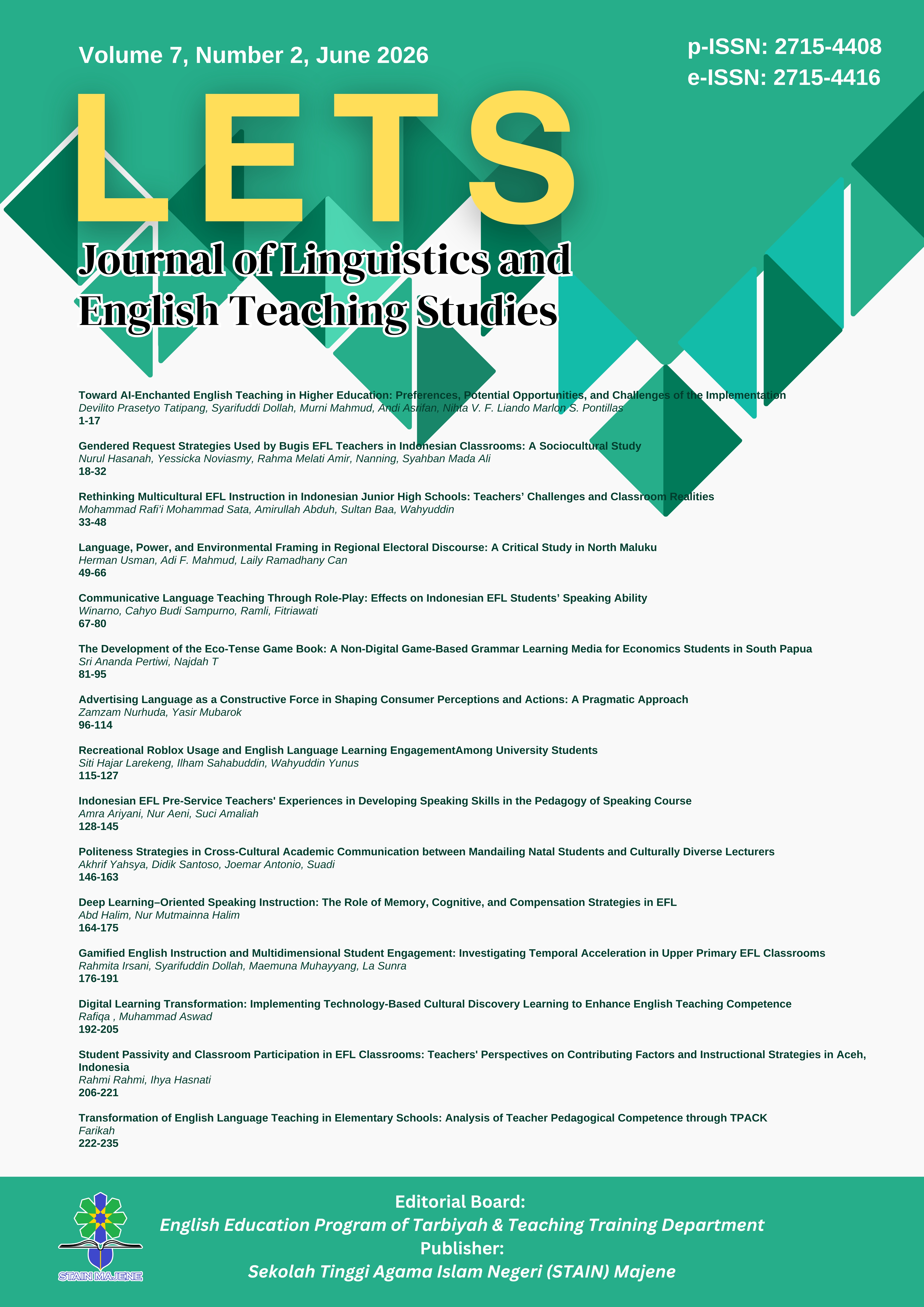
The Development of the Eco-Tense Game Book: A Non-Digital Game-Based Grammar Learning Media for Economics Students in South Papua
DOI:
https://doi.org/10.46870/lets.v7i2.2072Keywords:
Educational Media Development, Economics Students, Eco-Tense Game Book, English For Specific Purposes (ESP), Grammar InstructionAbstract
Mastery of English tense forms remains a persistent linguistic challenge for students in Papua, largely due to limited access to contextualized English learning resources, restricted digital connectivity, and unequal ownership of digital devices, particularly among indigenous Papuan students. To address these constraints, this study developed the Eco-Tense Game Book, a non-digital, game-based instructional medium designed for economics students. The development followed Plomp’s Research and Development (R&D) model, encompassing five stages: needs analysis, design, development, evaluation and revision, and implementation. Data were collected through semi-structured interviews and evaluation instruments administered to experts, practitioner, and students. The results showed that expert validation produced a high validity scoreof 91.5%, practitioner evaluation demonstrated good instructional feasibility with a score of 82.5%, and student evaluation revealed strong usability and learner acceptance, reflected in an overall score of 90.5%. The findings indicate that expert validation confirmed the academic appropriateness of the Eco-Tense Game Book, practitioner evaluation demonstrated its feasibility for classroom use, and student evaluation revealed that the media was easy for learners to use. The findings are based on validation and user perception data rather than experimental measurement of learning outcomes. A limitation of this study is the absence of a pre-test and post-test design to evaluate learning effectiveness. This study contributes to the development of non-digital game-based learning in English for Specific Purposes (ESP) by providing an alternative instructional resource for low-resource and low-connectivity educational settings.
References
Adys, H. P., Adys, H. P., & Usman, M. (2025). Enhancing ESP reading comprehension through context clues and digital strategies. Edu Cendikia: Jurnal Ilmiah Kependidikan, 5(2). https://doi.org/10.47709/educendikia.v5i02.6916
Agustus, F. S., Andoko, D., Muniasari, Savitri, M., Maharani, Nurisnaeny, C., Setiawati, P., Batara, M., & Heny. (2025). Strengthening the Papua steering committee strategy: Reducing instability for accelerated development in Papua, Indonesia. Social Sciences & Humanities Open, 11. https://doi.org/10.1016/j.ssaho.2025.101413
Apolonio, J. A. (2021). Needs analysis, challenges, and teaching strategies in English grammar learning [Doctoral dissertation, Lyceum of the Philippines University]. https://files.eric.ed.gov/fulltext/ED613630.pdf
Arikunto, S. (2008). Dasar-dasar evaluasi pendidikan (Edisi revisi). Bumi Aksara.
Basturkmen, H. (2025). Core concepts in English for Specific Purposes. Cambridge University Press.
Benchennane, D., & Stambouli, M. (2021). Challenges in English for Specific Purposes: Economics students with speaking deficiencies. Global Journal of Foreign Language Teaching, 11(1). https://doi.org/10.18844/gjflt.v11i1.5215
Bruner, J. (1996). The culture of education. Harvard University Press.
Dahalan, F., Alias, N., & Shaharom, M. S. N. (2023). Gamification and Game Based Learning for vocational education and training: A systematic literature review. Education and Information Technologies. https://doi.org/10.1007/s10639-022-11548-w
Damis, W. H., Jabu, B., & Salija, K. (2024). Difficulties in learning English tenses encountered by senior high school students. Phinisi Journal of Art, Humanities, & Social Studies, 4(2).
DeKeyser, R. M. (2007). Introduction: Situating the concept of practice. In Practice in a second language: Perspectives from applied linguistics and cognitive psychology (pp. 1–18). Cambridge University Press. https://doi.org/10.1017/CBO9780511667275.002
Evayani, D. A. M. C. D. (2021). Pengembangan media Game Mission Book untuk meningkatkan motivasi belajar siswa kelas V di SD Gugus II Kecamatan Susut Kabupaten Bangli tahun pelajaran 2020/2021 [Universitas Pendidikan Ganesha]. https://repo.undiksha.ac.id/8794/9/1611031381-LAMPIRAN.pdf
Harwood, M., & Omar, A. R. (2024). Overview of gamified and game-based vocabulary learning in ESP. 9th International Conference Vallis. https://doi.org/10.62598/9thICVA.008
Hu, K., Tang, D., & He, H. (2025). The mediating role of learning engagement in the relationship between master’s students’ learning motivation and scientific research and innovation capability. Frontiers in Education, 10. https://doi.org/10.3389/feduc.2025.1604792
Jaramillo-Mediavilla, L., Basantes-Andrade, A., Cabezas-González, M., & Casillas-Martín, S. (2024). Impact of gamification on motivation and academic performance: A systematic review. Education Sciences, 14(6), 639. https://doi.org/10.3390/educsci14060639
Kolb, D. A. (1984). Experiential learning: Experience as the source of learning and development. Prentice-Hall.
Muslimin, M., & Indrawati, R. (2024). Digitalization and education equity in remote areas: Challenges and strategic solutions. Journal of Education Humaniora and Social Sciences (JEHSS), 7(2). https://doi.org/10.34007/jehss.v7i2.2356
Mustakim, M., Musfirah, N., & Jabri, U. (2025). Challenges in grammar learning among EFL students: A case study of an Indonesian University. Seltics Journal: Scope of English Language Teaching, Literature and Linguistics Journal, 8(1). https://doi.org/10.46918/seltics.v8i1.2598
Nassaji, H., & Fotos, S. (2011). Teaching grammar in second language classrooms: Integrating form-focused instruction in communicative context. Routledge.
Oxford, R. L. (2011). Teaching and researching: Language learning strategies. Routledge.
Plass, J. L., Homer, B. D., & Kinzer, C. K. (2015). Foundations of Game-Based Learning. Educational Psychologist, 50(4). https://doi.org/10.1080/00461520.2015.1122533
Plomp, T. (2013). Educational design research: An introduction. In T. Plomp & N. Nieveen (Eds.), Educational design research. Netherlands Institute for Curriculum Development (SLO).
Prasetio, A., Anggadwita, G., & Pasaribu, R. D. (2021). Digital learning challenge in Indonesia. In Advances in educational technologies and instructional design (pp. 56–71). IGI Global. https://doi.org/10.4018/978-1-7998-4972-8.ch004
Richards, J. C. (2006). Communicative language teaching today. Cambridge University Press.
Simbolon, T. N. (2025). Exploring non-digital gamification in English education: Insights from a middle school study. Journal of English Language and Education, 10(1). https://doi.org/10.31004/jele.v10i1.669
Smith, C. S. (2007). Tense and temporal interpretation. Lingua, 117(2). https://doi.org/10.1016/j.lingua.2004.10.005
Sugiyono. (2015). Metode penelitian pendidikan: Pendekatan kuantitatif, kualitatif, dan R & D. Alfabeta.
Sweller, J. (2011). Cognitive load theory. In Psychology of learning and motivation (pp. 37–76). Elsevier Academic Press. https://doi.org/10.1016/B978-0-12-387691-1.00002-8
Villacis, M. A. B., Gualpa, S. C. G., Sandoval, D. J. D. la V., & García, M. R. A. (2025). Use of low-cost educational technologies to enhance English language learning. Revista Ciencia Innovadora, 3(3). https://doi.org/10.64422/rci.v3n3.2025.67
Vygotsky, L. S. (1978). Mind in society: The development of higher psychological processes. Harvard University Press.
Wicaksana, M. F., Sari, N. K., & Alfiana, N. (2025). Assessing the impact of Game-Based Learning through TikTok on English as a Foreign Language (EFL) vocabulary acquisition: An innovative approach to achieving SDG 4. International Conference on Games-Based Learning (ICGBL 2025), 38–52.
Zakaria, A., & Zakaria, N. Y. K. (2025). The impact of digital game-based learning tools on motivation, engagement, and performance in language education: A systematic literature review. International Journal of Academic Research in Progressive Education and Development, 14(1). https://doi.org/10.6007/ijarped/v14-i1/24954
Zimmerman, B. J. (2022). Becoming a self-regulated learner: An overview. Theory Into Practice, 41(2). https://doi.org/10.1207/s15430421tip4102_2
Downloads
Published
Versions
- 2026-07-06 (2)
- 2026-06-30 (1)
Issue
Section
License
Copyright (c) 2026 Sri Ananda Pertiwi, Najdah T.

This work is licensed under a Creative Commons Attribution-ShareAlike 4.0 International License.