
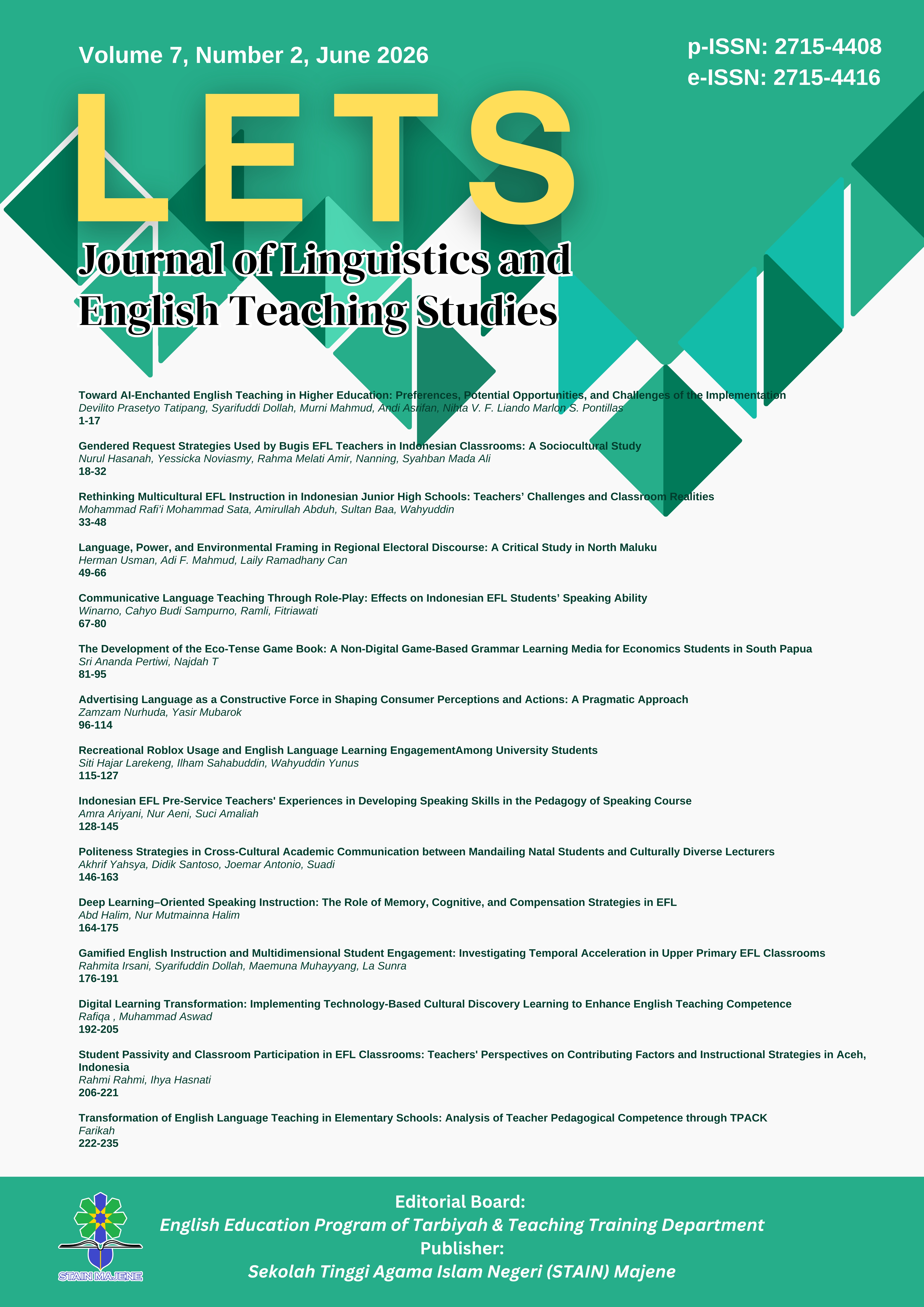
Digital Learning Transformation: Implementing Technology-Based Cultural Discovery Learning to Enhance English Teaching Competence
DOI:
https://doi.org/10.46870/lets.v7i2.1885Keywords:
Cultural Discovery Learning, Digital, English Teaching, Technology, Teaching CompetenceAbstract
Digital transformation has reshaped English language teacher education by requiring pre-service teachers to develop not only pedagogical knowledge but also digital literacy, intercultural awareness, and reflective teaching competence. However, the integration of technology, culture, and pedagogy remains limited in many teacher education contexts. This study investigated the effectiveness of technology-based Cultural Discovery Learning (CDL) in enhancing the teaching competence of pre-service English teachers and examined the quality of its implementation in the learning process. A quantitative approach with a quasi-experimental design was employed. The participants were 77 undergraduate students from the English Education Study Program at Universitas Sulawesi Barat, consisting of 38 students in the experimental group and 39 students in the control group. Data were collected through pre-tests, post-tests, classroom observation, and documentation. Descriptive statistics and an independent-sample t-test were used to analyze the data. The findings revealed that the experimental group achieved a higher gain score (21.39) than the control group (7.62). The independent-sample t-test showed a significant difference between the two groups, t(75) = 6.212, p < .001. Observation results also indicated that the CDL model was implemented with very high fidelity, with an average score of 90 across cultural objectives, authentic digital media, cultural discovery activities, reflection, and digital product creation. These findings suggest that technology-based CDL is an effective pedagogical framework for developing pre-service English teachers’ pedagogical, digital, intercultural, and reflective competencies.
References
Altun, M., & Ahmad, H. K. (2021). The use of technology in English language teaching: a literature review. International Journal of Social Sciences & Educational Studies, 8(1). https://doi.org/10.23918/ijsses.v8i1p226
Aniq, L. N., Drajati, N. A., & Fauziati, E. (2022). Covid-19 outbreak response: Tracing EFL teachers’ beliefs & practices of TPACK in teaching writing. Indonesian Journal of Applied Linguistics, 12(1). https://doi.org/10.17509/ijal.v12i1.46535
An-Nisa, N., Astika, G. A., & Suwartono, T. (2021). Millennials, Technology, and English Language Teaching. Tarling : Journal of Language Education, 5(1). https://doi.org/10.24090/tarling.v5i1.4072
Asfihana, R., Rafiqa, R., Iskandar, I., Rahayu, P. S., & Fuentes, A. S. (2024). The impact of virtual video project on students’ English learning engagement. LLT Journal: A Journal on Language and Language Teaching, 27(2), 613–631. https://doi.org/10.24071/llt.v27i2.6483
Aswad, M., Yassi, Abd. H., Nasmilah, N., & Pammu, A. (2022). Technology-enhanced Learning in Indonesian EFL classes: The Case of Videoscribe. Proceedings of the 2nd International Conference on Social Science, Humanities, Education and Society Development (ICONS 2021), 629. https://doi.org/10.2991/assehr.k.220101.004
Aziz, A., Budiyono, B., & Subanti, S. (2017). The effect of inquiry learning and discovery learning on student learning achievement viewed from spatial intelligence. Southeast Asian …. http://www.journal.qitepinmath.org/index.php/seamej/article/view/54
Aziz, R. A. (2018). Developing students’ information literature skill through the application of learning discovery learning model in social studies learning. International Journal Pedagogy of Social Studies. https://ejournal.upi.edu/index.php/pips/article/view/13435
Bello Nawaila, M., Kanbul, S., & Alhamroni, R. (2020). Technology and English language teaching and learning: A content analysis. Journal of Learning and Teaching in Digital Age, 2020(1).
Belz, J. A. (2005). Intercultural questioning, discovery and tension in internet-mediated language learning partnerships. Language and Intercultural Communication, 5(1), 3–39. https://doi.org/10.1080/14708470508668881
Creswell, J. W., & Guetterman, T. C. (2019). Educational research: Planning, conducting, and evaluating quantitative and qualitative research. Pearson Education, Inc.
Dagar, & Yadav. (2016). Constructivism: a paradigm for teaching and learning. Arts and Social Sciences Journal. https://doi.org/10.4172/2151-6200.1000200
Dasli, M., & Simpson, A. (2023). Introducing intercultural communication pedagogy and the question of the other. Pedagogy, Culture and Society, 31(2). https://doi.org/10.1080/14681366.2022.2164339
Dewi, S. L. (2023). Merdeka Belajar–Kampus Merdeka (MBKM) to strengthen the culture and citizenship literacy of pre-service efl teachers. Studies in English Language and Education, 10(3), 1270–1289. https://doi.org/10.24815/siele.v10i3.28596
Dinneen, C. (2021). Students’ use of digital translation and paraphrasing tools in written assignments on direct entry english Programs. English Australia Journal, 37(1).
Esmailzadeh, F., Lotfi, S. A. T., & ... (2019). The effects of guided-discovery, self-discovery, and situational-presentation techniques on learning conditional sentences in English. In Applied Linguistics …. scholar.archive.org. https://scholar.archive.org/work/wo5x2yr32faepozsbwobhzudwa/access/wayback/https://www.journalagent.com/alrj/pdfs/ALRJ_3_3_51_63.pdf
Firmansyah, R., Putri, D. M., Wicaksono, M. G. S., Putri, S. F., Widianto, A. A., & Palil, M. R. (2021). Educational transformation: An evaluation of online learning due to COVID-19. International Journal of Emerging Technologies in Learning, 16(7). https://doi.org/10.3991/ijet.v16i07.21201
Hambali, U. N., Natsir, R. Y., & Nasir, N. (2023). Tinjauan literatur tentang integrasi teknologi dalam proses pembelajaran keterampilan bahasa Inggris. Jurnal Dieksis Id, 3(2), 128–141. https://doi.org/10.54065/dieksis.3.2.2023.346
Holmes, P., & Peña Dix, B. (2022). A research trajectory for difficult times: Decentring language and intercultural communication. Language and Intercultural Communication, 22(3). https://doi.org/10.1080/14708477.2022.2068563
Irma, I., Rafiqa, R., & Danial, M. (2022). Online and offline English learning systems: Perceptual from teachers and students. LETS: Journal of Linguistics and English Teaching Studies, 4(1), 13–23. https://doi.org/10.46870/lets.v4i1.346
Jeffreys, M. R., & O’donnell, M. (1997). Cultural discovery: An innovative philosophy for creative learning activities. Journal of Transcultural Nursing, 8(2). https://doi.org/10.1177/104365969700800203
Johnson, A. (2016). Bruner’S learning theory. In Essential Learning Theories and Their Applications.
Junina, I., & Halim, A. (2020). The effect of discovery learning-based worksheet on students’ metacognition skill and learning outcomes. Journal of Physics: Conference Series. https://doi.org/10.1088/1742-6596/1460/1/012100
Mofareh A, A. (2019). The use of technology in English language teaching. Frontiers in Education Technology, 2(3). https://doi.org/10.22158/fet.v2n3p168
Pradita, L., Mardiana, W., & Mustpa, D. (2023). Pre-service efl teachers’ experience in integrating tpack during teaching practice program. UC Journal: ELT, Linguistics and Literature Journal, 4(1). https://doi.org/10.24071/uc.v4i1.5613
Pretorius, L. (2018). Experiential and self-discovery learning in digital literacy: Developing the discernment to evaluate source reliability. College & Undergraduate Libraries. https://doi.org/10.1080/10691316.2018.1530626
Qiang, Z., & Yue, W. (2021). Routledge Encyclopedia of translation studies. Across Languages and Cultures, 22(2). https://doi.org/10.1556/084.2021.00017
Rafi, N. P., & Usman, O. (2021). The Influence of Information technology, discovery learning and digital literacy learning models on citizenship education learning outcomes. … , Discovery Learning and Digital Literacy …. https://papers.ssrn.com/sol3/papers.cfm?abstract_id=3995268
Rafiqa, R. (2022a). Discovery learning based-instruction in teaching productive skills for English education students at a University. Universitas negeri Makassar.
Rafiqa, R. (2022b). The Implementation of MBKM through Cultural Discovery Learning to Elevate Learner Autonomy and Speaking Skill.
Rafiqa, R., Aswad, M., Asfihana, R., & Singh, A. K. J. (2023). Implementation of “Merdeka Belajar”: Evolving Learner Autonomy and Speaking Skill through Cultural Discovery Learning Model. Script Journal: Journal of Linguistics and English Teaching, 8(01). https://doi.org/10.24903/sj.v8i01.1237
Rafiqa, R., & Munawir, A. (2017). Mandar culture-based English education. ELT WORLDWIDE.
Rafiqa, Sabil, M., & Aswad, M. (2023). How to implement discovery learning in English language teaching at indonesian higher education? IDEAS: Journal of Language Teaching and Learning, Linguistics and Literature, 11(1). https://doi.org/https://doi.org/10.24256/ideas.v11i1.3654
Raja, R., & Nagasubramani, P. C. (2018). Impact of modern technology in education. Journal of Applied and Advanced Research. https://doi.org/10.21839/jaar.2018.v3is1.165
Rosmayanti, V., Ramli, R., & Rafiqa, R. (2023). Building beginners� self-confidence in speaking at private high school in Makassar. EduLite: Journal of English Education, Literature and Culture, 8(1). https://doi.org/10.30659/e.8.1.192-208
Simamora, R. E., & Saragih, S. (2019). Improving students’ mathematical problem solving ability and self-efficacy through guided discovery learning in local culture context. International Electronic Journal of Mathematics …. https://eric.ed.gov/?id=EJ1227360
Solihin, Agustini, K., Rasben Dantes, G., & Wawan Sudatha, I. G. (2024). Transformasi pengajaran bhs Inggris berbasis teknologi. JIIP (Jurnal Ilmiah Ilmu Pendidikan), 7(8), 8380–8386.
Suryanti, Y., Rostikawati, T., & Budiana, S. (2022). The effectiveness of online learning on students’ TPACK based teaching instrument. Pedagonal : Jurnal Ilmiah Pendidikan, 6(1). https://doi.org/10.55215/pedagonal.v6i1.4526
Susanti, A., Trisusana, A., Pusparini, R., & Kurniasih, E. (2022). Menumbuhkan kreativitas mahasiswa melalui integrasi teknologi dalam task-based language teaching untuk mahasiswa pendidikan bahasa Inggris. NDRUMI: Jurnal Pendidikan Dan Humaniora. https://jurnal.uniraya.ac.id/index.php/NDRUMI
Walo, S. W., Ilyas, I., & Rahmawati, A. S. (2021). The effect of discovery learning learning models on student physics learning outcomes class X SMA. ScienceEdu: Jurnal Pendidikan …. https://jurnal.unej.ac.id/index.php/Scedu/article/view/23860
Yani, C. F., Murni, A., & Roza, Y. (2021). Development of mathematic learning devices using discovery learning models with riau cultural context to improve students ’mathematic problems understanding and solving ability. Journal of Educational Sciences, 5(1). https://doi.org/10.31258/jes.5.1.p.11-22
Yasseen Shukr, H., & Adnan Jameel, T. (2022). Digital technology in English language teaching and learning. NTU Journal for Administrative and Human Sciences (JAHS), 2(2). https://doi.org/10.56286/ntujahs.v2i2.240
Yu, R. (2020). On fostering learner autonomy in learning English. Theory and Practice in Language Studies, 10(11). https://doi.org/10.17507/tpls.1011.09
Zambrana, J. M. V. (2020). Use of communicative strategies in L2 learning: An intercultural study. International Journal of English Studies, 20(3). https://doi.org/10.6018/IJES.399631
Downloads
Published
Issue
Section
License
Copyright (c) 2026 Rafiqa Rafiqa, Muhammad Aswad

This work is licensed under a Creative Commons Attribution-ShareAlike 4.0 International License.