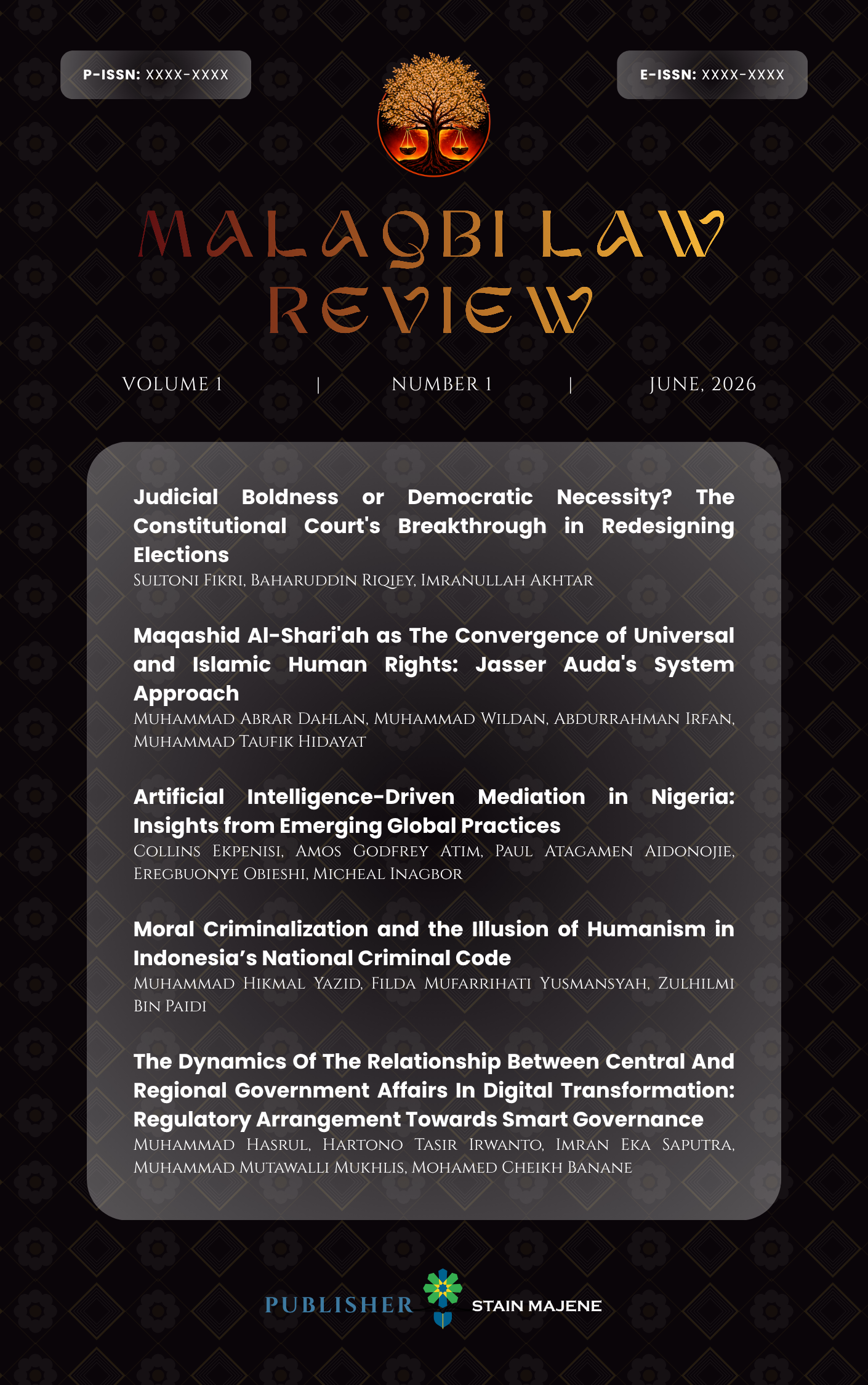
Artificial Intelligence-Driven Mediation in Nigeria: Insights from Emerging Global Practices
Keywords:
Mediation, Disputes, Artificial Intelligence, Alternative Dispute Resolution (ADR), Information and Communication TechnologyAbstract
The revolutionary trend and integration of artificial intelligence (AI) into all facets of society is no longer a subject of debate. Rather, the present discussion is on the extent to which AI is influencing the global juridical legal system and, most especially, mediation practices. While several jurisdictions are rapidly integrating AI into their mediation practices to enhance access to justice, Nigeria remains at an early stage of engagement with artificial intelligence. The research adopted the doctrinal method of data analysis alongside a comparative approach in examining the extent to which artificial intelligence has been applied to mediation in different countries and how this could serve as a lesson to mediation in Nigeria. The research highlights mediation and technology laws in Nigeria and how they provide a foundation for AI use in mediation practice. It then explores how other countries and jurisdictions use AI in mediation, identifying both practical applications and results. Building on these insights, the paper then outlines specific opportunities for implementing AI in Nigerian mediation practices, while also considering several key challenges. It concludes with policy recommendations to guide structured and effective integration of artificial intelligence in mediation practice within the Nigerian context.
References
Abbott, R., & Elliott, B. S. (2023). Putting the Artificial Intelligence in Alternative Dispute Resolution. Amicus Curiae, 4(3). https://doi.org/10.14296/ac.v4i3.5627
Abu, M., & Miazi, N. (2023). Interplay of legal frameworks and Artificial Intelligence (AI): A global perspective. Law and Policy Review, 2(2).
Alessa, H. (2022). The role of Artificial Intelligence in Online Dispute Resolution: A brief and critical overview. Information & Communications Technology Law, 31(2), 1–24. https://doi.org/10.1080/13600834.2022.2088060
Amir Kashdaran. (2024, August). Overview of the Canadian Legal Framework Relative to Artificial Intelligence Systems Following the Adoption of the AI Act in Europe - McMillan LLP.
Arakpogun, E. O., Elsahn, Z., Olan, F., & Elsahn, F. (2021). Artificial Intelligence in Africa: Challenges and Opportunities. In Studies in Computational Intelligence (Vol. 935). https://doi.org/10.1007/978-3-030-62796-6_22
Ark Mediation. (2025, January). Ark Mediation launches the UK’s first Family Mediation AI Service.
Bellucci, E., & Zeleznikow, J. (2005). Developing Negotiation Decision Support Systems that Support Mediators: A Case Study of the Family_Winner System. Artificial Intelligence and Law, 13(2). https://doi.org/10.1007/s10506-006-9013-1
Bichia, M. (2023). Confidentiality of the Mediation Process and Ethical Dilemmas. Alternative Dispute Resolution Yearbook, 12(1). https://doi.org/10.60131/adr.1.2023.7081
Carneiro, D., Novais, P., & Neves, J. (2014). Online dispute resolution: an artificial intelligence perspective. Artificial Intelligence Review, 41, 211–240,. https://doi.org/https://doi.org/10.1007/s10462-011-9305-z
Daddie, J. A., Victor Iheanyichukwu, A., & Esther, O. (2025). Leveraging Artificial Intelligence (Ai) For Educational Development In Nigeria: Examining The Challenges And Opportunities. Journal of Social Science, 2(2). https://doi.org/10.61796/ijss.v2i2.42
Enebeli, V., & Gilbert, S. (2022). Artificial Intelligence: Challenges and Opportunities for Arbitration in Nigeria. SSRN Electronic Journal. https://doi.org/10.2139/ssrn.4245238
Fayigbe, B. O., Simon, B., & Oyebanji, A. O. (2025). Assessing the Impact of Artificial Intelligence on Community-Level Negotiations in Akwa Ibom North-West Senatorial District. International Journal of Research and Scientific Innovation, 12(10). https://doi.org/10.51244/ijrsi.2025.1210000283
Fei Lu. (2024, July). Overview of Dispute Resolution in the Digital Environment in China.
Franck, S. D. (2023). Challenges Facing Investment Disputes: Reconsidering Dispute Resolution in International Investment Agreements. In Appeals Mechanism in International Investment Disputes. https://doi.org/10.1093/oso/9780195341560.003.0009
Garg, R. (2024). THE ROAD TO MEDIATION. LawFoyer International Journal of Doctrinal Legal Research, 2(3). https://doi.org/10.70183/lijdlr.2024.v02.15
Giuggioli, G., & Pellegrini, M. M. (2023). Artificial intelligence as an enabler for entrepreneurs: a systematic literature review and an agenda for future research. In International Journal of Entrepreneurial Behaviour and Research (Vol. 29, Issue 4). https://doi.org/10.1108/IJEBR-05-2021-0426
Gobile, S., & Awoyemi, O. (2024). Mediation as a Strategic Tool: A Comparative Framework for Reducing Court Backlogs in U.S. and Nigerian Legal Systems. Journal of Frontiers in Multidisciplinary Research, 5(1). https://doi.org/10.54660/.jfmr.2024.5.1.240-252
Gul, S., Khan, M. sulaim A., Shah, S. mobassir, & Javed, A. (2025). AI and Alternative Dispute Resolution (ADR): History and Innovations. ACADEMIA International Journal for Social Sciences, 4(3). https://doi.org/10.63056/acad.004.03.1357
Gyurász, Z., & Krkošková, E. (2024). Artificial Intelligence Driven Alternative Dispute Resolution. European Studies: The Review of European Law, Economics and Politics, 11(2). https://doi.org/10.2478/eustu-2024-0015
Härmand, K. (2023). AI Systems’ Impact on the Recognition of Foreign Judgements: The Case of Estonia. Juridica International, 32. https://doi.org/10.12697/ji.2023.32.09
Hodge, S. D. (2023). Revolutionizing Justice: Unleashing the Power of Artificial Intelligence. SMU Science and Technology Law Review, 26(2). https://doi.org/10.25172/smustlr.26.2.3
Hussein, E. (2025). AI Meets Mediation: Shaping the Future of Dispute Resolution in a Digital World. Arbitration, 91(2). https://doi.org/10.54648/amdm2025012
Insight. (2024, February). AI and Arbitration: China’s efforts : Clyde & Co. Article.
Isiaka, M., Nasirudeen, I. A., Yusuf, T. A., Ayodele, A., & Sheu, W. B. (2025). The adoption of restorative justice models in criminal justice system: decongesting backlogs in conventional court system in Nigeria. Contemporary Justice Review: Issues in Criminal, Social, and Restorative Justice, 28(4). https://doi.org/10.1080/10282580.2025.2536290
Joe Mandela & Hannah Adeleye Oluwadara. (2025, May). AI-Driven Dispute Resolution: Evaluating the Impact of Machine Learning on Mediation Practices in Canada | Request PDF. Journal.
Justice Jane Needham. (2025, June). AI and the courts in 2025. Where are we, and how did we get here.
Karthikeyan, C. (2024). AI (Artificial Intelligence) for Conflict Resolution and Negotiation: Enhancing Mediation and Collaboration Through Intelligent Technology. In Navigating Organizational Behavior in the Digital Age with AI. https://doi.org/10.4018/979-8-3693-8442-8.ch002
Khaleel, M., Jebrel, A., Sustain., D. S.-I. J. E. E. and, & 2024, undefined. (2020). Artificial intelligence in computer science: Https://doi. org/10.5281/zenodo. 10937515. Ijees.Org, 1(3), 91–108. https://doi.org/10.5281/ZENODO
Kumar, R., & Singh, B. D. (2025). The Rise Of The Robo-Mediator: Ai’s Transformative Role In Alternative Dispute Resolution. SSRN Electronic Journal. https://doi.org/10.2139/ssrn.5222318
Laptev, V. A., & Feyzrakhmanova, D. R. (2024). Application of Artificial Intelligence in Justice: Current Trends and Future Prospects. Human-Centric Intelligent Systems, 4(3), 394–405. https://doi.org/10.1007/s44230-024-00074-2
Lee, E. G., & Willging, T. E. (2010). Defining the problem of cost in federal civil litigation. Duke Law Journal, 60(3).
Leonas, L. (2025). The Possibilities and Risks of Using Artificial Intelligence in Mediation. ACTA PROSPERITATIS, 16(1). https://doi.org/10.2478/acpro-2025-0010
Melnychuk, O., Opolska, N., Ostapenko, O., Lapshyn, S., & Ishchuk, A. (2024). Utilising mediation for conflict resolution: Insights and future directions. Salud, Ciencia y Tecnologia - Serie de Conferencias, 3. https://doi.org/10.56294/sctconf20241143
Minson, J. A., & Chen, F. S. (2022). Receptiveness to Opposing Views: Conceptualization and Integrative Review. Personality and Social Psychology Review, 26(2). https://doi.org/10.1177/10888683211061037
Monika Wyszomirska. (2023). Technological Developments as a New Challenge for Modern Legislation. Safety & Fire Technology, 62(2). https://doi.org/10.12845/sft.62.2.2023.6
Mustafa, A. S., & Garcia, M. B. (2021). Theories Integrated with Technology Acceptance Model (TAM) in Online Learning Acceptance and Continuance Intention: A Systematic Review. 2021 1st Conference on Online Teaching for Mobile Education, OT4ME 2021. https://doi.org/10.1109/OT4ME53559.2021.9638934
Nikolaeva, V. (2023). Mediation as a Strategic Tool in the Manager’s Practice. Izvestia Journal of the Union of Scientists - Varna. Economic Sciences Series, 12(3). https://doi.org/10.56065/ijusv-ess/2023.12.3.14
Obiahu, B. C. (2024). Regulating Artificial Intelligence In Nigeria: Balancing Innovation With Ethical And Legal Considerations. Alex-Ekwueme Federal University Faculty Of Law Ll.B Projects, 0(0).
Obidimma & Ishiguzo. (2023). Artificial Intelligence And Cybercrime Investigation In Nigeria: Addressing The Legal And Technical Skills Gaps. African Journal of Criminal Law and Jurisprudence (AFJCLJ), 8(2).
Okwukwu, M., Oluwafemi Olofin, D., & Akintayo Taiwo, A. (2025). Artificial Intelligence in Nigeria Healthcare: A Review of State, Challenges and Opportunities. EthAIca, 4. https://doi.org/10.56294/ai2025210
Oluseye Olugboyega, C. A., & Faith Ajao, T. A. (2024, December). (PDF) Potentials of an artificial intelligence-based dispute resolution system as an alternative dispute resolution method for construction disputes. Conference: Sustainable Development International Conference.
Owoche Antai, G., Mulegi, T., Kirahora Barongo, E., Ekpenisi, C., & Kisubi, E. C. (n.d.). Legal issues concerning the role of arbitration in resolving corporate governance dispute in Nigeria. Kampalajournals.Ac.Ug, 10(1), 59–70.
Philip Corsano. (2025). Mediation and AI: Balancing Benefits and Confidentiality — Civil Mediation.
Rabinovich-Einy, O., & Katsh, E. (2021). Lessons from Online Dispute Resolution for Dispute System Design. SSRN Electronic Journal. https://doi.org/10.2139/ssrn.3830035
Rai, A., Sarker, S., & Constantinides, P. (2019). Next-Generation Digital Platforms: Toward Human-AI Hybrids. MIS Quarterly, 43(1).
Rodríguez-Salcedo, E., Molina-Torres, M., Chagcha-Solís, C., Naranjo-Ruiz, V., & Naranjo-Llerena, L. (2025). Rethinking Mediation and Arbitration in the Age of Artificial Intelligence: A Systematic Review. Salud, Ciencia y Tecnología, 5. https://doi.org/10.56294/saludcyt20252316
Samuel D. Hodge Jr. (2024, May). Is the Use of Artificial Intelligence in Alternative Dispute Resolution a Viable Option or Wishful Thinking? . Journal.
Sasmiar, S., Hasan, U., & Suhermi, S. (2024). Legal Certainty Of Alternative Dispute Resolution Mediation. Bengkoelen Justice : Jurnal Ilmu Hukum, 14(1). https://doi.org/10.33369/jbengkoelenjust.v14i1.33432
Sebayiga, V. (2023). Evaluating the Role of Technology-Powered Alternative Dispute Resolution (ADR) in a Post-Pandemic Africa. SSRN Electronic Journal. https://doi.org/10.2139/ssrn.4136496
Sherman, N., & Momani, B. T. (2025). Alternative dispute resolution: Mediation as a model. F1000Research, 13. https://doi.org/10.12688/f1000research.152362.2
Siitam, N. (2025). IT and AI at national courts. Some examples from Estonia. ERA Forum, 26(4). https://doi.org/10.1007/s12027-025-00861-9
Singapore International Mediation Centre celebrates a decade of growth, unveils AI-powered tool | Singapore International Mediation Centre. (n.d.).
Sourdin, T., Li, B., & Burke, T. (2019). Just, Quick And Cheap? 1 Civil Dispute Resolution And Technology. ResearchGate, 19.
Swanson, T. C. (2021). Mediation: Alternative? Or a First Choice for Resolving Disputes. Amicus Curiae, 2(2).
Syed Shaharyar Ahmed, M. J. I. and M. S. (2025). Leveraging Artificial Intelligence in Cross-Cultural Mediation: Enhancing Neutrality and Efficiency in Dispute Resolution. Law and Policy Review (LPR)Volume 4 Issue 1, Spring 2025.
The Legal Issues Concerning the Implementation of the Administration of Criminal Justice Act of Nigeria. (2024). NIU Journal of Legal Studies, 10(1). https://doi.org/10.58709/niujls.v10i1.1928
Ucheakonam, C. (2023). Arbitration, International Mediation, and the Widening of the Alternative Dispute Resolution Space: Bloated Expectations or a Matter of Time? SSRN Electronic Journal. https://doi.org/10.2139/ssrn.4491851
Usman, I., Ahmed, T. M., & Odobo, S. O. (2025). Achieving Effective Conflict Resolution through Alternative Dispute Resolution (ADR) Mechanisms in Nigeria. Journal of Guidance and Counselling Studies, 9(1).
Victorian Law Reform Commission. (2024). 4. AI in courts and tribunals - Victorian Law Reform Commission.
Wang, P., & Qu, G. (2024). AI in court: The promotion and regulation of information technology in China’s Smart Court movements. In Artificial Intelligence and International Human Rights Law. https://doi.org/10.4337/9781035337934.00025
Downloads
Published
How to Cite
Issue
Section
License
The copyright of the received article shall be assigned to the journal as the publisher of the journal. The intended copyright includes the right to publish the article in various forms (including reprints). The journal maintains the publishing rights to the published articles. Therefore, the author must submit a statement of the Copyright Transfer Agreement.*)

This work is licensed under a Creative Commons Attribution-ShareAlike 4.0 International License.
In line with the license, authors and third parties (readers, researchers, and others) are allowed to share and adapt the material. In addition, the material must be given appropriate credit, provided with a link to the license, and indicated if changes were made. If authors remix, transform or build upon the material, authors must distribute their contributions under the same license as the original.
________
*) Authors whose articles are accepted for publication will receive confirmation via email and send a Copyright Transfer Agreement.