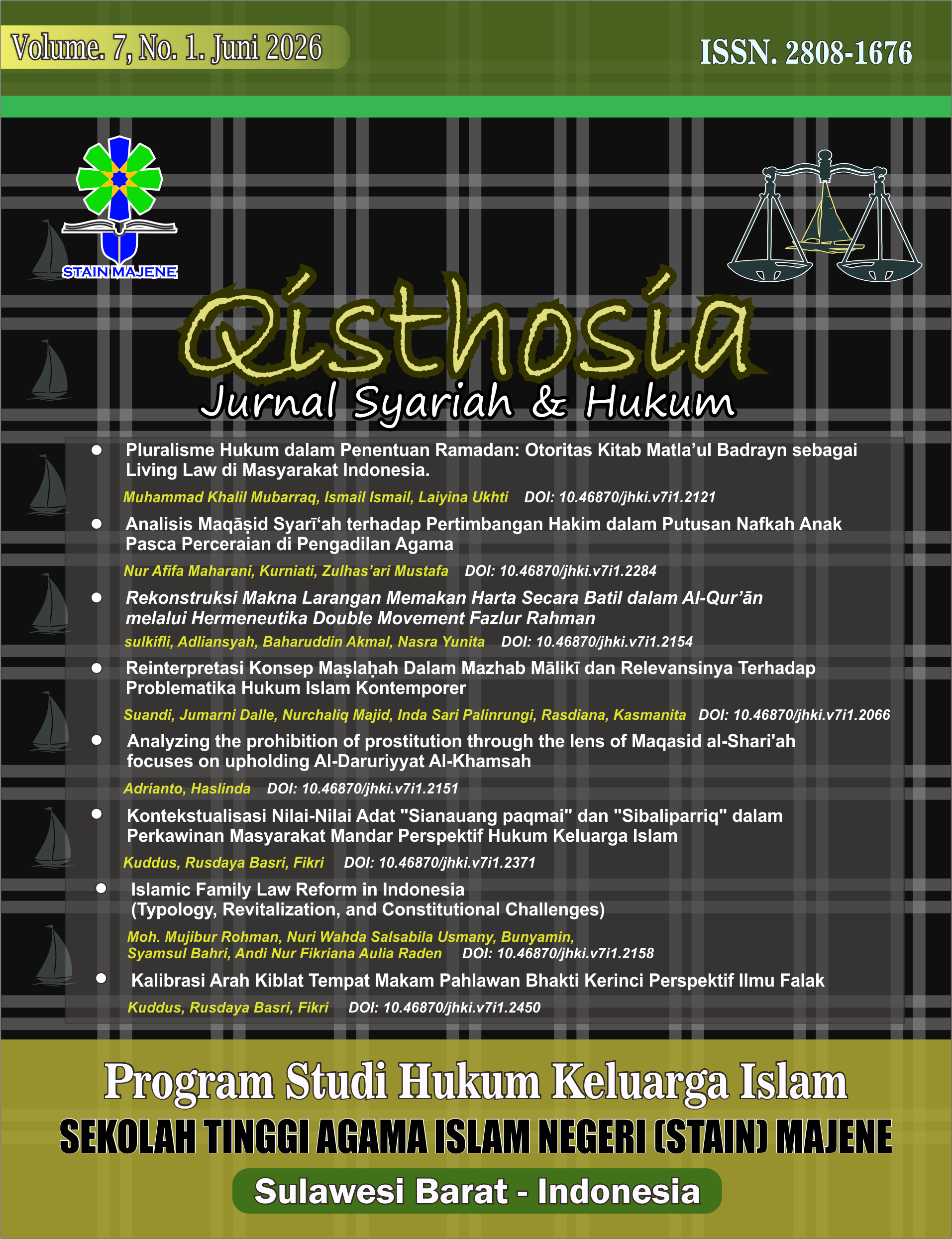
Rekonstruksi Makna Larangan Memakan Harta Secara Batil dalam Al-Qur’ān melalui Hermeneutika Double Movement Fazlur Rahman
Reconstructing the Meaning of the Prohibition Against Unjustly Acquiring Wealth in the Qur'an through Fazlur Rahman's "Double Movement" Hermeneutics
DOI:
https://doi.org/10.46870/jhki.v7i1.2154Keywords:
Munaqahat, Walimah, Islamic Law, Islamic Family LawAbstract
This article examines the prohibition of consuming wealth unlawfully (akl al-amwal bi al-batil) in the Qurʼan through Fazlur Rahman’s double movement hermeneutical approach. The study is based on the observation that interpretations of Qurʼanic verses concerning unlawful acquisition of wealth are often confined to normative and textual understandings, making them less capable of addressing the complexities of contemporary economic issues. This research employs a library-based qualitative method and adopts a contemporary Qurʼanic interpretation perspective by analyzing both the historical context of revelation and its relevance to present-day social realities. The discussion focuses on Q.S. al-Nisā’ (4):29 and Q.S. al-Baqarah (2):188 as the primary textual foundations for the prohibition of acquiring wealth through illegitimate means. The findings reveal that the prohibition of consuming wealth unlawfully is not merely a legal-formal injunction but also embodies universal moral principles, including justice in the acquisition and management of wealth, mutual consent in transactions, transparency, and the protection of human dignity and welfare. Through the first movement of Rahman's hermeneutics, the study finds that these verses were revealed as a response to exploitative and unjust economic practices prevalent in pre-Islamic Arabian society. The second movement demonstrates that the moral ideals embedded in these verses remain relevant for evaluating contemporary economic practices, such as digital fraud, corruption, market manipulation, online gambling, and other forms of economic exploitation. Therefore, the double movement approach highlights the dynamic and contextual nature of Qurʼanic teachings, demonstrating their continued relevance in addressing modern socio-economic and transactional challenges.
References
Abu al-Husain Ahmad bin Faris bin Zakariyya. Mu'jam Maqāyīs al-Lugah. Beirut: Dār al-Fikr, 1994.
Al-Qurthubi, Abu Abdullah Muhammad bin Ahmad bin Abi Bakr. Al-Jāmi' li Ahkām al-Qur'an wa al-Mubayyin Limā Tad hmannanahu min as-Sunnah wa Āyī al-Furqān, Vol. 9. Jakarta: Pustaka Azzam, 2008. [Juga terbit dalam terjemahan Muhammad Ibrahim al-Hifnawi, Tafsir al-Qurthubi, Cet. 1. Jakarta: Pustaka Azzam, 2009.]
Amir, Nurul Hikmah, dan Sulkifli. "Kontribusi Metode Double Movement Fazlur Rahman terhadap Penafsiran Al-Qur'an." Jurnal Tafsere 11, no. 1 (2023): 55–77. DOI: https://doi.org/10.24252/jt.v11i1.37050.
Hermawan, Nur Fadly. "Hikmah Peradaban Arab Pra-Islam (Segi Ekonomi, Sosial, Budaya, Politik dan Pendidikan)." n.d., 59–73.
Ibn Katsir, Ismail bin 'Umar. Tafsīr al-Qur'an al-'Azhīm. Kairo: Al-Maktabah al-Islamīyah, 2017.
Kementerian Agama RI. Al-Qur'an dan Terjemahnya (Edisi Penyempurnaan). Jakarta: Lajnah Pentashihan Mushaf Al-Qur'an (LPMQ) Kemenag RI, 2019.
Nisya, Isnaini Fauziatun. "Fazlur Rahman sebagai Tokoh Pembaharu Islam 1919–1988 M." Qurthuba: The Journal of History and Islamic Civilization 3, no. 1 (2019): 1–20.
Prayoga, Ferdi, Nurvina Hidayati, Aidil Alfin, dan Adri. "Harta dan Hak Milik dalam Islam: Pembagian Harta dan Akibat Hukumnya." Jurnal Ilmiah Manajemen dan Kewirausahaan 4, no. 2 (2025): 525–543. DOI: https://doi.org/10.55606/jimak.v4i2.4708.
Priyantika Lesyaina Az Zahra, Aniatul Fukoroh, dan Andi Rosa. "Teori Double Movement pada Penafsiran Fazlur Rahman." Jurnal Intelek Insan Cendikia 1, no. 10 (2024): 4–15. URL: https://jicnusantara.com/index.php/jiic/article/view/2049/2085.
Putra, Fuad Dwi. "Hermeneutika Al-Qur'an Fazlur Rahman (Studi Pemikiran Fazlur Rahman dan Metodologi Hermeneutikanya)." Mutiara: Multidisciplinary Scientific Journal 3, no. 9 (2025): 852–872.
Putri, Nanda Kartika. "Prinsip Perdagangan dalam Islam Menurut Tafsir Al-Qur'an: Analisis Q.S. Al-Baqarah Ayat 275 dan Q.S. An-Nisa Ayat 29." Sahmiyya: Jurnal Ekonomi dan Bisnis 3, no. 2 (2024): 349–355. URL: https://e-journal.uingusdur.ac.id/sahmiyya/article/view/9160.
Rahman, Fazlur. Islam and Modernity: Transformation of an Intellectual Tradition. Chicago: University of Chicago Press, 1982.
Sarip, Muhammad. "Empowering Socialprenneur dengan Pendekatan Holistik Asma'ul Husna: Spirit Manajemen Pemberdayaan Socialprenneur dalam Mengasah Social Intelligence." Muamalah 3 (2017): 119–131.
Sri Karmila Dol, Muhammad Amri, and Darussalam Syamsuddin. 2025. “Tekstualisasi Dan Kontektualisasi Hukum Islam Dalam Al-Quran Dan Hadis: Textualization and Contextualization of Islamic Law: Perspectives from the Qur’an and Hadith”. QISTHOSIA : Jurnal Syariah Dan Hukum 6 (2):109-16. https://doi.org/10.46870/jhki.v6i2.1747.
Sumardianto, Eko. "Telaah Harta dalam Perspektif Al-Qur'an: Amanah dan Tanggung Jawab Sosial." IMTIYAZ: Jurnal Ilmu Keislaman 9, no. 1 (2025): 93–110.
Syakir, Ahmad Irfan, Asnan Napis Daulay, dan Shafira Ramadhana Fitri. "Metode Tafsir Kontekstual Fazlur Rahman dalam Al-Qur'an Berpendekatan Double Movement dan Sintetis Logis." Jurnal Keilmuan dan Keislaman 4, no. 3 (2025): 332–342. DOI: https://doi.org/10.23917/jkk.v4i3.571.
Zaprulkhan. "Maqāṣid al-Sharīah in the Contemporary Islamic Legal Discourse: Perspective of Jasser Auda." Walisongo: Jurnal Penelitian Sosial Keagamaan 26, no. 2 (2018): 445–472. DOI: https://doi.org/10.21580/ws.26.2.3231.
Ziarahah, Lena Ishelmiani, Rosihon Anwar, dan Edi Solehudin. "Akad Mudharabah dan Relevansinya dengan Tafsir Qur'an Surah An-Nisa Ayat 29 tentang Larangan Mencari Harta dengan Cara yang Bathil." Equality: Journal of Islamic Law (EJIL) 1, no. 1 (2023): 26–38. DOI: https://doi.org/10.15575/ejil.v1i1.480.
Downloads
Published
How to Cite
Issue
Section
License
Copyright (c) 2026 QISTHOSIA : Jurnal Syariah dan Hukum

This work is licensed under a Creative Commons Attribution-NonCommercial-ShareAlike 4.0 International License.