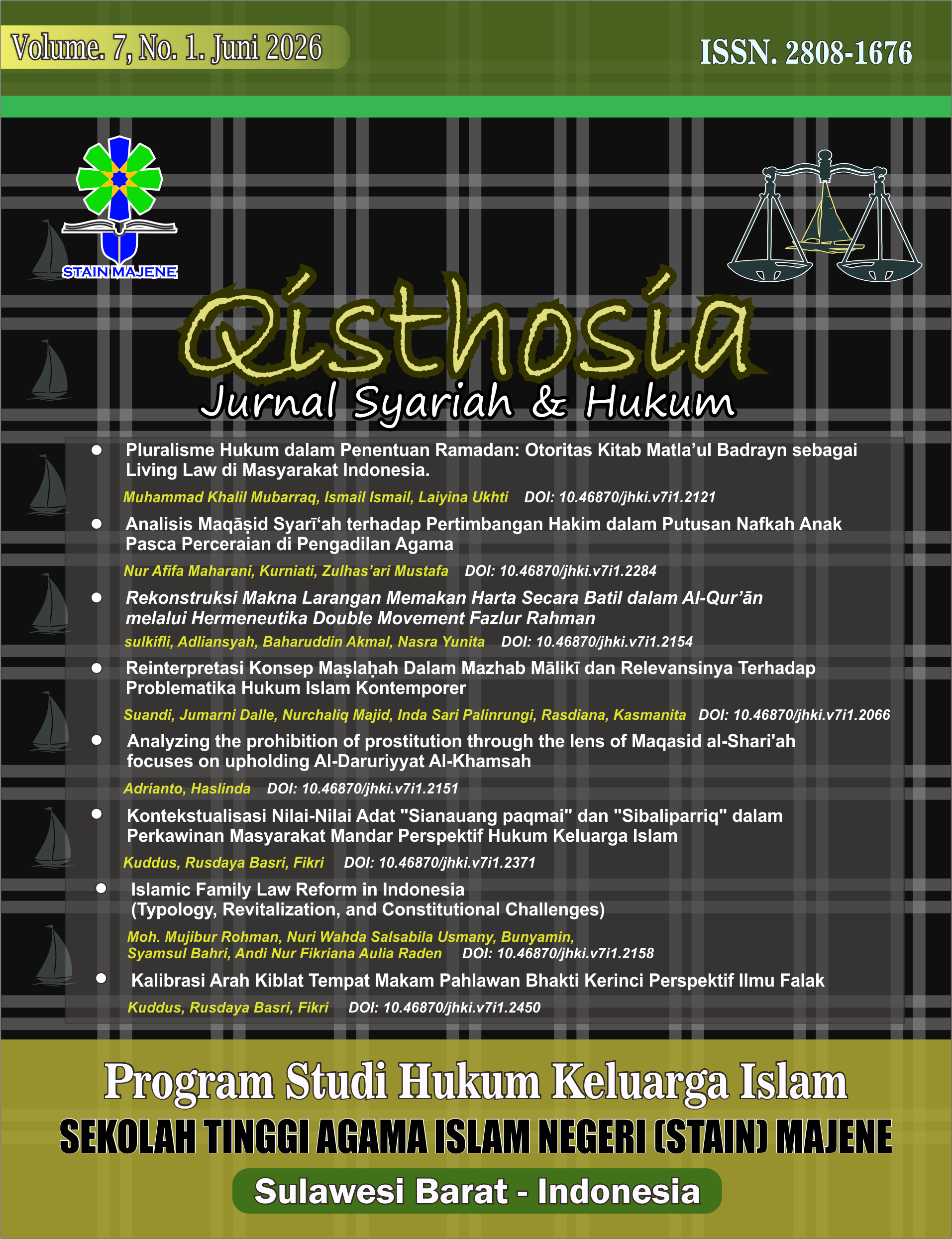
Pluralisme Hukum dalam Penentuan Ramadan: Otoritas Kitab Matla’ul Badrayn sebagai Living Law di Masyarakat Indonesia.
Legal Pluralism in Determining the Start of Ramadan: The Authority of the Book Matla'ul Badrayn as "Living Law" in Indonesian Society.
DOI:
https://doi.org/10.46870/jhki.v7i1.2121Keywords:
Beginning of Ramadan, Indonesian, Living Law, Legal Pluralism, Textual AuthorityAbstract
Determining the beginning of Ramadan in Indonesia is frequently marked by tension between the state regulatory authority and traditional religious texts. This article analyzes the Kitab Matla' al-Badrayn wa Majma' al-Bahrayn by Sheikh Muhammad bin Ismail al-Fathani, which has transformed from classical literature into a living law within the Muslim community of the Archipelago (Nusantara). Employing a socio-legal approach, this study examines how theological compliance with the text, specifically page 60, which prescribes methods for determining Ramadan through istikmal, rukyah hilal, isbat hilal, and customary signs, challenges the hegemony of the national calendar unification based on MABIMS astronomical criteria. The findings indicate that the community's continued adherence to the local matla' territorial limit of 24 farsakh is a unique phenomenon. Although information technology enables the instant distribution of rukyah hilal news beyond physical boundaries, a segment of society continues to reject long-distance rukyah results that transcend textual stipulations. This underscores that for traditional society, legal certainty in worship is determined more by steadfast conviction in the turats heritage than by the administrative rationality of Wilayatul Hukmi proposed by the state. This article concludes that the reality of legal pluralism cannot be negated solely through a technocratic approach. The existence of Matla' al-Badrayn as a moral compass demands that the state acknowledge differences in month-determination methods as logical consequences of diversity within Islamic legal epistemology. These differences must be managed through constructive dialogue rather than coercive unification.
References
Annisa Nurfadilah, Ahmad Adib Rofiuddin, and Muh. Rasywan Syarif. “Fiqh Principles and the Legitimacy of Indonesia’s Isbat Session System.” Astroislamica: Journal of Islamic Astronomy 4, no. 2 (December 2025): 341–70. https://doi.org/10.47766/astroislamica.v4i2.6890.
Bely, Ahmad Hariz bin, and Mohd Jais Anuar Bin Ahmad. “Matlak (Al-Mathâli’) Teks, Konteks Dan Penerapan.” Al-Marshad: Jurnal Astronomi Islam Dan Ilmu-Ilmu Berkaitan 7, no. 1 (June 2021): 76–92. https://doi.org/10.30596/jam.v7i1.6861.
Bruckmayr, Philipp. “The Long Shadow of Malay Kitab Jawi Publishing in the Hejaz and Cairo.” Oriente Moderno 105, no. 1–2 (December 2025): 33–69. https://doi.org/10.1163/22138617-12340366.
Deviyanti, Dita. “Konsep Asas Legalitas Terhadap Pengaturan Living Law Dalam Pembaharuan Kitab Undang-Undang Hukum Pidana Terkait Fungsi Penuntutan Oleh Kejaksaan Republik Indonesia Pada Sistem Peradilan Pidana.” The Prosecutor Law Review 3, no. 3 (December 2025). https://doi.org/10.64843/prolev.v3i3.72.
Fatani, Muhammad bin Ismail Daud. Matla’ul Badrain Wa Majma’ul Bahrain, 1885.
Hashim, Muhammad Ridzuan, Raihana Abdul Wahab, Mohd Saiful Anwar Mohd Nawawi, Nazhatulshima Ahmad, and Muhamad Syazwan Faid. “Unification of Hijri Calendar Under One Maṭla’ : A Case Study of MABIMS Through the Lens of Islamic Jurisprudence and Astronomy.” Jurnal Fiqh 22, no. 2 (December 2025): 389–433. https://doi.org/10.22452/fiqh.vol22no2.7.
Helim, Abdul. “Hamka’s Legal Methodology on Hisab–Ru’yah in His Book ‘Saya Kembali Ke Ru’yah.’” JURIS (Jurnal Ilmiah Syariah) 23, no. 2 (July 2024): 215. https://doi.org/10.31958/juris.v23i2.11952.
Ismail, Ismail, Machzumy, and Mohd. Yusri bin Jusoh. “Ulama and Islamic Astronomy in Contemporary Indonesia: T.M. Ali Muda’s Concept on Matlak Hilal.” Journal of Indonesian Ulama 3, no. 1 (April 2025). https://doi.org/10.30821/JIU.V3I1.596.
Junidar, Dilla Sri, Hasna Tuddar Putri, Laiyina Ukhti, and Rina Murinda. “Islamic Astronomy in Modern Aceh: Sheikh Muhammad Amin Al-Tirawi and His Manuscript.” Journal of Indonesian Ulama 1, no. 2 (December 2023): 80–98. https://doi.org/10.30821/JIU.V1I2.1139.
Karim, Moh. Fadllur Rohman, and Mahsun Mahsun. “Kriteria Baru Mabims 3-6,4: Upaya Penyatuan Kalender Hijriah Di Indonesia Dalam Perspektif Maqāṣid Al-Syarī’ah.” Astroislamica: Journal of Islamic Astronomy 3, no. 1 (June 2024): 51–75. https://doi.org/10.47766/ASTROISLAMICA.V3I1.2735.
Kasim, A. Jusran, Ahmad Abbas, Nurul Adhha, and Iin Mutmainnah. “Determination of Hijri Calendar in Islamic History and Its Criteria in Southeast Asia.” Journal of Al-Tamaddun 19, no. 1 (2024): 247–59. https://doi.org/10.22452/JAT.vol19no1.18.
Kasim, Andi Jusran, Dwi Utami Hudaya Nur, Rizqi An’nisah, and Ahmad Fadli Gazali. “Peran Musim, Ekonomi, Politik, Dan Agama Dalam Transformasi Kalender Masehi Sebagai Sistem Penanggalan Global.” JIS: Journal Islamic Studies 3, no. 2 (2025): 53–61. https://doi.org/10.71456/jis.v3i2.1251.
Mahrus, Erwin, Zaenuddin Hudi Prasojo, Sukino Sukino, Nopi Purwanti, and Bayu Suratman. “Transmission of Local Islamic Texts in Islamic Education: Materials, Actors, and the Historical Trajectory of Islamic Knowledge in Borneo.” Nazhruna: Jurnal Pendidikan Islam 8, no. 2 (September 2025): 447–63. https://doi.org/10.31538/nzh.v8i2.200.
Marpaung, Wanti. “MAZHAB NEGARA: ALTERNATIF SOLUSI TERHADAP PERBEDAAN PENENTUAN AWAL BULAN QAMARIYAH DI INDONESIA.” Jurisprudensi: Jurnal Ilmu Syariah, Perundang-Undangan Dan Ekonomi Islam 10, no. 2 (June 2018): 121–31. https://doi.org/10.32505/JURISPRUDENSI.V10I2.943.
Marwadi, Marwadi, and Mughni Labib. “Saadoe’ddin Djambek’s Thoughts on Calculating the Beginning of the Hijri Month.” QISTHOSIA : Jurnal Syariah Dan Hukum 6, no. 1 (July 2025): 81–98. https://doi.org/10.46870/jhki.v6i1.1515.
Marwadi, Marwadi, Eva Mir’atun Niswah, Muhammad Fuad Zain, Ahmad Rezy Meidina, and Muhammad Akmal Kafi. “Traditional Islamic Legal Epistemology in Pesantren’s Practice of Ḥisāb.” Al-Ahkam 35, no. 2 (October 2025): 429–58. https://doi.org/10.21580/ahkam.2025.35.2.27687.
Maskufa, Sopa, Sri Hidayati, and Adi Damanhuri. “Implementation of the New MABIMS Crescent Visibility Criteria: Efforts to Unite the Hijriyah Calendar in the Southeast Asian Region.” AHKAM : Jurnal Ilmu Syariah 22, no. 1 (2022). https://doi.org/10.15408/ajis.v22i1.22275.
Mohd Salleh, Mohd Mahyeddin, A’wani Aziz Nurdalila, Setiyawan Gunardi, Hajah Mas Nooraini Haji Mohiddin, and Chairill Anuar Abdul Ghani. “Analisis Penyenaraian Haiwan Menerusi Kitab Kasyf Al-Litham ’An As-Ilah Al-Anam Karya Syeikh Zainul Abidin Bin Muhammad Al-Fatani Menurut Perspektif Halal Dan Haram.” Journal of Fatwa Management and Research 30, no. 2 (May 2025): 139–61. https://doi.org/10.33102/jfatwa.vol30no2.671.
Muh. Arif Royyani. Dasar-Dasar Penelitian Ilmu Falak: Teori Dan Aplikasi. Bildung, 2024.
Muhammad Bin Ismail Daud Fatani. Matla Al- Badrain Wa Majma’ Al- Bahrain . Pustaka Mukmin KL - Malaysia’s Online Bookstore. Pulau Pinang: Percetakan Almuarif, n.d.
Mundzir, Chaerul, Abdul Syatar, Muh. Rasywan Syarif, Abdul Hayyaqdhan Ashufah, and Muhammad Fazlurrahman Syarif. “The Oran Fatwa as an Emergency Fiqh Strategy Addressing the 16th-Century Identity Crisis of Morisco Muslims.” Ulumuna 29, no. 2 (January 2026): 731–54. https://doi.org/10.20414/ujis.v29i2.1611.
Mustaqim, Riza Afrian, Boihaqi bin Adnan, Husnul Khawatinnisa, Cut Diva Hayana, and Rahma Dhiyaa Sausan. “The Implementation of Mathlak in Determining the Beginning of the Lunar Month of the Majelis Pengkajian Tauhid Tasawuf Indonesia (MPTT-I).” Al-Marshad: Jurnal Astronomi Islam Dan Ilmu-Ilmu Berkaitan 10, no. 2 (December 2024): 157–70. https://doi.org/10.30596/JAM.V10I2.21094.
Soderi, Ridhokimura, Darlius Darlius, and Riza Afrian Mustaqim. “Rekontruksi Kriteria Visibilitas Hilal Serta Dampak Implementasi Kriteria Imkanurukyah MABIMS Baru Dalam Kemaslahatan.” Astroislamica: Journal of Islamic Astronomy 3, no. 2 (December 2024): 233–55. https://doi.org/10.47766/astroislamica.v3i2.3642.
Yacob, Faisal Yahya, and Faisal Ahmad Shah. “METODE PENENTUAN AWAL RAMADHAN DAN HARI RAYA MENURUT ULAMA DAYAH ACEH.” Jurnal Ilmiah Islam Futura 16, no. 1 (July 2017): 9. https://doi.org/10.22373/jiif.v16i1.741.
Downloads
Published
How to Cite
Issue
Section
License
Copyright (c) 2026 QISTHOSIA : Jurnal Syariah dan Hukum

This work is licensed under a Creative Commons Attribution-NonCommercial-ShareAlike 4.0 International License.