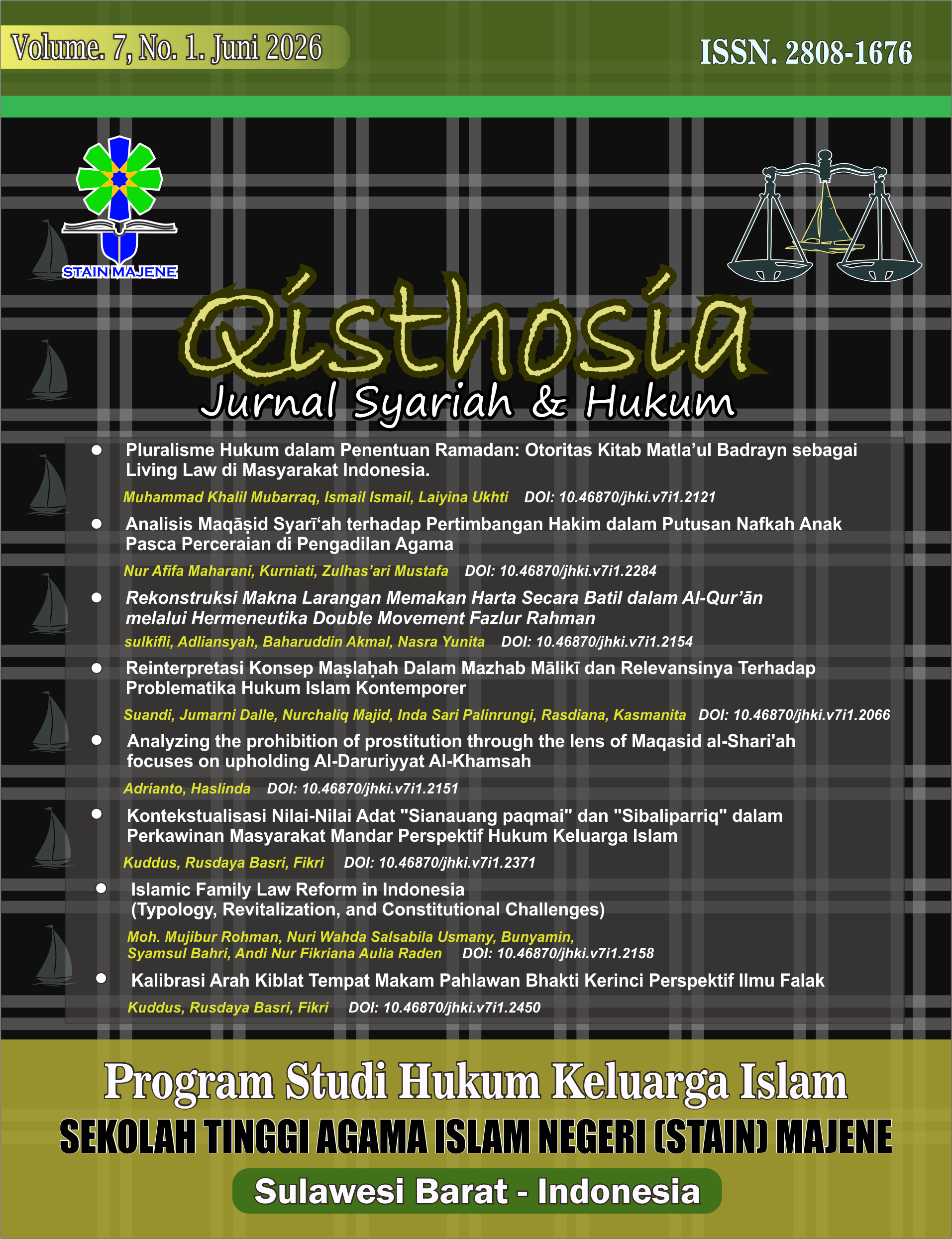
Reinterpretasi Konsep Maṣlaḥah Dalam Mazhab Mālikī dan Relevansinya Terhadap Problematika Hukum Islam Kontemporer
A Reinterpretation of the Concept of Maṣlaḥah in the Mālikī School and Its Relevance to Contemporary Issues in Islamic Law
DOI:
https://doi.org/10.46870/jhki.v7i1.2066Keywords:
Maṣlaḥah Mālikī, Maqāṣid al-syarī‘ah, Contemporary Islamic LawAbstract
This article examines the reinterpretation of maṣlaḥah in the Mālikī School of Law and its relevance to contemporary Islamic legal issues in a global context. It departs from the tension between textual-normative reasoning and the increasing need to contextualize Islamic law. The study argues that maṣlaḥah is not merely a utilitarian instrument, but a methodological principle rooted in the Mālikī uṣūl al-fiqh tradition and oriented toward the realization of maqāṣid al-sharīʿah. Historically, maṣlaḥah developed through three phases. The first was a practical phase grounded in the social reality of Madinah and the tradition of ʿamal ahl al-Madīnah. The second was a systematic phase in which maṣlaḥah was integrated with the maqāṣid framework, especially in medieval legal thought. The third was a contemporary phase marked by the demand for contextual reinterpretation. Using library research and a conceptual-historical approach, this article analyzes the thought of Mālikī scholars, especially Mālik ibn Anas and al-Shāṭibī, and its development in contemporary scholarship. This study finds that many previous works discuss maṣlaḥah in a normative, abstract, and cross-madhhab manner, which obscures the distinctive epistemological character of the Mālikī tradition. The findings show that reinterpretating Mālikī maṣlaḥah through maqāṣid al-sharīʿah provides a controlled evaluative framework for addressing global issues, such as human rights, social justice, bioethics, public governance, and digital technology ethics. This article contributes a systematic and applicable framework for moderate, contextual, and substantively just Islamic legal ijtihad, while preserving legal continuity, methodological accountability, and the normative authority of Islamic law in modern societies.
References
Agusman, Bachtiar, Najla Amali, Nisa Adelia, Muhammad Taha Madani, Nur Azmi, Universitas Islam, and Negeri Antasari. “Rekonstruksi Teori Hukum Islam Pada Masa Imam Mazhab.” Ijijel: Indonesian Journal of Islamic Jurisprudence,Economic and Legal Theory 2, no. 4 (2024): 2066–80. https://shariajournal.com/index.php/IJIJEL/.
Ahmad al-Raysūnī. Naẓariyyat Al-Maqāṣid ʿinda Al-Imām Al-Shāṭibī. Riyadh: Dār al-ʿĀlamiyyah, 1995.
Ahmed An-Na‘im, Abdullahi. Islam and the Secular State. Cambridge: MA: Harvard University Press, 2008.
Auda, Jasser. Maqāṣid Al-Sharīʿah as Philosophy of Islamic Law. London: International Institute of Islamic Thought, 2008.
Auladi, Akrom. “Reinterpretasi Hifdzul Aqli Dan Relevansi Maqasid Syariah Terhadap Kebijakan Pembelajaran Tatap Muka Di Masa Pandemi.” QALAMUNA: Jurnal Pendidikan, Sosial, Dan Agama 13, no. 1 (2021). https://doi.org/10.37680/qalamuna.v13i1.633.
Baderin, Mashood A. International Human Rights and Islamic Law. Oxford: Oxford University Press, 2003.
Bagaskara, Adhimas, Figlia Mutmainnah Syakura, Rifa Hanifah, M Rid Fadhilah, and Muhamad Parhan. “Paradigma Kritisisme Dalam Pemikiran Islam Kontemporer: Analisis Filosofis Dan Implikasi Metodologis.” Jurnal Kajian Islam Dan Sosial Keagamaan 02, no. 4 (2025). https://doi.org/https://jurnal.ittc.web.id/index.php/jkis/index.
E. Vogel, Frank. Islamic Law and Legal System: Studies of Saudi Arabia. Leiden: Brill, 2000.
Fadel, Mohammad. “Maslaha as ‘Flourishing’ and Its Place in Sunnī Political Thought.” Journal of Islamic Ethics 18, no. 1 (2022). https://doi.org/10.1163/24685542-12340085.
Felicitas Opwis. “Maslaha and the Purpose of the Law.” Islamic Law and Society 13, no. 2 (2006): 181–203.
Fikri Ys, Irsyad Al, and Asep Fu’ad. “Peran Maslahah Mursalah Dalam Legislasi Islam Kontemporer: Analisis Mazhab Dan Implikasi Kebijakan.” Equality: Journal of Islamic Law (EJIL) 3, no. 2 (2025). https://doi.org/https://doi.org/10.15575/ejil.v3i2.1936.
Ibrahim, Zumiyati Sanu, Suud Sarim Karimullah, Andi Istiqlal Assaad, Rina Septiani, and Huseyin Okur. “Integration of Maqaṣid Al-Shari’ah in the Criminal Law Reform to Achieve Justice and Human Dignity.” Jurnal Hukum Islam 23, no. 1 (2025). https://doi.org/10.28918/jhi.v23i1.04.
Jahar, Asep Saepudin. “Al-Bid‘Ah versus Al-Mashlahah Al-Mursalah and Al-Istihsân: Al-Syâthibî’s Legal Framework.” Ahkam: Jurnal Ilmu Syariah 12, no. 1 (2012). https://doi.org/10.15408/ajis.v12i1.975.
Lestianingsih, Eneng Nenden, Hisam Ahyani, Muharir, Agus Munjirin Mukhotib Lathif, Sérgio António Neves Lousada, Naeli Mutmainah, and Umi Atiqoh. “MAQĀṢID AL-SHARĪʿAH AL-SHATIBI IN THE DIGITAL ERA: CONTEMPORARY PERSPECTIVES ON HALAL LIFESTYLE AND TECHNOLOGY IN INDONESIA.” Al-Mawarid Jurnal Syariah Dan Hukum (JSYH) 7, no. 1 (2025). https://doi.org/10.20885/mawarid.vol7.iss1.art4.
Masud, Muhammad Khalid. Islamic Legal Interpretation: Muftis and Their Fatwas. Cambridge: Harvard University Press, 1996.
Mubarrak, Zahrul, Imran Abu Bakar, Muslem Hamdani, Musrizal, and Khalilullah. “The Urgency of the Islamic Law and Contemporary Societal Challenges: The Flexibility of Al-Maslahah in Determining the Hierarchy of Maqāṣid Al-Sharīʿah.” El-Usrah 8, no. 1 (2025). https://doi.org/10.22373/pxydd884.
Muhammad Aldi Dahri, Ahmad Fadly Rahman, Ferdiansa Putra, and Kurniati Kurniati. “Rekonstruksi Maqasid Syariah: Relevansi Dan Implementasinya Dalam Konteks Hukum Islam Kontemporer.” Amandemen: Jurnal Ilmu Pertahanan, Politik Dan Hukum Indonesia 3, no. 1 (2026). https://doi.org/10.62383/amandemen.v3i1.1492.
Nur Wahid, Sulkifli Sul, and Makmur. “Aborsi Dalam Perspektif Al-Qur’an (Studi Tematik Dengan Pendekatan Kontekstual Abdullah Saeed).” QISTHOSIA : Jurnal Syariah Dan Hukum 5, no. 2 (2024). https://doi.org/10.46870/jhki.v5i2.1201.
Opwis, Felicitas. “New Trends in Islamic Legal Theory: Maqāṣid Al-Sharīʿa’ as a New Source of Law?” Die Welt Des Islams 57, no. 1 (2017). https://doi.org/Doi: 10.1163/15700607-00571p03.
Rahman, Fazlur. Islam and Modernity: Transformation of an Intellectual Tradition. Chicago: University of Chicago Press, 1982.
Ramadhania, Safrida. “MAQASID SYARIAH DAN KESETARAAN HAK PEREMPUAN.” Maliki Law and Islamic Journal 1, no. 1 (2025). https://doi.org/https://doi.org/10.18860/mlijo.v1i1.18035.
Ridwan, Muannif. “Ijtihad Pada Era Kontemporer (Konteks Pemikiran Islam Dalam Fiqih Dan Maqashid Al-Syariah).” Jurnal Masohi 1, no. 2 (2020). https://doi.org/10.36339/jmas.v1i2.356.
Rohman, Taufiqur. “KONTROVERSI PEMIKIRAN ANTARA IMAM MALIK DENGAN IMAM SYAFI’I TENTANG MASLAHAH MURSALAH SEBAGAI SUMBER HUKUM.” International Journal Ihya’ ’Ulum Al-Din 19, no. 1 (2017). https://doi.org/10.21580/ihya.18.1.1743.
Sulthon, Mohammad. “Peranan Maslahah Mursalah Dan Maslahah Mulghah Dalam Pembaruan Hukum Islam.” Al-Qanun: Jurnal Pemikiran Dan Pembaharuan Hukum Islam 25, no. 1 (2022). https://doi.org/10.15642/alqanun.2022.25.1.59-70.
Sutikno, Sutikno, Kurniati Kurniati, and Lomba Sultan. “Konsep Maslahat Dalam Pandangan Imam Malik, Al Ghazali, Dan Al Tufiy.” Al-Mashlahah Jurnal Hukum Islam Dan Pranata Sosial 11, no. 01 (2023). https://doi.org/https://doi.org/10.30868/am.v11i01.3908.
Tijue, Iqbal Lamkaruna, and Fatimahzahara. “Pertanggungjawaban Pemerintah Daerah Terhadap Korban Kecelakaan Bus Trans Metro Deli Perspektif Maslahah Mursalah.” Edunomika 09, no. 01 (2025): 1–20. https://doi.org/https://doi.org/10.29040/jie.v9i1.16420.
Tsaniyah, Rikha ’Iffatuts, Wilda Nurona Khaerani, Naela Nurona Agatsya, Saqila Daffa Sabila, and Siyono. “Dinamika Fatwa Fiqh Kontemporer: Analisis Metodologi Istinbath Empat Mazhab Dalam Menilai Fenomena Artificial Intelligence.” Jurnal Sinda 5, no. 2 (2025): 61–70. https://doi.org/doi.org/10.28926/sinda.v4i2.2281.
Wael B. Hallaq. A History of Islamic Legal Theories. Cambridge: Cambridge University Press, 1997.
———. Authority, Continuity, and Change in Islamic Law. Cambridge: Cambridge University Press, 2001.
Wahid, Abdul. “PENDEKATAN MAQASID AL-SYARIAH DALAM STUDI HUKUM ISLAM.” Jurisy: Jurnal Ilmiah Syariah 4, no. 2 (2023): 75–83. https://ejurnal.inhafi.ac.id/index.php/jurisy/article/view/402.
Wanto, Deri, Rahmad Hidayat, and Repelita. “Maqasid Shariah’s Change as Theory: From Classical to Cotemporary Maqasid Shariah.” Al-Istinbath: Jurnal Hukum Islam 6, no. 2 (2021). https://doi.org/10.29240/jhi.v6i2.3122.
Zainudin, and Mutawali. “Maqashid Al-Syari‘ah and the Reconfiguration of Maslahah: A Critique of Classical Ushul Al-Fiqh Epistemology.” Asy-Syir’ah: Jurnal Ilmu Syari’ah Dan Hukum 58, no. 2 (2024): 296–330. https://doi.org/https://doi.org/10.14421/ajish.v58i2.1521.
Zameri, S N M, S F S Alwi, M F M Hatta, and A A H S Fikri. “Maslahah and Its Application in Islamic Finance.” International Journal of Islamic Business 9, no. 1 (2024). https://doi.org/https://doi.org/10.32890/ijib2024.9.1.5.
Zaprulkhan, Zaprulkhan. “Maqāṣid Al-Shariah in the Contemporary Islamic Legal Discourse: Perspective of Jasser Auda.” Walisongo: Jurnal Penelitian Sosial Keagamaan 26, no. 2 (2018). https://doi.org/10.21580/ws.26.2.3231.
Downloads
Published
How to Cite
Issue
Section
License
Copyright (c) 2026 QISTHOSIA : Jurnal Syariah dan Hukum

This work is licensed under a Creative Commons Attribution-NonCommercial-ShareAlike 4.0 International License.