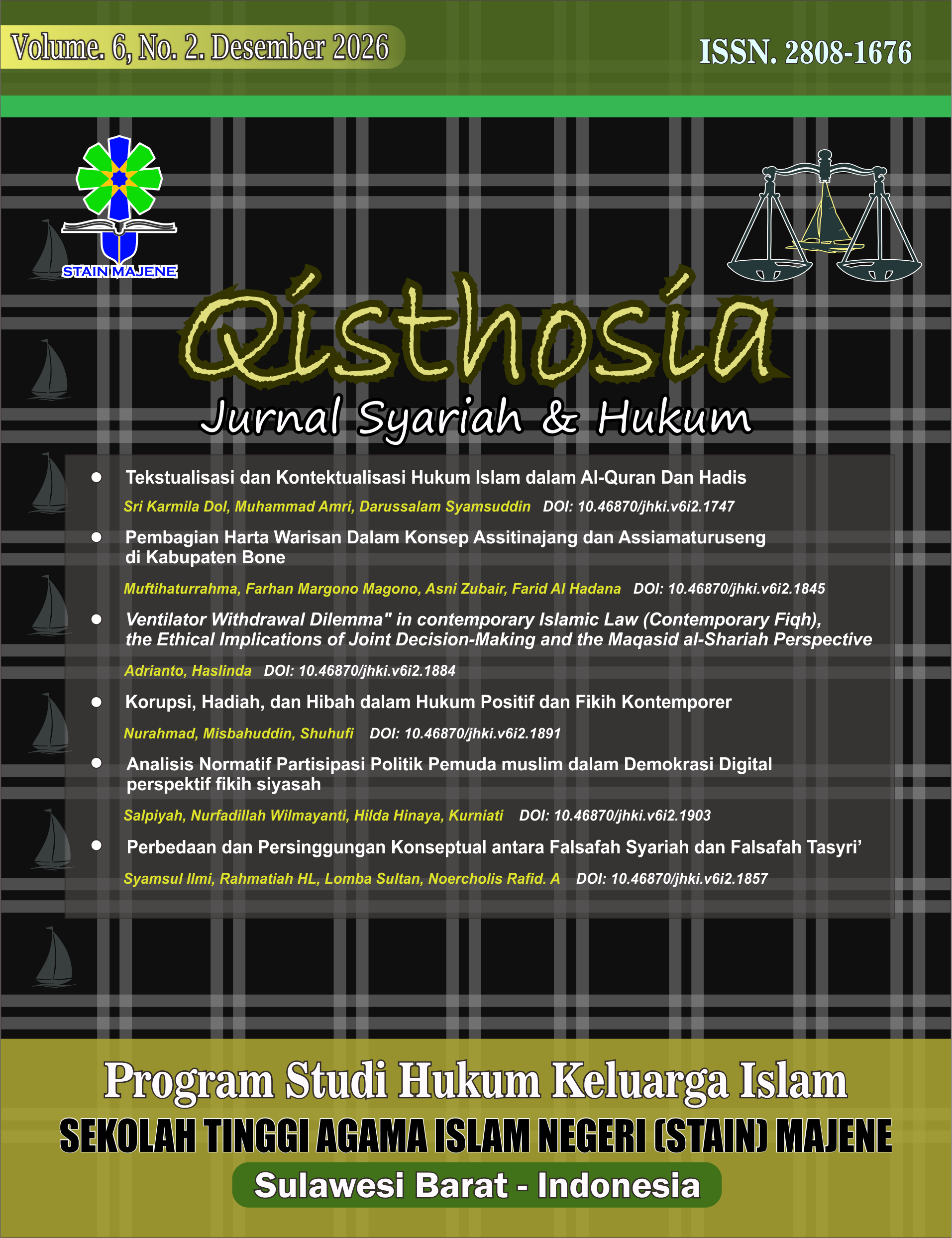
Perbedaan dan Persinggungan Konseptual antara Falsafah Syariah dan Falsafah Tasyri’
Conceptual Differences and Intersections between Falsafah al-Sharī‘ah and Falsafah al-Tashrī‘
DOI:
https://doi.org/10.46870/jhki.v6i2.1857Keywords:
falsafah syariah, falsafah tasyri’, Islamic Legal Philosophy, Conceptual Comparison, Contemporary Islamic LawAbstract
Philosophical studies, particularly in Islamic legal philosophy, continue to generate dynamic intellectual discourse among scholars of Islamic law. One significant area of inquiry concerns the relationship between the philosophy of sharia (falsafah al-sharī‘ah) and the philosophy of legislation (falsafah al-tashrī‘). The urgency of distinguishing and understanding the points of convergence between these two concepts becomes increasingly evident when Islamic law is confronted with contemporary challenges. This study focuses on two main objectives: (1) comparing the scope, objects, and approaches of falsafah al-sharī‘ah and falsafah al-tashrī‘; and (2) providing a clear conceptual framework to prevent overlap and terminological confusion between these two concepts in the study of Islamic legal philosophy. This research employs a qualitative library-based method using normative-theological and conceptual-comparative approaches. Data were collected from classical and contemporary Islamic legal literature and analyzed using descriptive-analytical techniques. The findings indicate that falsafah al-sharī‘ah is oriented toward legal values, objectives, and wisdom (maqāṣid), whereas falsafah al-tashrī‘ focuses on the legislative process and the methodology of legal formulation. Both intersect within the domains of maqāṣid al-sharī‘ah and uṣūl al-fiqh, which function as a bridge between ideal values and the normative formulation of Islamic law. This study contributes conceptually to clarifying the epistemological foundations of Islamic legal philosophy and its relevance to the development of contemporary Islamic law.
References
Akbar, W., Anshary, A. H., Umar, M., & Khasyi’in, N. (2024). ASURANSI DAN KOPERASI SYARIAH DI INDONESIA. AT-TASYRI’ Jurnal Ilmiah Prodi Muamalah, 16(1). https://doi.org/10.47498/tasyri.v16i1.1973
Baihaqi, B., Ahmad Musadad, & Tri Pujiati. (2025). Karakteristik Hukum Islam: Fleksibilitas, Keadilan, dan Kemaslahatan dalam Perspektif Normatif. Nuris Journal of Education and Islamic Studies, 5(2), 80–95. https://doi.org/10.52620/jeis.v5i2.110
Hisbullah, Hanaping, Misbahuddin, Samin, S., Moh. Rezki Darma, A., Jaki, M., & Sofyan. (2022). HARMONISASI SYARI’AT DAN HAKIKAT DALAM PENERAPAN HUKUM ISLAM DI INDONESIA: KAJIAN FALSAFAH TASYRI. Bilancia: Jurnal Studi Ilmu Syariah dan Hukum, 16(2), 295–312. https://doi.org/10.24239/blc.v16i2.1361
Jauhari, Ahsanuddin. Moh. (2020). Filsafat Hukum Islam (Bandung: PT. Liventurindo).
Mas’ud, I., Fahmi, A. A., & Saputra, A. (2025). Dynamics of Islamic Legal Theory (Ushul al-Fiqh) toward Addressing Challenges of Halal Products in the 21st Century. International Journal of Islamic Thought and Humanities, 4(1), 88–105. https://doi.org/10.54298/ijith.v4i1.403
Mohamad Subli. (2024). Penerapan Maqosid Syariah Dalam Pembentukan Hukum Era Digital: Regulasi Cryptocurrency. AL-MUTSLA, 6(2), 298–310. https://doi.org/10.46870/jstain.v6i2.1366
Muchlis, M., & Rois, C. . (2024). Urgensi Teori Maqashid al-Syariah Sebagai Metodologi Hukum Islam: (Analisis Nalar konstruksi Maqashid Al-Syariah Imam Al-Syatibi). Ulumuna: Jurnal Studi Keislaman, 10(1), 17–33. https://doi.org/10.36420/ju.v10i1.7558
Mustafa, Soge, A. D., & Edy, S. S. (2025). The Existence of Islamic Law in The Legal System And Constitution in Indonesia: Reflection of Islamic Legal Thought and Positive Law. Jurnal Hukum Caraka Justitia, 5(1), 55–70. https://doi.org/10.30588/jhcj.v5i1.2146
Najib, A. (2021). Dialektika Politik Hukum Islam Dalam Pembangunan Sistem Hukum Nasional. HUKMY : Jurnal Hukum, 1(1), 109–131. https://doi.org/10.35316/hukmy.2021.v1i1.109-131
Nst, V. F. H., Nasution, M. Y., & Sugianto, S. (2024). Relationship ushul Fiqh, Qowa’id Fiqih dan Maqashid Al- Syariah With Islamic Economy. Jurnal Ilmiah Ekonomi Islam, 10(1), 1017–1023. https://doi.org/10.29040/jiei.v10i1.12787
Pertiwi, T. D., & Herianingrum, S. (2024). Menggali Konsep Maqashid Syariah: Perspektif Pemikiran Tokoh Islam. Jurnal Ilmiah Ekonomi Islam, 10(1), 807. https://doi.org/10.29040/jiei.v10i1.12386
Putra, D. A., & Sa’adah, M. (2024). Implementasi Maqasid Shariah Terhadap Produk Tabungan Berjangka Di BSI KCP Surabaya Ampel Mas Mansyur. 2(1). https://doi.org/10.32493/amq.v2i1.41733
Safarni et. al, H. (2025). FLEKSIBILITAS HUKUM ISLAM DALAM MENJAWAB TANTANGAN HUKUM KELUARGA, HAM DAN EKONOMI MODERN. Tinjauan Maqashid Syariah. Tasyri’ Journal of Islamic Law, 4(2). https://doi.org/10.53038/tsyr.v4i2.387
Umar, A., Detrial Maulana, M., Hidayat Ediz, M., Fadli, M., Mauliah, S., Irawan, A., & Apriansyah Pratama, M. (2024). Maqasid Syari’ah and the Renewal of the Tradition in Understanding Fiqh. Jurnal Elsyakhshi, 2(2), 71–79. https://doi.org/10.69637/jelsy.v2i2.348
Zuhdi, M. H., & Nasir, M.A. (2024). Al-Mashlahah and Reinterpretation of Islamic Law in Contemporary Context. Samarah: Jurnal Hukum Keluarga Dan Hukum Islam, 8(3), 1818-1839. https://doi.org/10.22373/sjhk.v8i3.24918
Downloads
Published
How to Cite
Issue
Section
License
Copyright (c) 2025 QISTHOSIA : Jurnal Syariah dan Hukum

This work is licensed under a Creative Commons Attribution-NonCommercial-ShareAlike 4.0 International License.